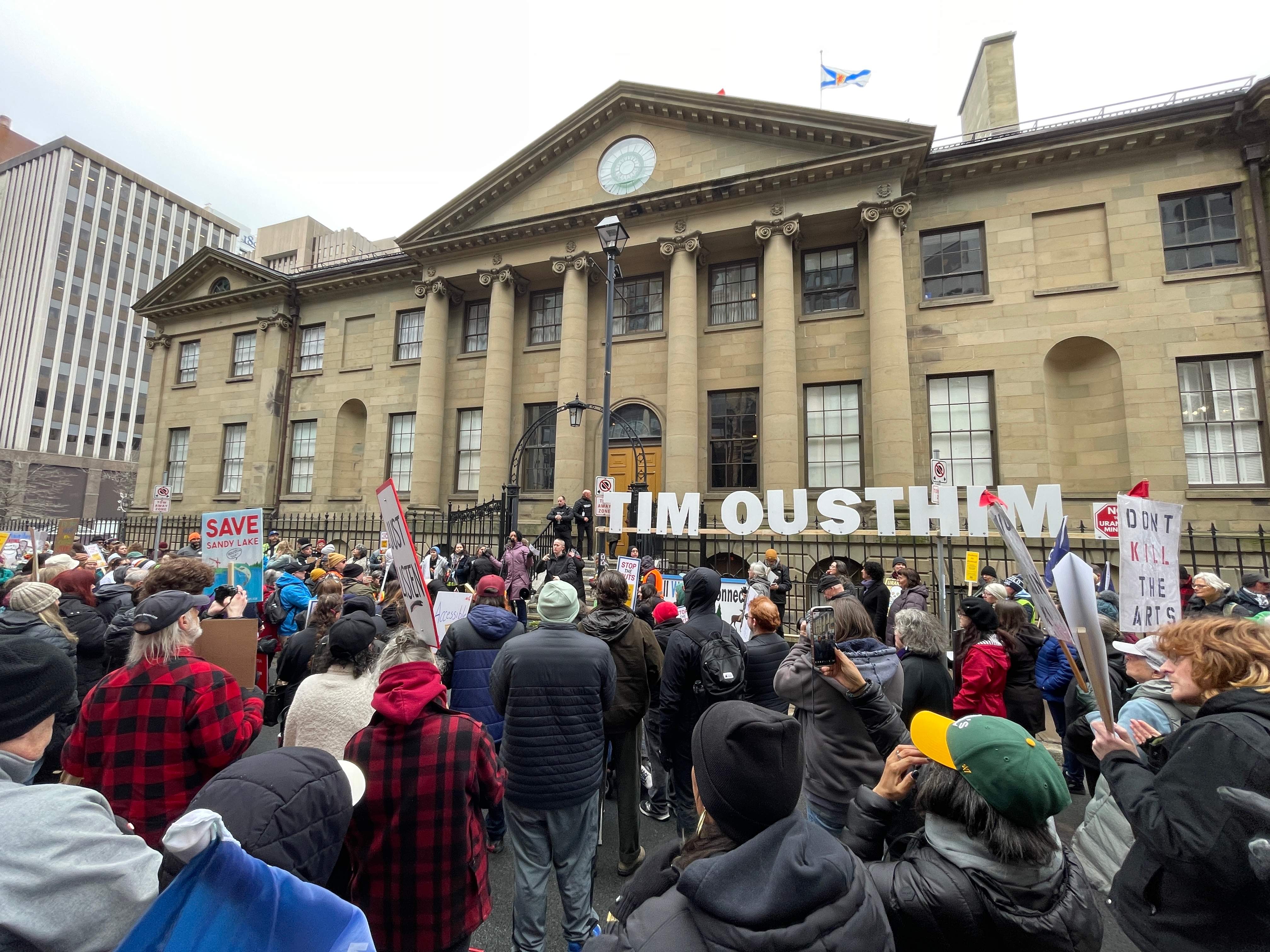
The suspension of legislative proceedings by external disruption represents a failure of the physical and procedural "perimeter" designed to protect democratic deliberation. When protesters halted a vote in the Nova Scotia legislature, they didn't just delay a line item; they triggered an institutional reset. The resulting implementation of new security protocols—ranging from restricted gallery access to enhanced screening—is not a localized reaction but a case study in the friction between public accessibility and institutional continuity.
The Architecture of Legislative Disruption
A legislature functions as a high-pressure processor of public policy. For this processor to operate, it requires a specific environment: controlled access, recognized rules of order, and the physical safety of the participants. The breach in Nova Scotia highlights three specific vulnerabilities in the parliamentary model.
1. The Proximity Paradox
Westminster-style democracies pride themselves on "the people’s house" being accessible. This transparency creates a security vulnerability where the physical distance between a decision-maker and a disruptor is measured in feet rather than yards. The moment a protest moves from the sidewalk to the gallery, the cost of maintaining order scales exponentially.
2. The Procedural Bottleneck
Legislative rules are designed to manage internal dissent (between members) rather than external interference. When a gallery is cleared, the session often must be suspended to ensure the record remains "clean" and the safety of the Mace—the symbol of authority—is maintained. This creates a high-leverage point for small groups to exert disproportionate influence over the state’s timeline.
3. The Security-Access Trade-off
Every new rule introduced by the Speaker’s office acts as a filter. While these filters increase the "Signal-to-Noise" ratio by ensuring only peaceful observers enter, they also increase the "Cost of Entry" for the average citizen. This tension defines the new operational reality in Halifax.
Quantifying the New Security Framework
The response from the Nova Scotia legislature involves a shift from a "High-Trust" model to a "Verified-Access" model. This transition is built on four distinct pillars of institutional hardening.
Pillar I: Kinetic Barriers and Controlled Entry
The most immediate change is the physical screening process. By introducing more rigorous bag checks and potentially metal detection, the legislature increases the "Time-to-Entry" (TTE). From a consulting perspective, this is a throughput management strategy. By slowing down the rate at which the public can enter the gallery, security personnel can perform more detailed risk assessments per individual.
Pillar II: Identity Verification Protocols
The new rules require a higher degree of identification for those wishing to observe proceedings. This moves the gallery from an anonymous space to a registered space. Identification acts as a deterrent; it raises the personal "Risk Profile" for any individual considering a disruption, as their actions can now be immediately tied to a legal identity, facilitating post-incident prosecution or banning.
Pillar III: Gallery Conduct Thresholds
The Speaker has recalibrated the threshold for what constitutes a "disruptive act." Previously, minor vocalizations might have been met with a warning. Under the new regime, the "Zero-Tolerance Window" has shrunk. Security is empowered to preemptively remove individuals who exhibit behaviors that correlate with historical disruption patterns, such as standing in prohibited areas or displaying unauthorized signage.
Pillar IV: Communication Redundancy
A significant failure during the initial disruption was the lack of clear communication between the floor and the gallery. The new framework includes upgraded protocols for how the Sergeant-at-Arms communicates with the Speaker to trigger an immediate recess. This reduces the "Reaction Gap"—the time between the start of a disruption and the securing of the legislative floor.
The Economic and Social Cost Function of Legislative Security
Increasing security is never a "free" move. It carries a heavy overhead that must be measured in both fiscal and democratic capital.
Fiscal Overhead
The direct costs involve increased staffing for the Sergeant-at-Arms’ office and the potential procurement of scanning technology. However, the indirect costs are more significant. If security delays result in shorter legislative sessions or the need for extended "emergency" sittings, the taxpayer pays for the inefficiency of the process.
Democratic Friction
We can define "Democratic Friction" as the difficulty a constituent faces when trying to engage with their elected representatives in person. As friction increases:
- Participation rates among low-income or marginalized groups often drop, as they may lack the specific identification required or the time to wait through enhanced screening.
- The "Aura of Authority" shifts from being welcoming to being defensive, which can further polarize the relationship between the state and its critics.
Analyzing the Causal Link: Why Now?
The disruption in Nova Scotia did not happen in a vacuum. It is a symptom of a broader trend where physical space is used as a final frontier for political leverage when digital or traditional lobbying feels exhausted.
The core mechanism at play is "Asymmetric Disruption." A group of twenty protesters can effectively shut down a multi-million dollar government operation for hours. For the protesters, the "Return on Investment" (ROI) is high: for the cost of travel to the legislature, they achieve national media coverage and a direct halt to government business.
The legislature's new rules are a direct attempt to break this ROI. By making it harder to enter and easier to be removed, the "Cost" to the protester increases, while the "Probability of Success" decreases.
Structural Logic of the Revised Rules
The Speaker’s office has essentially applied a "Risk-Based Access Control" (RBAC) model. This is standard in corporate cybersecurity but relatively new in the open-access world of provincial politics.
- Authentication: Who are you? (ID checks).
- Authorization: Do you have a reason to be here? (Registration for the gallery).
- Accounting: Monitoring what you do while you are here. (Enhanced gallery surveillance).
This model assumes that the threat is internal—not in the sense of being a member of the legislature, but in the sense of being an authorized visitor who misuses their authorization. This is a significant shift in the philosophy of public space.
Limitations of the Hardened Perimeter
No security framework is absolute. The "Maginot Line" of the Nova Scotia legislature faces three primary risks that the new rules do not fully address.
- The Spillover Effect: When the gallery becomes too difficult to disrupt, protests inevitably move to the hallways, the steps, or the parking areas. This merely shifts the security problem from the Sergeant-at-Arms to local police, often creating more volatile public-facing confrontations.
- The Insider Threat: While unlikely in this specific context, the most robust gallery security does nothing to prevent disruption from within the bar of the house by members themselves—a tactic seen globally in increasingly polarized chambers.
- The Legitimacy Gap: If the rules are perceived as a way to "hide" from public anger rather than "protect" the process, the legislature risks losing its moral authority. Security must be seen as a neutral procedural requirement, not a partisan shield.
Strategic Trajectory for Legislative Management
The Nova Scotia legislature must move beyond reactive "hardening" and toward "resilient design." This involves decoupling the physical presence of the public from the legal validity of the vote.
The primary strategic move is the institutionalization of Virtual Observation Galleries. By providing a high-quality, real-time digital alternative to physical attendance, the legislature can justify stricter physical controls. If the "right to observe" is fulfilled via a robust digital platform, the physical gallery can be managed with the same level of strictness as a courtroom or a high-security briefing room without infringing on the fundamental democratic right to transparency.
The second move is the implementation of a Tiered Response Matrix. Instead of a binary "Open/Closed" state, the legislature should adopt a color-coded readiness level based on intelligence and the nature of the day’s agenda (e.g., a controversial budget vote triggers "Level 2" security). This allows the institution to remain as open as possible during routine business while scaling up defenses only when the risk of disruption—and the cost of a delay—is at its peak.
The final strategic play is the formalization of the Protest Liaison Role. By creating a designated channel where groups can register their dissent without entering the chamber, the legislature creates a "Pressure Valve." This channel must be more than a mailbox; it must be a recognized part of the legislative record. By absorbing dissent into the process, you neutralize its ability to break the process.
The legislature is no longer a passive stage; it is an active, defended system. Survival in a period of high social volatility requires the institutionalization of these frictions to ensure that the "Engine of State" continues to turn, regardless of the noise in the gallery.