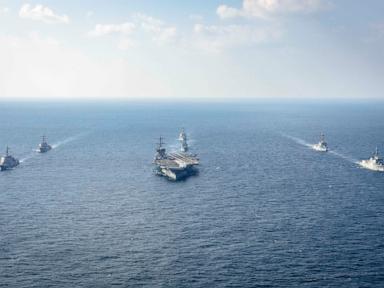
South Korea, Japan, and the United States will push forward with the Freedom Edge trilateral military exercises in the waters south of Jeju Island, attempting to project a unified front even as Washington scrambles its strategic priorities across multiple global flashpoints.
This upcoming five-day mobilization arrives during a tense period of shifting alliances and fractured deterrence. Beneath the routine diplomatic language of regional stability lies a starkly different reality. Washington's commitment to the Asia-Pacific is colliding with immediate military drains in the Middle East and erratic presidential overtures toward Pyongyang. The alliance is straining under the weight of competing geopolitical demands.
The Cost of Washington's Divided Attention
Military readiness cannot be turned on and off like a desk lamp. When the Pentagon abruptly curtails major exercises to appease a nuclear-armed adversary or redirect assets elsewhere, the foundation of extended deterrence starts to crack.
Consider the recent curtailment of the annual Ulchi Freedom Shield exercises. Washington truncated the drills by nearly a week following executive orders to scale down operations. Ostensibly, this reduction was packaged as a goodwill gesture to court North Korean leadership back to stalled denuclearization talks.
Yet, Pyongyang greeted this olive branch with a barrage of short-range ballistic missiles and scathing rebukes. North Korea understands leverage. The regime in Pyongyang recognizes that a superpower distracted by conflicts elsewhere and desperate for diplomatic wins is a superpower vulnerable to coercion.
Compounding this instability is the quiet sidelining of other critical combined operations. Bilateral amphibious drills face indefinite delays. U.S. Marine Corps constraints, directly tied to heavy operational commitments stemming from the ongoing conflict with Iran, have left critical gaps in regional amphibious readiness. Seoul is left holding the bag, wondering how much reliability remains in an alliance dependent on the shifting political winds of Washington.
Pyongyang's Calculated Escalation
North Korea is not reacting out of blind panic. Kim Jong Un's regime operates from a position of enhanced military strength compared to the collapsed diplomacy of 2019.
Years of clandestine and overt weapons development have yielded a diversified missile inventory. Furthermore, direct military exchanges with Moscow—supplying conventional munitions and artillery in exchange for technological assistance—have given North Korean conventional forces a level of industrial and logistical integration previously absent.
When Pyongyang denounces the upcoming Freedom Edge drills as a reckless provocation, the rhetoric masks a calculated strategy. The North wants to institutionalize a new normal where allied defensive preparations are treated as illegal acts of aggression. By coupling verbal threats with targeted missile tests, Pyongyang tests the cohesion between Washington, Seoul, and Tokyo.
The strategy works because the allies are not entirely on the same page. While Tokyo views these trilateral mechanisms as vital to countering a growing axis of authoritarian powers stretching from Moscow to Beijing, Seoul faces a more immediate existential threat across the 38th parallel. When Washington treats joint military preparedness as a negotiable bargaining chip, it creates deep anxiety in Seoul regarding whether American security guarantees will hold under pressure.
The Trilateral Tightrope
Freedom Edge remains the primary anchor keeping this trilateral security architecture from drifting apart. Launched to institutionalize complex, simultaneous air, naval, and anti-submarine drills, the exercise attempts to bridge historical animosity between South Korea and Japan.
Seoul and Tokyo share an uneasy history, marked by colonial grievances and trade disputes. For decades, Washington acted as the indispensable hinge holding bilateral defense cooperation together. If that hinge weakens due to erratic U.S. policy shifts or a retreat into unilateral diplomacy, the entire security framework in Northeast Asia risks unraveling.
Regional capitals are beginning to calculate life after absolute American reliability. Discussions that were once taboo, such as the viability of independent nuclear deterrents in South Korea and Japan, are moving from fringe academic circles into mainstream policy debates.
The upcoming naval maneuvers near Jeju Island will showcase advanced missile defense tracking and interoperability. Surface combatants and air assets will execute complex coordination scenarios designed to counter incoming payloads from the north.
These maneuvers are necessary, but they cannot compensate for a lack of strategic clarity at the top. Hardware and interoperability matter very little if the political will behind them is subject to sudden executive whim. As North Korea continues to modernize its nuclear posture and deepen its external partnerships, the alliance needs more than temporary shows of force. It requires an honest reckoning over whether short-term political theater is quietly dismantling long-term regional security.


