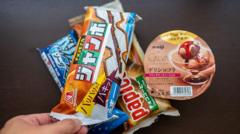
Japan’s antitrust regulators just shattered the polite facade of the domestic dairy industry. When the Japan Fair Trade Commission (JFTC) launched unannounced raids on the Tokyo headquarters of the nation’s largest ice cream manufacturers, it was not tracking a minor corporate infraction. Investigators were targeting a systemic culture of coordinated pricing that has quietly squeezed Japanese consumers for over a decade. This aggressive regulatory intervention signals a massive crackdown on legacy corporate boards that used rising raw material costs as a smoke-screen to artificially inflate retail prices.
For years, the major players in the Japanese confectionery market operated with a comfortable, unspoken understanding. Industry giants like Meiji, Morinaga, and Lotte have faced the same compounding pressures: a shrinking domestic population, skyrocketing dairy costs, and soaring logistics expenses. Instead of fighting for market share through aggressive price competition, evidence suggests these boardroom executives chose a different path. They chose collusion.
The JFTC raid focuses on a series of synchronized price hikes. When one major distributor announced a ten-yen increase on a flagship vanilla bar, competitors followed within days, citing identical macroeconomic pressures. This uniformity is rarely an accident of the free market. It is the hallmark of a cartel.
The Secret Mechanics of the Confectionery Cartel
Price-fixing in Japan rarely involves clandestine meetings in smoky backrooms. Instead, it relies on a sophisticated system of public signaling and retail dominance. In the highly concentrated Japanese grocery and convenience store sector, three or four mega-brands dictate what fills the freezer aisles.
When input costs rise, a single dominant manufacturer will typically float a trial balloon. They leak a proposed price hike to trade publications or announce it months in advance, claiming that expensive import feed and high fuel costs leave them no choice. In a truly competitive ecosystem, a rival would hold their prices steady to capture market share. In Japan's ice cream sector, rivals used these announcements as an open invitation to match the increase down to the exact yen.
[Typical Confectionery Supply Chain Breakdown]
Raw Dairy Producers -> Mega-Manufacturers (Meiji/Morinaga) -> Wholesale Distributors -> Convenience Stores (7-Eleven/Lawson) -> Consumer
This coordinated signaling effectively eliminated price competition. Wholesale distributors, caught between massive manufacturing cartels and powerful convenience store chains like 7-Eleven and Lawson, had no leverage to negotiate. They passed the inflated costs directly to the consumer. The JFTC claims to have uncovered internal communications showing that executives actively monitored competitor timelines to ensure no company broke ranks.
The Role of Wholesalers as Enforcers
To understand how a price-fixing ring survives for years, you have to look at the distribution network. Japan’s multi-layered wholesale system often acts as an unintended buffer that protects cartels.
Manufacturers do not sell directly to supermarkets. They route products through powerful intermediary wholesalers. If a smaller regional ice cream maker attempts to undercut the major brands, the dominant manufacturers can use their massive product portfolios to pressure wholesalers. A distributor who gives prime freezer placement to a cheap competitor risks losing their allocation of top-selling milk, yogurt, and chocolate brands. The system rewards conformity and brutally punishes independent pricing.
The Inflation Scapegoat Meets a Shrinking Market
The defense mounted by the dairy giants is predictable. Corporate spokespeople immediately pointed to global inflation, the weak yen, and the rising cost of imported alfalfa for dairy cows. These pressures are real. Hokkaido dairy farmers have faced genuine economic hardship, with many forced to dump milk or cull herds due to misaligned domestic subsidies.
However, the regulatory data tells a completely different story. While raw material costs rose by roughly eight percent over a multi-year period, retail prices for mass-market frozen desserts jumped by nearly twenty-five percent. The mathematics do not add up.
The industry used legitimate inflation as a cover to expand their profit margins. They sought to insulate their bottom lines from a much more terrifying structural reality: Japan is running out of children.
[The Demographic Squeeze]
Shrinking Youth Population -> Lower Volume of Ice Cream Sales -> Artificially Inflated Prices to Maintain Profit Margins -> Regulatory Backlash
Ice cream is historically a volume game. It relies on a steady stream of school-aged consumers with pocket money. As Japan's birthrate hits historic lows year after year, the absolute volume of units sold has stagnated. To maintain the earnings growth that institutional investors demand, these corporations could no longer rely on selling more ice cream. They had to make each individual sale significantly more lucrative. When organic premiumization failed, cartel behavior became the default strategy.
The Problem with Price Elasticity in Tokyo
Economists often talk about price elasticity, which measures how much consumer demand drops when prices rise. For luxury goods, elasticity is high. For daily staples, it is low.
Mass-market ice cream occupying the 100-yen to 150-yen sweet spot occupies a strange psychological space in Japanese culture. It is treated as an affordable, daily indulgence—a small reward after a long corporate shift or a school day. Manufacturers knew that a 10-yen or 20-yen hike would not cause consumers to boycott their favorite treats. The cartel exploited this deep consumer loyalty, realizing they could milk predictable profits from a captive audience without triggering a massive drop in sales volume.
Why the Japan Fair Trade Commission Changed Its Strategy
For decades, the JFTC was widely criticized as a toothless tiger. It preferred to issue quiet administrative warnings rather than launch public, reputation-destroying raids. That era of corporate leniency is officially over.
The shift began when international supply chain shocks started threatening the broader Japanese economy. The government realized that artificial price inflation across consumer goods was depressing domestic spending, directly undermining state efforts to generate sustainable economic growth. The ice cream raids are a shot across the bow for the entire food and beverage sector.
[Evolution of JFTC Enforcement]
Old System: Private Warnings -> Minor Administrative Fines -> Unchanged Corporate Culture
New System: Dawn Raids -> Criminal Referrals -> Massive Revenue-Based Penalties
Under Japan's revised Anti-Monopoly Act, the financial penalties for price-fixing are no longer just a minor cost of doing business. The JFTC now has the authority to levy fines based on a direct percentage of the cartel-derived revenue over the entire duration of the conspiracy. For multi-billion-yen operations like Meiji and Morinaga, a sustained price-fixing ruling could result in catastrophic financial penalties that wipe out multiple quarters of profit.
The Leniency Program and the Race to Confess
The real drama in modern antitrust enforcement happens behind closed doors through the JFTC’s leniency program. The first company to step forward with definitive proof of a cartel can receive complete immunity from administrative fines. The second company to confess gets a substantial discount.
This creates a high-stakes prisoner's dilemma for corporate boards. Once the JFTC investigators walk through the front doors with search warrants and seize corporate hard drives, the clock starts ticking. Executives know that if their competitors cooperate first, their own company will bear the full brunt of the financial and legal fallout. This mechanism virtually guarantees that the cartel will fracture from within as legal teams scramble to secure the immunity slot.
The Broken Promises of Abenomics and Corporate Reform
This scandal exposes a fundamental flaw in the corporate governance reforms pushed by the Japanese government over the last decade. The state urged companies to increase return on equity and become more responsive to shareholders. The goal was to modernize corporate Japan.
The unintended consequence was a hyper-focus on short-term quarterly earnings at the expense of market health. When faced with declining domestic demographics, instead of innovating or aggressively expanding into Southeast Asian markets, these legacy executives chose the low-risk, illegal route of domestic price coordination. They protected shareholder value by cheating the domestic consumer.
[The Governance Failure Loop]
Pressure for Quarterly Profits -> Stagnant Domestic Demographics -> Avoidance of Global Risk -> Illegal Price-Fixing Agreements
Furthermore, the cross-shareholding structure that still defines much of Japanese business creates an environment ripe for collusion. When major food conglomerates own significant stakes in each other or share the same primary lenders, independent corporate oversight vanishes. Board members sit on multiple friendly committees, and the line between fierce competitor and industry ally becomes dangerously blurred.
What Happens to the Freezer Aisle Now
Consumers expecting an immediate drop in ice cream prices will be disappointed. The immediate impact of the JFTC investigation will not be a price war; it will be a period of absolute pricing paralysis.
Major brands will freeze any scheduled price adjustments indefinitely. They cannot risk announcing further increases while under federal scrutiny. Retailers will likely demand better wholesale terms, fearing that their own brands will be tarnished by association with a price-fixing scandal. This will squeeze manufacturer profit margins significantly as actual input costs continue to fluctuate.
The Opportunity for Disruptive Brands
This scandal opens the door for nimble, transparent competitors. Foreign brands and smaller independent regional dairies that were previously locked out of prime convenience store freezer space now have a powerful narrative. They can market directly to consumers as the honest alternative to the Tokyo corporate establishment.
Supermarket chains may also accelerate the development of their own private-label ice creams. By sourcing directly from independent co-packers and bypassing the traditional wholesale cartel network, grocery giants can offer lower prices while capturing higher margins. The legacy dairy giants have handed their biggest retail customers a perfect excuse to cut them out of the profit loop.
The True Cost of Corporate Collusion
The damage to brands like Meiji and Morinaga cannot be measured solely in regulatory fines or lost supermarket shelf space. The real loss is institutional trust. In a society that values corporate social responsibility and public harmony, being exposed as a cartel leader is a profound reputational disaster.
For years, these corporations built their marketing campaigns on wholesome images of family, health, and tradition. That carefully curated image has evaporated. Consumers now know that while they were adjusting their household budgets to cope with global economic uncertainty, the executives running Japan's favorite dairy brands were quietly coordinating how much extra money to extract from their pockets. The Tokyo ice cream raids have revealed that the biggest threat to the Japanese consumer is not external inflation, but the systemic greed of an entrenched corporate elite determined to protect their margins at any cost.