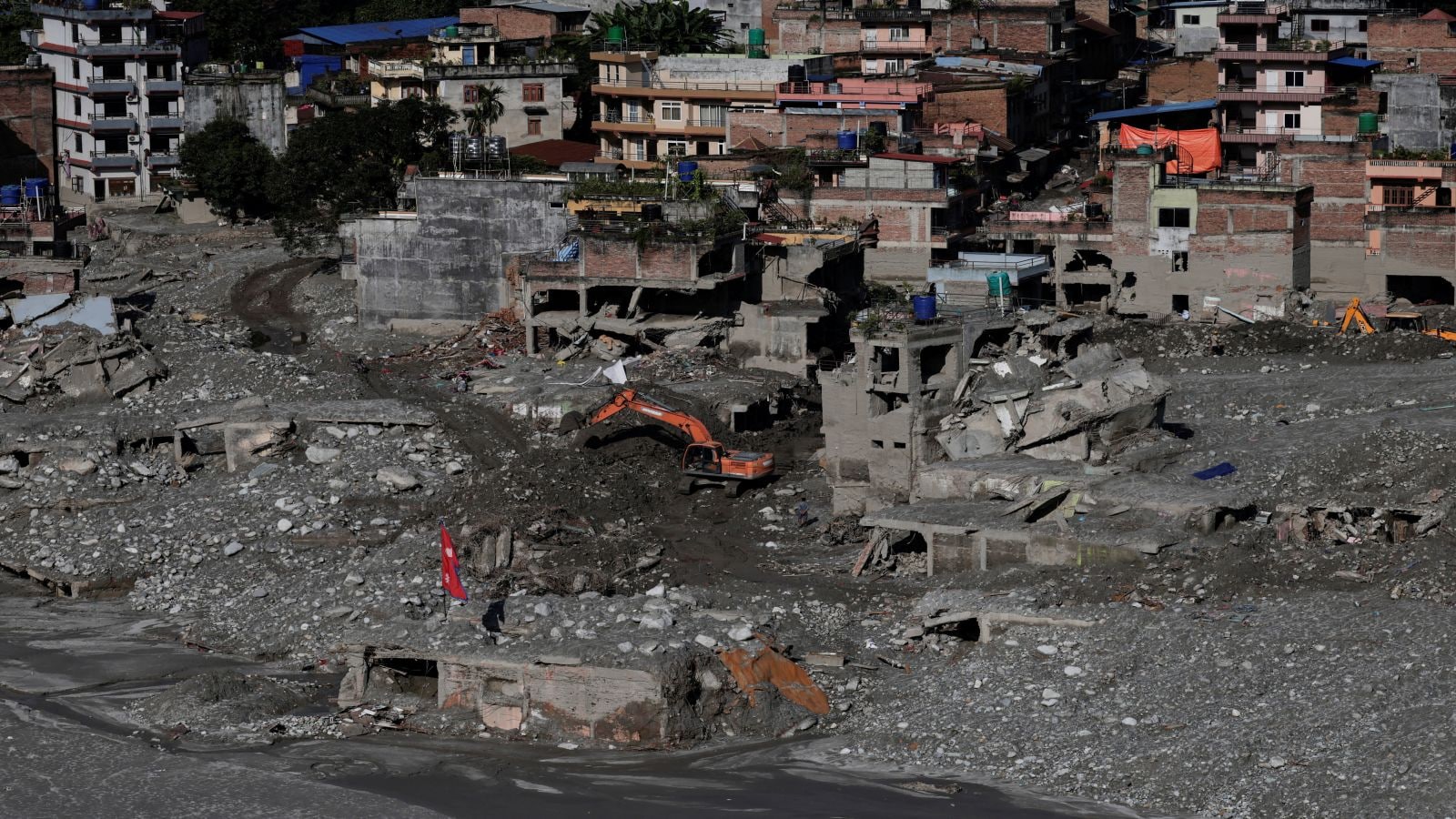
When the Bhotekoshi river basin swelled into a destructive torrent, the financial toll on state-owned Nepal Telecom initially settled at a staggering NPR 88.51 million. For an enterprise tasked with stitching together the high-altitude topography of the Himalayas, this figure represents more than broken glass and twisted metal. It exposes the fragile architecture of mountain communications in an era of intensifying climate volatility. Across Rasuwa, Nuwakot, and Dhading, 120 distinct telecom sites faced the brunt of the disaster, with 83 experiencing total service interruptions. Three major nodes—Trishuli-3 'B', Chilime Khola, and Timure—were wiped clean off the map.
Money alone does not capture the operational nightmare of mountain telecommunications failure. When optical line terminals shatter and tens of kilometers of fiber-optic cables vanish beneath mud and silt, the immediate consequence is absolute isolation. Emergency responders, rescue coordinators, and stranded families found themselves shouting into dead air.
The Anatomy of a High-Altitude Failure
To understand why a regional flash flood can inflict millions of dollars in damages on a national telecommunications provider, one must examine the engineering realities of laying infrastructure along Himalayan corridors. Fiber lines are rarely buried deep beneath stable bedrock in these rugged terrains; instead, they often run parallel to river gorges and highway arteries where excavation is marginally feasible. When the Bhotekoshi and Trishuli rivers burst their banks, they did not merely rise—they acted as hydraulic battering rams.
Out of roughly 65 kilometers of critical fiber network in the hardest-hit zones, more than half was severely compromised. Physical geography dictates that these transmission paths are bottlenecks. If a single gorge floods, redundant pathways spanning alternate mountain passes are frequently non-existent or equally vulnerable to secondary landslides.
[River Gorge Route] --> [Fiber Line Exposed to Flash Floods] --> [Total Node Isolation]
State engineers faced a grim operational calculus in the immediate aftermath. Traditional heavy machinery could not be brought in because the access roads had dissolved into the riverbed. Restoring connectivity required leaning heavily on alternative technologies while the primary conduits remained buried or broken.
The Microwave Pivot and Bandwidth Bottlenecks
Faced with severed fiber links, Nepal Telecom engineers deployed microwave technology to re-establish backbone transmission services into isolated pockets like Timure and Rasuwagadhi. Microwave links serve as an effective stopgap, bypassing physical line-of-sight breaks by bouncing signals through the air from ridge to ridge.
Yet, microwave communication is an imperfect substitute for fiber-optic cables.
- Bandwidth capacity drops significantly compared to high-speed fiber trunks.
- Atmospheric interference during heavy monsoon rains can degrade signal quality.
- Power dependency at remote relay stations becomes acute when local grids fail.
While mobile connectivity in surrounding valleys was partially salvaged by diverting signals through surviving peripheral towers, the overall network throughput shrank precisely when data demands for rescue and relief operations spiked. Battery backups installed across regional provinces provided temporary life support, but prolonged isolation quickly exhausted auxiliary power reserves at sites cut off from fuel re-supply.
The Broader Economic Ripple
The damage sustained by Nepal Telecom is a microscopic fragment of a much larger national catastrophe. Broader governmental assessments indicate that recovery efforts across the entire disaster zone require astronomical sums running into hundreds of billions of rupees, touching everything from wiped-out hydropower projects to washed-out suspension bridges. In that context, an NPR 88.5 million repair bill might seem manageable for a corporate balance sheet.
The real danger lies in systemic vulnerability. Every time extreme weather events knock out critical infrastructure, capital that should be funding modernization and rural 5G expansion is diverted into emergency repair work. Insurance payouts and state subsidies buffer the immediate shock, but they do nothing to alter the underlying geography.
Rebuilding the exact same fiber pathways along the exact same riverbanks invites a repeat performance during the next monsoon cycle. True resilience requires burying trunk lines deeper into stable mountain walls, establishing genuinely independent satellite redundancy loops, and rethinking how critical data arteries traverse flood-prone Himalayan river valleys. Until those structural shifts occur, every heavy downpour remains an existential stress test for the nation's digital backbone.