Ted Turner’s Western art collection is not merely a hobby for a retired cable pioneer. According to his son, Beau Turner, the sprawling assembly of paintings and sculptures is a direct reflection of the media mogul’s lifelong obsession with anything "big." From acquiring roughly two million acres of North American land to building CNN from a fledgling upstart into a global news juggernaut, Turner has always operated on a continental scale. His art vault simply mirrors that appetite, trading small, delicate brushwork for monumental canvases of bison, frontier landscapes, and nineteenth-century American expansion.
Most profiles of billionaire art collectors treat their acquisitions as refined exercises in cultural philanthropy. That framing misses the point entirely when it comes to Ted Turner. You do not buy tens of thousands of bison, become the largest private landowner in the United States for decades, and fill ranch houses across Montana and New Mexico with massive frontier bronzes because you appreciate subtle chiaroscuro. You do it because you want to own the mythos of the American West itself. Learn more on a related topic: this related article.
The Architecture of a Frontier Ego
Beau Turner’s observation cuts straight through decades of public relations polish. To understand Ted Turner’s relationship with Western art, you have to look at the physical footprint of his life. In the late 1980s and 1990s, while other media titans were bidding up French Impressionists at Sotheby’s in New York or buying minimalist steel sculptures for Manhattan penthouses, Turner was pouring his capital into dirt and bronze.
Scale was the unifying currency. Whether he was defending the America’s Cup in twelve-meter yachts, launching the Goodwill Games, or buying MGM’s film library just to get his hands on Gone with the Wind, Turner gravitated toward things that dominated the horizon. Western art—specifically the nineteenth-century and early twentieth-century works of painters like Albert Bierstadt, Thomas Moran, Frederic Remington, and Charles Marion Russell—offered something European modernism could not. It offered sheer, unfiltered vastness. Further analysis by Reuters Business delves into related views on this issue.
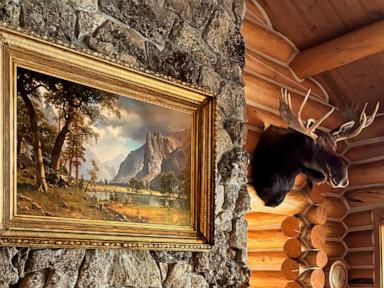
Consider the mechanics of the Hudson River School and Rocky Mountain School painters. Artists like Bierstadt and Moran did not paint intimate portraits. They painted twelve-foot-wide panoramas of Yosemite Valley and the Grand Canyon, canvases designed to overwhelm the viewer’s peripheral vision and induce a sense of Manifest Destiny awe. For a man who famously hung a plaque on his desk reading "Lead, follow, or get out of the way," a tiny watercolor simply does not register. He needed walls that looked like windows onto an untamed continent.
Why Media Moguls Buy the American West
Turner is hardly alone in this impulse, though he took it further than almost anyone else in modern American business. Throughout the twentieth century, industrialists and media barons repeatedly turned to Western Americana as a form of reputational alchemy.
Think about the trajectory of the American tycoon. First comes the ruthless accumulation phase—the cutthroat cable carriage battles, the leveraged buyouts, the regulatory knife-fights in Washington. During the 1980s, Turner was widely viewed by Wall Street and the established broadcast networks as a reckless gambler, "The Mouth of the South" who was over-leveraging his company to chase an absurd twenty-four-hour news channel.
Then comes the conservationist and heritage phase. By acquiring vast stretches of Montana’s Flying D Ranch or New Mexico’s Vermejo Park Ranch, and filling those lodges with historic Western art, a mogul transforms his public identity from a corporate raider into a steward of the American frontier.
There is a massive difference, however, between buying Western art for a corporate headquarters and living inside it. Many corporate collections—banks, oil companies, insurance giants—treated Western art as boardroom wallpaper meant to project stability and rugged individualism to shareholders. Turner treated it as personal immersion. The paintings hung in the very ranch houses where he slept, negotiated business deals, and entertained world leaders. When you sit beneath a massive oil painting of a stampeding buffalo herd after spending the morning riding across a hundred-thousand-acre pasture stocked with actual living bison, the boundary between art and reality disappears.
The Economics of Western Americana
From a pure market standpoint, Turner’s focus on big Western art also reflects a distinct niche in the global art economy. The traditional art world, centered in New York, London, and Basel, has historically treated Western American art as a regional stepchild. Critics in Manhattan spent decades dismissing Remington and Russell as mere illustrators rather than serious fine artists.
That institutional snobbery created a massive pricing arbitrage for buyers who did not care about East Coast gallery validation. While a top-tier Monet or Picasso could easily clear fifty or a hundred million dollars by the turn of the twenty-first century, museum-grade Western masterworks frequently traded for a fraction of those sums.
For a buyer like Turner, who has always despised doing things simply because the establishment approved of them, this market dynamic was ideal. Let the hedge fund managers fight over Andy Warhol screenprints and Jean-Michel Basquiat canvases. Turner could acquire monumental, historically significant works depicting the exact ecosystems he was actively restoring, often without paying the inflated "trophy tax" of the contemporary art circuit.
| Market Dimension | Contemporary / Modern Art (NYC/London) | Historic Western Art (Turner’s Focus) |
|---|---|---|
| Primary Buyer Base | Global hedge funds, tech founders, sovereign wealth | Landowners, energy executives, legacy media moguls |
| Valuation Drivers | Gallery representation, biennial inclusion, auction hype | Historical provenance, subject scale, regional scarcity |
| Physical Scale | Varies wildly from miniature to architectural | Predominantly grand, horizontal, and panoramic |
| Institutional Prestige | High among coastal critics and major museums | High among specialized institutions (e.g., Gilcrease, Autry) |
| Asset Correlation | Closely tied to global equity and liquidity cycles | Tied to domestic wealth and agricultural/ranching dynasties |
Yet the market has shifted dramatically over the past twenty years. As billionaires from the technology and finance sectors—figures like Jeff Bezos, Bill Gates, and Stan Kroenke—began buying up massive tracts of Western ranchland, the demand for authentic Western art followed. Suddenly, every newly minted ranch owner in Jackson Hole, Bozeman, and Santa Fe wanted historic bronzes and sweeping landscapes for their timber-and-stone lodges. Prices for prime works by Russell, Remington, and the Taos Society of Artists surged, proving that Turner’s instinct for "big" had once again anticipated a broader wave of billionaire migration.
The Contradiction Inside the Frame
Any honest assessment of Ted Turner’s art collection has to confront a glaring historical irony. The nineteenth-century painters who created the most iconic Western imagery were, knowingly or not, visual propagandists for the exact ecological destruction Turner spent the second half of his life trying to reverse.
Look closely at the history of the American frontier between 1860 and 1900. Artists like Bierstadt and Moran painted pristine valleys and towering peaks that looked untouched by human hands, even though Indigenous nations had lived on and managed those lands for millennia. Their paintings sparked a tourism and settlement boom in the East. Railroad barons literally commissioned Western painters to create monumental landscapes to hang in train stations, enticing settlers and hunters to buy tickets west.
What followed was one of the fastest ecological collapses in recorded history. Within a few decades, the North American bison population plummeted from an estimated thirty to sixty million animals down to fewer than a thousand. Prairies were fenced, rivers were dammed, and native predators were systematically eradicated.
Turner built his modern conservation empire on the wreckage of that nineteenth-century expansion. When he began buying ranches in the late 1980s, his explicit goal was to rip out interior fencing, restore native grasses, and bring back the bison herds that had nearly vanished. Today, Turner Enterprises manages roughly fifty thousand bison across more than a dozen ranches—the largest private herd in the world.
This creates a fascinating tension on the walls of his properties. The art celebrates the romantic, sweeping grandeur of the nineteenth-century frontier, while the land outside the window represents a twentieth- and twenty-first-century effort to undo the damage caused by the people who conquered it. Beau Turner’s comment about his father’s love for "big" bridges that gap. Whether it is the myth of the frontier or the ecological restoration of it, Ted Turner has never been interested in half-measures.
What Happens When a Mogul Downsizes
Collecting on a continental scale inevitably creates an estate and legacy problem. You cannot easily divide a two-million-acre land portfolio or a museum-grade collection of massive canvases among heirs without risking fragmentation.
In recent years, Turner has begun navigating the complex realities of succession, health challenges—including his public disclosure of Lewy body dementia—and asset preservation. When a collector accumulates hundreds of heavy bronzes, oversized oil paintings, and fragile historical artifacts across multiple states, those items require climate control, conservation staff, insurance, and eventual institutional placement.
Unlike contemporary art collectors who build private vanity museums in major cities to secure tax deductions and social status, Turner’s holdings are deeply tied to the specific geographies of his ranches and his philanthropic foundations. Moving a ten-foot Bierstadt landscape out of a Montana ranch house strips it of the exact environmental context that made it meaningful to him in the first place.
For the broader art market, the eventual disposition of major legacy Western collections always triggers intense speculation. Dealers and museum curators in places like Fort Worth, Cody, Tulsa, and Los Angeles watch these collections closely, knowing that a single major dispersal can reshape auction records for a generation. Yet those close to the family consistently emphasize that the collection was never assembled as an investment portfolio to be flipped at peak valuation.
The Legacy of Thinking at Scale
Beau Turner’s simple characterization—that his father’s Western art reflects a passion for "big"—is the most accurate summary you will ever read of Ted Turner’s entire career. Modern corporate culture rewards optimization, incremental margin growth, and risk mitigation. Executives today spend millions on consultants to avoid making a single bold mistake.
Turner operated from the opposite playbook. He risked bankruptcy to launch CNN. He risked ridicule to buy a failing baseball team in Atlanta and turn it into "America’s Team" via superstation broadcast. He risked alienating traditional ranchers across the West by replacing cattle with bison and reintroducing wolves and prairie dogs to his properties.
His art collection stands as the physical artifact of that mindset. In an era where billionaire taste increasingly favors minimalist digital displays, sleek architectural concrete, and sterile conceptual art, Turner’s walls remain unapologetically crowded with thundering hooves, towering granite peaks, and dramatic frontier skies. He did not buy art to whisper sophistication to his guests. He bought it to remind everyone in the room how vast the world actually is—and how aggressively he intended to leave his mark on it.