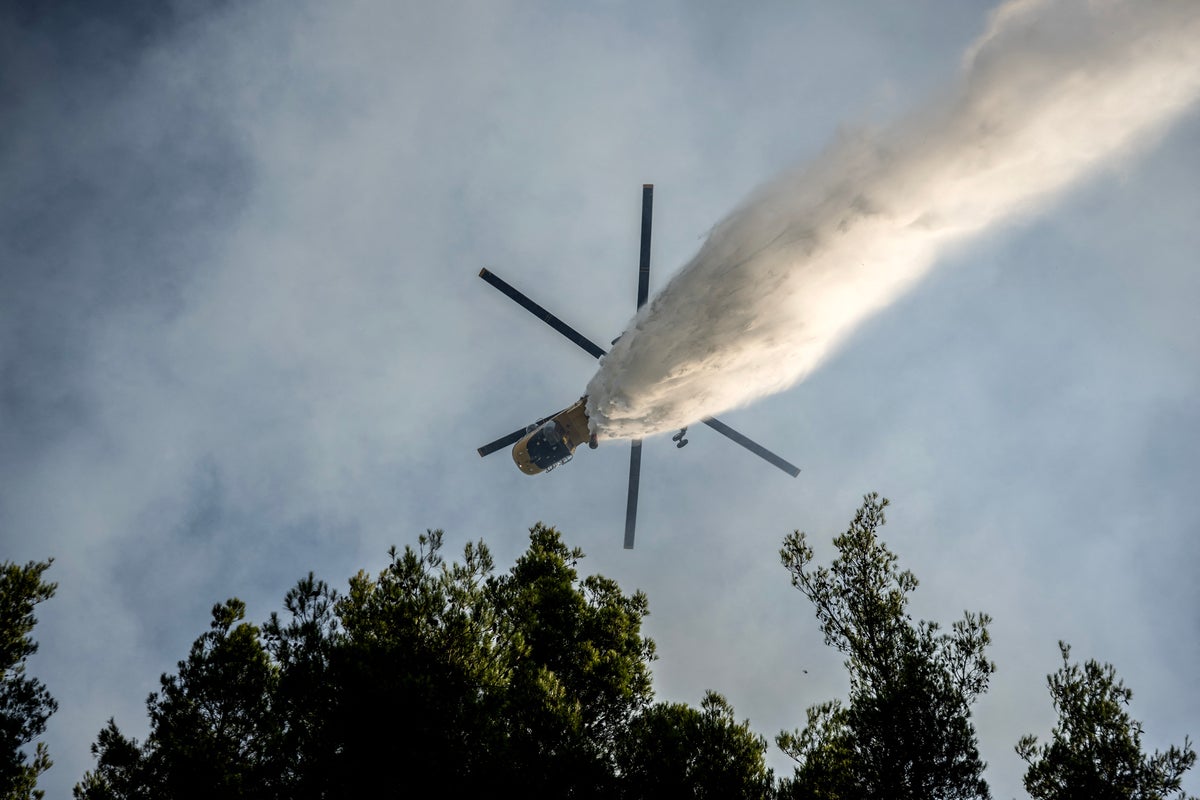
Two firefighting helicopters collided in midair over the rugged terrain west of Athens, resulting in the deaths of a Greek flight coordinator and a Danish pilot. The crash occurred during a desperate push to contain a wind-driven blaze near Porto Germeno and Psatha in the Attica region. When rotor blades slice into structural frames through thick plumes of smoke, the narrative usually pivots immediately toward human error or mechanical failure. That is an easy trap for casual observers. The reality on the ground—and in the choking air—is far more systemic, born of a compounding operational pressure cooker that turns routine emergency response into an airborne hazard zone.
Aerial firefighting is inherently high-stakes geometry executed under extreme psychological and environmental duress. To understand why two aircraft converged on the same fatal point in the sky, one must look past the immediate wreckage and examine the structural bottlenecks of modern wildfire management across Southern Europe.
The Physics of Overcrowded Airspaces
Smoke strips away the most critical tool a pilot possesses: horizontal reference. When multiple aircraft operate in a tight, confined corridor over a dynamic wildfire front, visibility drops to near zero. Pilots rely on radio communication, coordinators, and sheer spatial intuition to navigate valleys choked with particulate matter and whipped by erratic gale-force winds.
In the skies above western Attica, standard separation rules degrade rapidly. Ground commanders face immense political and social pressure to throw every available asset at an advancing wall of flame before it reaches densely populated areas or industrial zones near Megara.
This creates an intense bottleneck. Fixed-wing water bombers and nimble rotary aircraft must share narrow air corridors to scoop water from the sea or drop payloads precisely ahead of the fire line. When wind shear pushes a blaze unpredictably across mountain ridges—igniting old military firing ranges and unexploded ordnance along the way—flight paths must adjust in seconds. The margin for error shrinks to zero. A single misjudgement in closing speeds during a low-altitude maneuver can prove fatal before instruments can even register a warning.
The Strain on Aging Fleets and International Crews
Greece relies heavily on a mix of domestic resources and contracted international support during the peak summer months. Pilots from different nations, flying unfamiliar airframes, are thrust into coordinated operations with minimal ramp-up time. They bring varied backgrounds, distinct operational protocols, and language barriers into an environment where split-second radio clarity is the difference between survival and disaster.
The aircraft themselves are pushed far beyond normal commercial maintenance cycles. During an intense heatwave, high ambient temperatures reduce engine efficiency and lift capability, forcing pilots to fly harder and lower to deliver effective payloads. When fleets are stretched thin across simultaneous emergencies—such as concurrent outbreaks on the island of Kefalonia and major scars left by fires in France and Spain—the operational tempo becomes unsustainable.
Maintenance windows shrink. Fatigue accumulates quietly among ground crews and flight decks alike.
The Cost of Reactive Emergency Models
Governments consistently fund suppression rather than systematic prevention. Year after year, Mediterranean nations find themselves locked in a reactive cycle: watch the forests dry out, wait for the first spark, and then scramble an armada of aging aircraft to beat back the flames.
This approach treats the symptoms while ignoring the structural disease. Dense underbrush, unmanaged forest floors, and climate-driven drought conditions guarantee that every summer will feature fires too aggressive for ground crews to manage alone. Consequently, authorities lean more heavily on aerial assets, increasing the density of aircraft in smoke-filled skies until a statistical tragedy finally occurs.
Ground the fleet temporarily after an incident, and the political cost mounts instantly as uncontained fires threaten more homes. Keep flying under marginal conditions, and the human cost climbs higher.
The tragedy over Attica is not an isolated anomaly. It is the predictable outcome of an emergency response system operating past its structural limits, trading human lives in the cockpit for containment lines that can no longer hold against a changing climate.