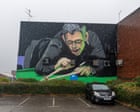
When a massive thirty-foot portrait of snooker legend Ronnie O'Sullivan was unveiled on the side of the Spot On snooker club in Sheffield, internet commenters did not see a seven-time world champion. They saw a walking corpse.
The mural, commissioned to honor "The Rocket" just down the road from the sport's spiritual home at the Crucible Theatre, immediately caught fire on social media. Observers compared the hollow-eyed, skeletal depiction to a zombie, Michael Jackson, and even an unfortunate tribute on par with the infamous Cristiano Ronaldo bronze bust. Yet behind the viral mockery lies a harsher reality about the modern intersection of public art, structural limitations, and the instant, merciless machinery of internet outrage.
The Anatomy of a Public Art Blunder
Artist Chris Ashmore found himself at the center of an international digital storm through no grand malicious intent, but rather due to the rigid physical constraints of urban street painting. Working on the back wall of the venue, Ashmore faced an immediate obstacle that derailed his usual creative workflow. The ground surrounding the club was far too uneven to safely operate a standard scissor lift.
Instead, the painter had to rely on a traditional scaffolding setup. Anyone who has spent time on large-scale exterior murals understands the optical trap of scaffolding. When you are standing mere inches away from a brick wall, tethered to metal poles and planks, your perspective is entirely compressed. You can see individual brushstrokes and mortar lines, but you lose sight of the composition as a whole.
Ashmore spent roughly two weeks of an allocated five-week schedule chipping away at the massive facade. Then, the scaffolding came down prematurely or simply shifted before the final detailing phase could begin. The artist stepped back, left the site, and within hours, photographs of the mid-process piece hit social media.
Boom. Viral status achieved.
The internet does not wait for context. By the time critics began dissecting the peculiar shading around the eyes and the gaunt structure of the jawline, the portrait looked less like a precision break-builder and more like a character from a horror film.
The Trap of Unfinished Truths
Public art is uniquely vulnerable because it is born in public view. Traditional studio artists spend months working in private isolation, scraping back paint, altering proportions, and fixing anatomical errors behind closed doors. Only a finished, curated piece ever meets the public eye.
Street artists enjoy no such luxury. Their mistakes, miscalculations, and awkward mid-stages are thrust onto the community in real time.
Club manager Dan Kirkland rushed to defend the project, pointing out the obvious truth that the work was only partially complete. Crucial layers of highlights, shadows, and facial corrections around the mouth and eyes—the features that capture a living person's likeness—were still sitting on the artist's mental and physical checklist. Kirkland noted that small, targeted adjustments would completely alter the outcome.
Yet the nuance of an unfinished canvas holds little currency online. The digital mob preferred to treat a work-in-progress as a finished final statement. Memes outpaced reality. Accounts with millions of followers shared the imagery stripped of any local context, turning a community tribute into global comedy fodder.
When Constructive Criticism Crosses the Line
There is a vast gulf between aesthetic critique and personal abuse. While local residents and internet users are entirely entitled to their opinions regarding a painting's success or failure, the discourse quickly devolved.
Club management expressed deep frustration not over the widespread laughter, but over the vitriol directed specifically at Ashmore as an individual. The artist possesses thick skin and has survived years in the trenches of commercial and public art commissions, but the sheer volume of personalized hostility reveals a toxic symptom of modern viral culture. Every brushstroke is now judged as if it were a finished museum piece evaluated by a panel of hostile judges who have never held a paintbrush in their lives.
This episode highlights the fragile ecosystem of local patronage. Independent venues like Spot On attempt to inject color, culture, and personality into urban environments by hiring local creators. When those projects are publicly ridiculed before the final varnish is even dry, it creates a chilling effect. Artists may begin to think twice before accepting public-facing commissions where a single awkward week of scaffolding work can ruin their professional reputation overnight.
The Path to Redemption
The story does not end with a destroyed wall. Spot On management confirmed that full access will be restored to Ashmore so he can finish what he started. The necessary touch-ups around O'Sullivan's notoriously sharp gaze and facial structure are already planned.
Whether the finished product can overcome the internet's first impression remains to be seen. In the digital age, a bad meme outlives reality. But for those walking past the Sheffield club, the 30-foot portrait will soon stand as intended—not as a skeletal specter, but as a tribute to one of the most brilliant minds ever to step around a snooker table.
The scaffolding is going back up. The paint is going back on. And the internet will just have to watch how the frame is actually cleared.


