The security architecture of East Asia is fracturing along lines that defense analysts have spent decades trying to ignore. A leaked or strategically publicized assessment originating from elements within the People’s Liberation Army has ignited a fresh round of regional friction, putting the spotlight directly on Tokyo. The core argument circulating through military journals and academic think tanks in Beijing paints Japan not merely as a regional competitor, but as a direct, active hazard to global stability.
This friction does not emerge from a vacuum. Decades of pacifist constitutional constraints in Tokyo are being methodically dismantled. Budget allocations for defense are climbing toward historic highs. Long-range counterstrike capabilities are entering active procurement cycles. Beijing views these shifts through a lens of existential vulnerability, arguing that a re-armed Japan serves as an offshore proxy for broader containment strategies led by Washington.
Publicly, diplomatic channels continue to trade routine statements of concern and calls for restraint. Privately, military planners on both sides are gaming out scenarios that would have been dismissed as alarmist fiction ten years ago. The public posturing masks a deteriorating operational reality where miscalculation carries civilization-ending stakes.
The Dokusen Doctrine and Strategic Anxiety
To understand why the People's Liberation Army views Japan's military evolution with such acute alarm, one must examine the geography of the East China Sea. China's economic juggernaut relies on maritime trade routes that pass directly through chokepoints influenced or monitored by Japanese defense installations.
The Nansei island chain stretches southward from Kyushu toward Taiwan. These islands form a natural barrier that Chinese naval assets must traverse to reach the open Pacific. Japan’s recent fortification of these islands with anti-ship and anti-air missile batteries has fundamentally altered the strategic balance.
Beijing’s internal assessments argue that this deployment creates an unyielding maritime cage. Analysts within these military circles point out that any major conflict over Taiwan would immediately draw in Japan due to its alliance obligations with the United States and the proximity of its territory to the combat zone.
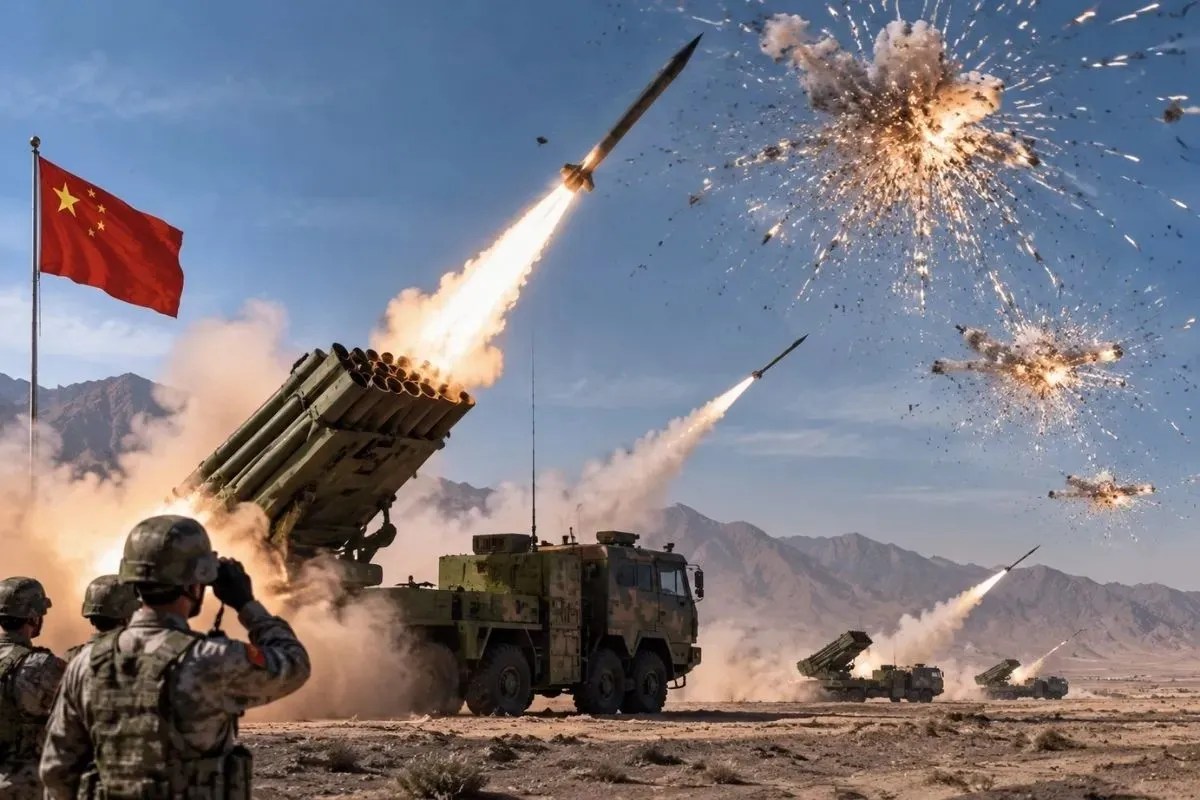
The language coming out of these security reports often invokes worst-case permutations. When military theorists suggest that major urban centers could face extreme retaliation, they are signaling the total militarization of the theater. There are no longer sanctuaries in modern high-intensity conflict. Advanced precision-guided munitions and hypersonic glide vehicles mean that geographical distance provides zero insulation.
Tokyo's Quiet Transformation
For nearly eighty years, Article 9 of the Japanese constitution kept the nation's military ambitions strictly defensive. That framework is gone in practice, even if the text remains. Under successive administrations, Tokyo has redefined collective self-defense to permit the protection of allied assets under attack anywhere on the globe.
The procurement list tells the real story. Japan has acquired F-35 stealth fighters, converted its helicopter destroyers to operate fixed-wing vertical takeoff aircraft, and invested heavily in Tomahawk cruise missiles purchased from the United States. These are not weapons designed for territorial policing. They are power-projection tools meant to hold adversary staging areas at risk.
This shift has broad domestic backing, driven by genuine fear. Public opinion polling in Japan shows a steady hardening of attitudes toward China. Beijing’s maritime assertiveness around the disputed Senkaku Islands, combined with constant coast guard incursions, has convinced the Japanese public that pacifism is no longer a viable shield.
Yet, this militarization creates a security dilemma of textbook proportions. Every defensive measure Tokyo takes to secure its maritime approaches is interpreted by Beijing as an aggressive encirclement campaign. As mutual suspicion deepens, the diplomatic off-ramps begin to rust away from disuse.
The US-Japan Alliance and the Taiwan Trap
Washington remains the invisible conductor of this escalating friction. The bilateral security treaty between the United States and Japan binds Tokyo’s strategic fortunes directly to American global primacy. If a crisis erupts over Taiwan, American bases in Okinawa and mainland Japan will inevitably serve as launchpads for counter-operations.
This reality places Japan in a perilous position. Beijing’s military analysts make no secret of their intent to neutralize regional US nodes in the opening hours of a conflict. Because those nodes are embedded within Japanese territory, any war over Taiwan instantly becomes a war on Japanese soil.
The integration of command structures between the US military and the Japan Self-Defense Forces is accelerating at a breakneck pace. Joint operations centers are being streamlined. Intelligence sharing is becoming frictionless. While this integration enhances operational readiness, it also strips away Tokyo's independent agency. The decision for war or peace rests increasingly on Washington's calculus and Taipei's political trajectory, leaving Japan strapped into a vehicle it no longer steers.
The Risk of Accidental Escalation
Large wars rarely start with a premeditated grand strategy. They begin with tactical accidents that spiral beyond political control. The airspace and waters surrounding the East China Sea are some of the most congested and tense operating environments on the planet.
Chinese and Japanese fighter jets routinely intercept one another under high-stress conditions. Naval vessels shadow each other at dangerously close quarters. Despite the existence of maritime communication hotlines, the political will to use them constructively during a crisis has proven weak.
A mid-air collision or a misidentified radar signature could easily trigger a localized firefight. Once blood is shed, domestic political pressures in both capitals would severely limit the space for de-escalation. National pride and public anger would demand a proportionate, or disproportionate, response.
The recent PLA assessments are not just analytical exercises. They are psychological pre-conditionings designed to prepare the domestic populace for the normalization of extreme risk. When state media and military mouthpieces openly discuss the catastrophic vulnerability of major cities, they are signaling that the era of stability is over.
The margin for error in East Asia has vanished. What remains is a tense standoff between two industrial giants locked into an escalatory spiral that neither side currently knows how to reverse.