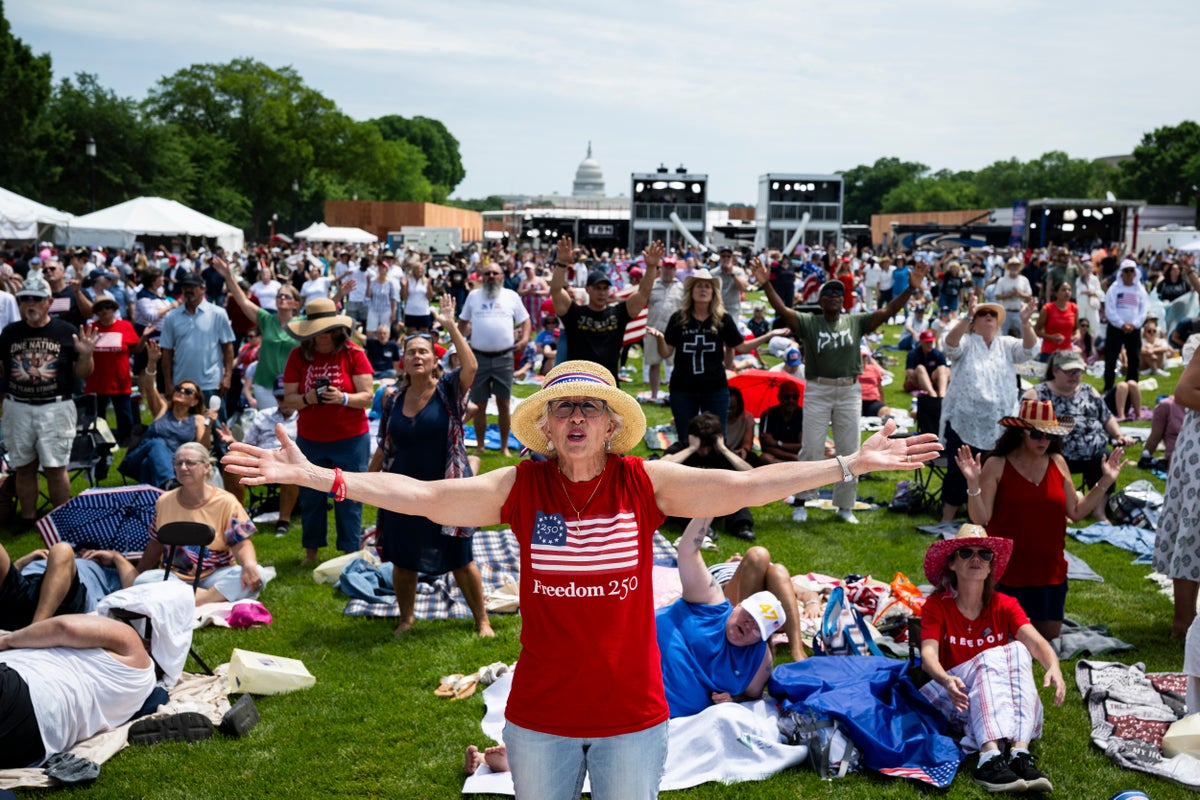
The corporate machinery of the entertainment industry collapsed in spectacular fashion over Memorial Day weekend, revealing a structural fracture that has nothing to do with the traditional mechanics of live music touring. When Freedom 250, a public-private partnership closely tied to the Trump administration, unveiled its entertainment roster for the "Great American State Fair" on the National Mall, the rollout was intended to kickstart the nation's semiquincentennial celebrations. Within 48 hours, the marquee disintegrated.
The immediate narrative framed this as a simple political boycott. Cultural observers noted that legacy acts like The Commodores, Martina McBride, Poison frontman Bret Michaels, Morris Day and the Time, and Young MC vanished from the bill almost as soon as their names hit the promotional posters. By Sunday night, the White House pivoted, declaring the musical lineup canceled in favor of a massive political rally headlined by the president himself. Expanding on this theme, you can also read: The Morning the Corner Office Went Dark.
To understand why a multi-million-dollar national birthday bash devolved into a series of frantic contract disputes and late-night social media retractions, one must look past the superficial culture-war headlines. The real crisis lies in a fundamental breakdown of modern talent acquisition, predatory booking practices, and the complete erosion of due diligence by third-party talent brokers who hid behind the word "nonpartisan" to secure signatures.
The Anatomy of the Ghost Booking
Modern talent booking relies heavily on a network of middle-tier agencies and independent talent buyers. For legacy acts whose peak commercial years occurred in the late 20th century, touring is the primary revenue stream. Deals are often packaged by regional brokers who present dates to an artist’s management as standalone, high-paying festival gigs. Observers at Harvard Business Review have provided expertise on this trend.
According to agency sources, multiple acts were approached with offers for a "nonpartisan historical celebration of America’s 250th anniversary." The contracts were structured through shell entities and event production firms that did not explicitly bear the political branding of the current administration. Young MC explicitly confirmed that the underlying political architecture of the event was actively withheld during negotiations.
When an agency accepts a deposit without fully vetting the ultimate source of the funding, a structural trap is sprung. The artist is announced on a public flyer before the performance contract is fully ratified by both legal teams. This is a common high-pressure tactic used by promoters to force compliance. Once the public associates the artist with the event, pulling out carries a reputational risk, while staying carries a different one. In this instance, the blowback from fans and industry peers was so immediate that artists chose to forfeit their deposits and risk breach-of-contract litigation rather than take the stage.
The Margin of Risk for Legacy Acts
For a contemporary stadium pop star, a political controversy is a manageable PR hurdle. For a legacy act relying on corporate casino dates, state fairs, and nostalgia packages, brand neutrality is economic survival.
| Artist | Initial Status | Public Reason for Withdrawal |
|---|---|---|
| The Commodores | Confirmed Lineup | Declined alignment with any single political party |
| Bret Michaels | Confirmed Lineup | Cited fan safety concerns and divisive atmosphere |
| Martina McBride | Confirmed Lineup | Stated original nonpartisan billing was misleading |
| Morris Day | Confirmed Lineup | Denied ever finalizing the booking agreement |
| Vanilla Ice | Remaining | Stated he does not vote and views it as non-political |
The economic reality of these acts explains their rapid exit. A country icon like Martina McBride or an arena-rock staple like Bret Michaels operates within a delicate ecosystem. Their core audience spans a wide political spectrum. Affiliating with a highly charged executive branch initiative threatens their bookings for the entire autumn state fair circuit. The calculus was simple. A single high-paying payday on the National Mall was not worth losing twenty future bookings down the line.
The Illusion of the Public-Private Partnership
The failure of the Great American State Fair lineup highlights a systemic flaw in how modern municipal and federal events are financed. True public-private partnerships require transparent governance. When Freedom 250 attempted to blend a federal milestone with a specific political brand, it alienated the corporate sponsors and insurance underwriters required to pull off a 16-day festival on the National Mall.
When an event loses its cultural center, the logistics instantly follow. Security costs skyrocket because the risk profile shifts from a family-friendly exhibition to a high-alert political demonstration. Bret Michaels hinted at this reality, explicitly citing "unfounded and unforgivable" threats regarding the safety of his crew and fans. When an artist's production manager looks at a security rider and realizes the local municipal police, park police, and private security forces are not aligned on crowd control protocols for a politicized event, the show cannot go on.
The Pivot to the Executive Monologue
The total collapse of the musical roster forced a predictable operational shift. By replacing a multi-genre festival with an executive rally featuring military bands and legacy ideological anthems, the administration effectively subsidized a commercial failure with federal infrastructure.
This maneuver exposes the shrinking pool of cultural capital available to national civic celebrations in a divided era. True state fairs succeed because they are hyper-local, community-driven, and inherently commercial rather than ideological. Attempting to manufacture a federal version of a state fair while using legacy musicians as nonpartisan window dressing was an operational error from its inception. The artists didn't just walk away from a gig. They exposed the fact that in the modern entertainment economy, corporate neutrality is far more lucrative than political patronage.