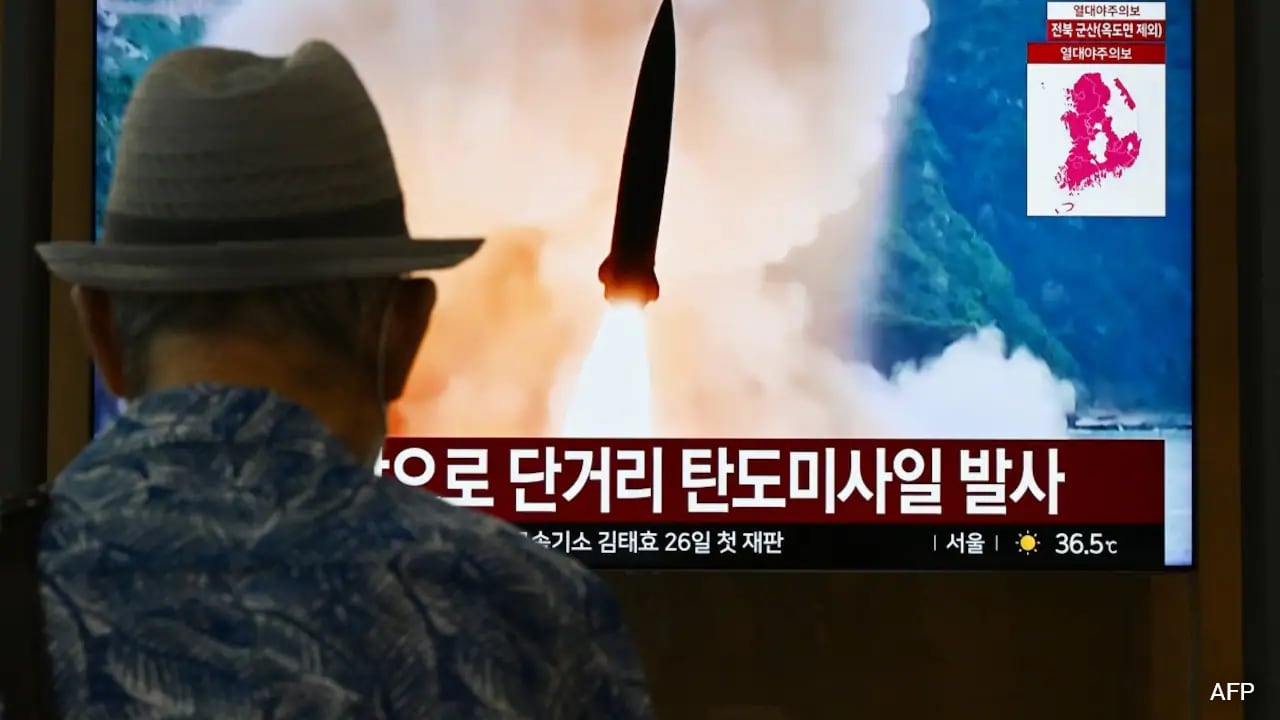
When North Korea fires another ballistic missile toward the Sea of Japan, the automated news cycles grind out a familiar, predictable rhythm. Wire services publish brief alerts about projectiles splashing into waters outside Japan's exclusive economic zone, defense ministries in Tokyo and Seoul issue measured statements of condemnation, and Washington reiterates its ironclad security commitments. Then, the news cycle moves on. This rote journalistic treatment misses the structural transformation happening across the Korean Peninsula. Pyongyang is not merely engaging in theatrical saber-rattling or routine attention-seeking. The latest series of missile launches represents a calculated, highly technical escalation driven by shifting geopolitical alliances, real-world combat validation, and a profound anxiety over Japan's quiet military normalization.
To understand why these launches matter, one must look past the coordinates of the splash zones and examine the mechanics of Pyongyang's recent weapons development. South Korea's Joint Chiefs of Staff detected the latest round of short-range ballistic missiles originating from the eastern coastal area around Wonsan. These are not primitive Scud variants built on obsolete Soviet blueprints. They are advanced, highly maneuverable tactical guided systems designed to evade layered missile defense networks like the Patriot Advanced Capability-3 and the Aegis Ballistic Missile Defense systems deployed by allied naval assets in the region.
The timing of these tests provides an analytical window into Pyongyang's operational calculus. The launches consistently precede major joint military exercises conducted by the United States and South Korea. North Korean state media and leadership inner circles, notably articulated through statements by Kim Yo Jong, frame these actions as direct countermeasures against what they characterize as the militarization of Japan and offensive allied drills. Tokyo’s steady departure from its historic pacifist posture—highlighted by increased defense spending, acquisitions of long-range counterstrike capabilities such as Tomahawk cruise missiles, and upgraded security postures—has fundamentally altered the threat perception inside Pyongyang. Where Tokyo sees necessary deterrence against a nuclear-armed rogue state, Pyongyang views an accelerating transformation into a regional power capable of preemptive strikes.
Yet, focusing exclusively on regional friction points overlooks the most critical variable introduced into East Asian security over recent years: the operational export of North Korean munitions to European conflict zones. Intelligence assessments from Ukraine and Western capitals confirm that North Korean ballistic missiles have been actively utilized in combat. This dynamic transforms the Sea of Japan test range into something far more valuable than a local firing ground. Pyongyang's engineers are receiving empirical telemetry data, failure rates, and performance metrics from actual battlefield usage. Weapons systems that previously existed only on drawing boards or controlled domestic test sites are being evaluated under real combat duress through partnerships with Moscow.
This feedback loop accelerates the technological maturation of North Korea's military-industrial complex. When Kim Jong Un inspects new destroyer-mounted cruise missile systems or oversees tactical ballistic tests, he is no longer relying on theoretical models. The state has amassed financial capital, diplomatic leverage via Russian backing on the United Nations Security Council, and critical engineering insights that blunt the long-term impact of international sanctions.
Western capitals routinely underestimate how these vectors intersect. Traditional deterrence theory relies heavily on the assumption that economic sanctions and diplomatic isolation will eventually force a regime to alter its strategic priorities. That framework is failing here. Pyongyang has found alternative economic lifelines and technological partners, insulating its weapons programs from traditional pressure points. Consequently, every missile arc across the Sea of Japan is a physical manifestation of a regime that feels increasingly confident in its conventional and nuclear deterrence posture.
The strategic reality for Japan and South Korea is stark. As intelligence agencies parse radar tracks and telemetry logs to determine whether a newly tested warhead utilized depressed trajectories or maneuvering re-entry vehicles, the margin for error shrinks. Interception windows are measured in minutes, and the psychological burden on civilian populations beneath these flight paths grows with every test cycle. The routine framing of these events as minor regional disruptions obscures an unfolding security dilemma where all sides are accelerating their military preparations with a palpable sense of urgency, leaving diplomatic channels effectively dormant while the hardware on both sides of the water continues to multiply.