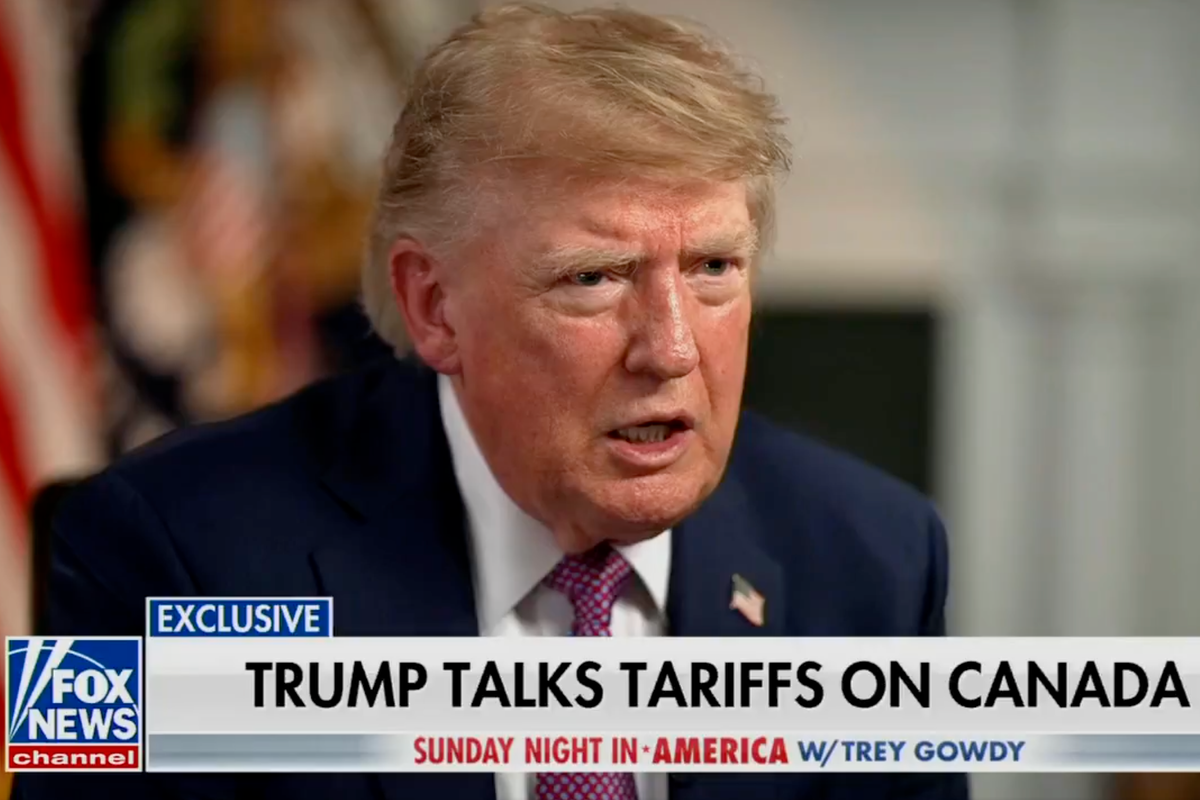
Donald Trump revived his provocative rhetoric regarding Canada's sovereignty, claiming that America's northern neighbor expects the economic advantages of an American state without accepting the responsibilities of union. This remark accompanied the dramatic collapse of bilateral trade negotiations and the implementation of severe 50 percent tariffs on Canadian steel, aluminum, and automotive imports. What began months prior as barbed remarks at Mar-a-Lago has mutated into a full-scale economic conflict. Prime Minister Mark Carney pulled Canadian negotiators from Washington and promised dollar-for-dollar retaliatory measures, transforming an integrated cross-border supply chain into a theater of economic retaliation.
The friction points run deeper than standard protectionist posturing. For decades, the economic relationship between Ottawa and Washington operated on the premise of frictionless integration. Auto parts cross international boundaries multiple times before a finished vehicle rolls off an assembly line. Trump’s insistence on sweeping tariffs breaks this machinery. By demanding that Canadian companies abandon their home jurisdiction or face prohibitive cost walls, the White House is weaponizing the tax code to force industrial migration.
The Mechanics of Economic Coercion
Trade negotiations between unequal partners rarely follow textbook economic models. The United States market dwarfs Canada's economy by a factor of ten, giving Washington immense structural leverage in any bilateral dispute. Yet leverage does not automatically translate into strategic victory.
Consider a hypothetical automotive manufacturer operating in Ontario. When a 50 percent levy hits raw steel and incoming components, management faces an immediate margin crisis. Passing those costs entirely to American consumers risks destroying retail demand, while absorbing the penalty drains capital reserves meant for research and expansion.
Washington assumes these pressures will naturally drive factories southward. Trump explicitly urged companies to cross the border and set up shop inside the United States to escape the penalty lines. Reality on the ground is more stubborn. Industrial ecosystems—skilled labor pools, specialized engineering clusters, and localized supply chains—cannot be disassembled and reassembled in a different country over a weekend.
Instead of capitulation, Ottawa chose retaliation. Carney’s government scheduled sweeping counter-tariffs targeting key American exports. Provincial leaders added their own leverage to the mix. Ontario Premier Doug Ford explicitly raised the prospect of restricting critical minerals and electricity exports to northern American states. Power grids in Michigan, Minnesota, and New York rely heavily on Canadian electricity generation. Weaponizing the power switch turns a trade dispute into a regional crisis for American consumers.
The Sovereignty Trap
Trump’s framing of Canada as an unassimilated state wanting the perks of the union without the burdens misses the foundational reality of national identity. No sovereign government can accept terms that effectively subordinate its foreign trade policy to Washington's approval.
Reports from the collapsed negotiation rounds indicate that the United States pushed for clauses restricting Canada's ability to forge trade partnerships with other global economies, such as India or various Asian nations. For an export-driven nation, agreeing to such clauses means signing away economic independence. Carney rejected the proposition outright, framing the administration's stance not as tough negotiating, but as an existential attack on domestic industry.
Political dynamics on both sides of the border have hardened positions beyond the point of easy compromise. Trump faces domestic pressure to prove that his tariff regime delivers manufacturing jobs and punishes external actors. In Canada, standing up to American pressure has become a unifying rallying cry across otherwise fractured political lines. When Ontario's premier dismisses personal insults from the White House with an invitation to bring on further economic pain, the dispute enters a phase where political survival supersedes rational economic calculation.
The Cost of Friction
Economic nationalism carries a steep invoice. Consumers on both sides of the border will ultimately foot the bill for higher duties on vehicles, construction materials, and everyday goods. Inflationary pressures that central banks spent years trying to tame are receiving a fresh, artificial injection from retaliatory tax walls.
Supply chains do not heal overnight once broken by political decree. Once a manufacturer reconfigures logistics to avoid a hostile border, those operational changes become permanent, permanently altering the North American economic landscape. The 51st state rhetoric may play well as political theater on social media platforms, but the structural damage being inflicted on interdependent industrial sectors threatens to leave both economies weaker in an increasingly competitive global market