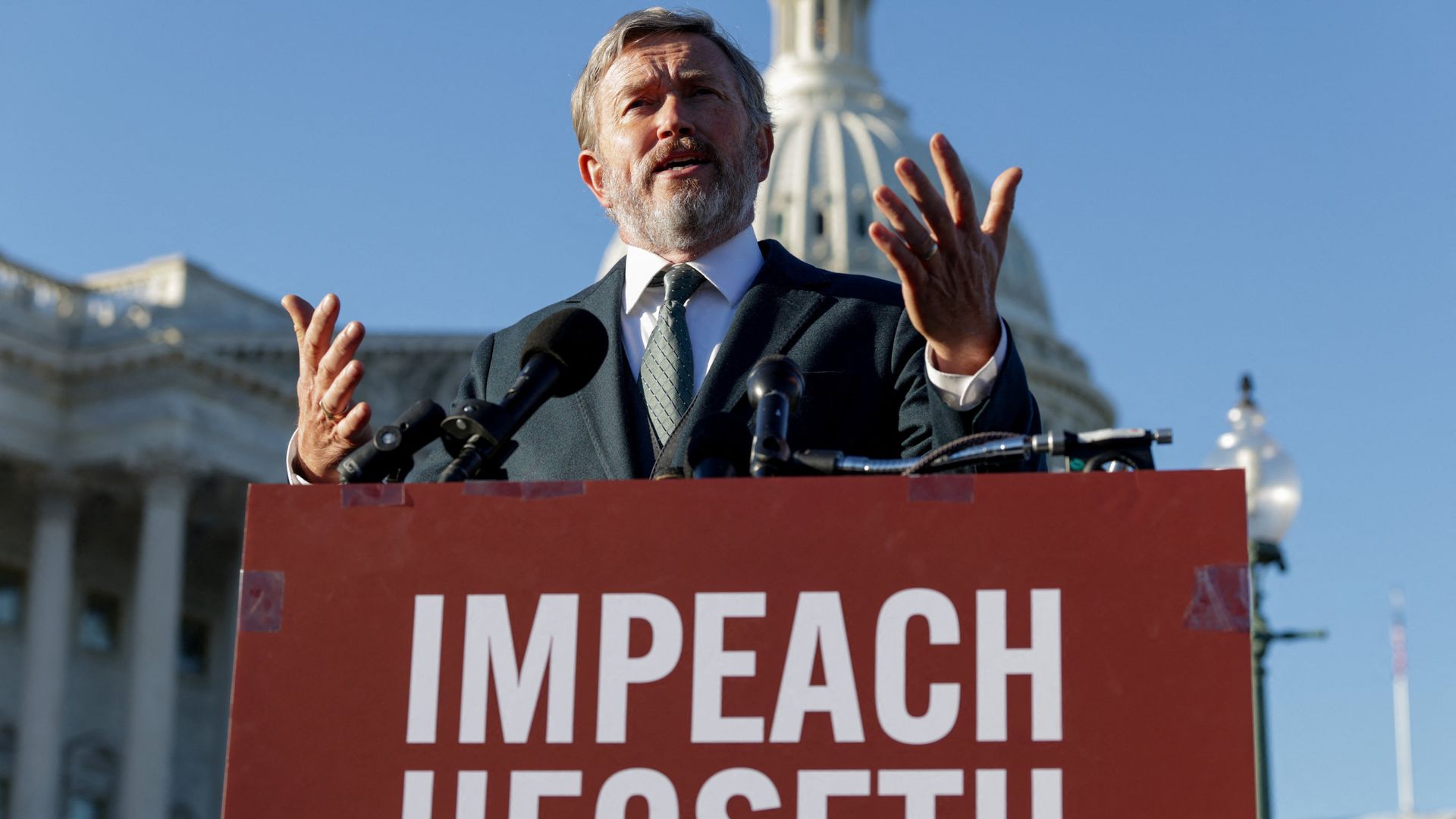
On November 9, 2026, outgoing Republican Representative Thomas Massie of Kentucky walked onto the House floor and read a 34-page privileged resolution. His target was Defense Secretary Pete Hegseth. Massie's move forced a procedural showdown within forty-eight hours, culminating in a 211–204 vote on November 10 that buried the eight articles of impeachment in the House Judiciary Committee.
Most surface-level coverage framed the episode as a predictable political stunt by a primary-defeated maverick. That reading misses the structural rot exposed on the House floor. The vote did not exonerate the Pentagon chief, despite President Donald Trump's celebratory rhetoric. Instead, it revealed a party trapped between its own executive branch's undeclared wars and an electorate that had just handed Republicans a historic midterm defeat. Expanding on this theme, you can find more in: The Quiet Arithmetic of a Ceasefire.
The Procedural Trap on the House Floor
Massie knew the parliamentary math before he ever approached the rostrum. Having lost his Republican primary earlier in 2026 to a Trump-backed challenger, the Kentucky libertarian had nothing left to lose inside the conference. Yet he was not acting out of mere spite. By invoking Rule IX of the House of Representatives, Massie triggered a privileged resolution, stripping Speaker Mike Johnson of the unilateral power to ignore the measure.
Johnson had successfully dodged an earlier iteration of Massie's resolution in September 2026 by recessing the chamber until the clock ran out. In November, with the midterm elections freshly settled and Republicans staring down the loss of both chambers come January 2027, hiding was no longer an option. Leadership had to put members on the record. Experts at TIME have provided expertise on this trend.
The mechanism chosen to kill the resolution—a motion to refer H. Res. 1655 to the Judiciary Committee, offered by California Republican Darrell Issa—was pure Washington triage. A direct vote on the merits would have forced moderate and war-weary Republicans to either endorse Hegseth's conduct in the Middle East or publicly break with the White House. Referring the articles to a friendly committee allowed 210 Republicans and one independent to claim they were merely following regular order, sparing them a binary verdict on a deeply unpopular conflict.
"The reality is, we're not indicting him for being bad at his job," Massie told reporters outside the Capitol. "In fact, he was very effective at killing school children in Iran. He was very effective at extrajudicial killings."
Even the final tally of 211–204 masked the true fragility of Hegseth's support. Eighteen members missed the roll call entirely, including eleven Democrats who failed to return to Washington in time for the Tuesday evening vote. Had Democratic attendance matched Republican whip discipline, the margin would have narrowed to a razor's edge, leaving leadership vulnerable to even a handful of defections from retiring or defeated GOP lawmakers.
What Is Actually Inside the Eight Articles
Critics in the conservative media ecosystem quickly dismissed H. Res. 1655 as partisan theater dressed up in constitutional language. A close reading of the text shows something far more specific. Unlike past impeachment drives built around vague claims of maladministration or rhetorical excess, Massie's resolution reads like a federal criminal indictment anchored in statutory violations and operational directives.
The Undeclared War in Iran
The first three articles strike directly at the heart of executive war-making power. On February 28, 2026, the United States and Israel launched Operation Epic Fury, a massive military campaign against the Islamic Republic of Iran. Massie's resolution charges that Hegseth knowingly executed orders to initiate hostilities without a congressional declaration of war, a specific statutory authorization, or an attack on the United States that would trigger emergency defensive authorities under Section 2(c) of the 1973 War Powers Resolution.
To undercut the Pentagon's claim of an imminent threat, the resolution cites the March 17, 2026 resignation letter of Joe Kent, the former Director of the National Counterterrorism Center. Kent explicitly wrote that Iran posed no imminent threat to the American homeland and that he could not in good conscience remain in office to support the offensive.
Article II goes further. In June 2026, the House passed House Concurrent Resolution 86, invoking the War Powers Resolution's statutory off-switch to direct the removal of U.S. forces from hostilities in Iran. According to the impeachment text, Hegseth treated the legislative directive as a dead letter, continuing to deploy personnel and munitions past the mandatory 60-day withdrawal clock.
Maritime Strikes and the Denial of Quarter
While the Iran conflict dominated cable news coverage, Article IV and its accompanying counts target a quieter, lethal campaign in the Western Hemisphere. Beginning with an August 5, 2025 Execute Order, Hegseth established targeting guidelines for U.S. special operations and naval assets operating against suspected narcotics vessels in the Caribbean Sea and Eastern Pacific.
The resolution alleges that Hegseth unilaterally displaced the longstanding maritime law-enforcement framework—which relies on Coast Guard interdiction, boarding, and arrest—with an armed-conflict model. Under these rules, U.S. forces targeted vessels affiliated with "Designated Terrorist Organizations," a label invented by the executive branch without congressional authorization, even when no weapons or narcotics were confirmed aboard.
More damaging still is the allegation of denial of quarter. The articles accuse Hegseth of overseeing orders that resulted in summary lethal strikes and the refusal to provide timely rescue to shipwrecked survivors in international waters, resulting in the deaths of more than 220 people. Under both the Uniform Code of Military Justice and the Geneva Conventions, firing upon or abandoning shipwrecked non-combatants is a textbook war crime—a point Massie argued puts captured American service members at grave reciprocal risk in future conflicts.
Civilian Safeguards, Venezuela, and Retaliation
The remaining articles round out a portrait of a Pentagon stripped of internal legal guardrails. They accuse Hegseth of dismantling Department of Defense protocols designed to minimize civilian casualties—citing a United Nations mission finding grounds to believe U.S. strikes hit an Iranian school and sports center. They challenge the January 2026 military operation to capture Venezuelan President Nicolás Maduro and ongoing strikes in Yemen as unauthorized acts of war. Finally, the resolution charges Hegseth with abuse of office for retaliating against Democratic Senator Mark Kelly after Kelly publicly reminded active-duty troops of their constitutional obligation to refuse unlawful orders.
Why Republicans Held the Line Despite Midterm Carnage
If the legal and operational record is this fraught, why did 210 Republicans vote to shield Hegseth just days after voters punished their party at the polls?
The answer lies in the brutal logic of intra-party survival. On November 4, 2026, Democrats swept back into majorities in both the House and the Senate, fueled heavily by public exhaustion over the war in Iran. Vice President JD Vance admitted as much the morning after the election, stating bluntly that the reason Republicans lost was the war. Yet admitting a political liability in a post-mortem is vastly different from handing the opposition party a scalpel to dissect your own administration.
| Political Pressure Point | Republican Leadership Calculation | Strategic Consequence |
|---|---|---|
| Trump's Loyalty Mandate | Trump framed the vote as a personal loyalty test and hailed the referral as an exoneration. | Crossing the White House risked immediate primary retribution or exile during the lame-duck session. |
| Chain-of-Command Exposure | Impeaching Hegseth for executing Trump's war orders implicitly indicts the President. | GOP lawmakers could not convict the Defense Secretary without validating articles against Trump himself. |
| Institutional Precedent | Moderate Republicans like French Hill argued policy failure is not a high crime. | Lowering the impeachment bar would weaponize the process against future conservative cabinets. |
| Lame-Duck Calendar | Leadership wanted to spend its final weeks confirming judges and passing spending bills. | A full floor debate on Iran would have paralyzed the remaining legislative agenda. |
There is also an undeniable legal shield protecting Hegseth. Throughout 2025 and 2026, attorneys inside the Department of Justice's Office of Legal Counsel and the Pentagon's General Counsel produced classified memos asserting broad Article II commander-in-chief authority to conduct limited strikes without congressional approval. While constitutional scholars widely deride those opinions as rubber stamps, their existence gives rank-and-file Republicans a convenient excuse. A cabinet secretary operating under formal executive branch legal clearance rarely faces bipartisan removal, no matter how tenuous the underlying statute.
The Looming Trap for the incoming Democratic Majority
For Hegseth, surviving Roll Call 317 buys roughly seven weeks of breathing room. On January 3, 2027, the 120th Congress convenes under Democratic control. Incoming Speaker Hakeem Jeffries has already declared that his caucus will "run Pete Hegseth out of town," signaling that the Judiciary and Armed Services committees will immediately reopen the files Massie tried to force onto the floor.
Yet Democrats face a strategic dilemma of their own. Massie openly described his 34-page resolution as a "much gentler version" of what awaits the Pentagon in 2027. When Democrats hold the gavels, they will possess full subpoena power to compel testimony from former counterterrorism officials like Joe Kent, obtain the unredacted August 2025 Caribbean Execute Order, and declassify battle-damage assessments from Operation Epic Fury.
Impeaching Hegseth in the House next spring will require only a simple majority, which Democrats will comfortably hold. Removing him from office, however, remains a mathematical impossibility. Republicans will still hold 53 seats in the Senate in January, far short of the 67 votes required for conviction. Senate Majority Leader John Thune would almost certainly table any House-passed articles immediately, turning a high-stakes constitutional trial into a one-day procedural dismissal.
More dangerously for Democrats, marching straight into a partisan impeachment vote risks allowing Trump and Hegseth to reframe the narrative. At his rare Pentagon press conference hours before the November 10 vote—his first formal briefing in more than six months—Hegseth previewed that exact counteroffensive, dismissing the charges as "the politics of personal destruction" and declaring he would execute every operation all over again.
The real vulnerability for the Pentagon is not a doomed Senate trial, but relentless, televised oversight paired with the power of the purse. Congress does not need two-thirds of the Senate to halt an unauthorized war or ground lethal maritime operations; it only needs to attach binding funding restrictions to must-pass defense appropriations bills. By burying Massie's resolution in committee, House Republicans spared Pete Hegseth a humiliating floor vote in November, but they handed the incoming majority a road map to dismantle his Pentagon piece by piece starting in January.