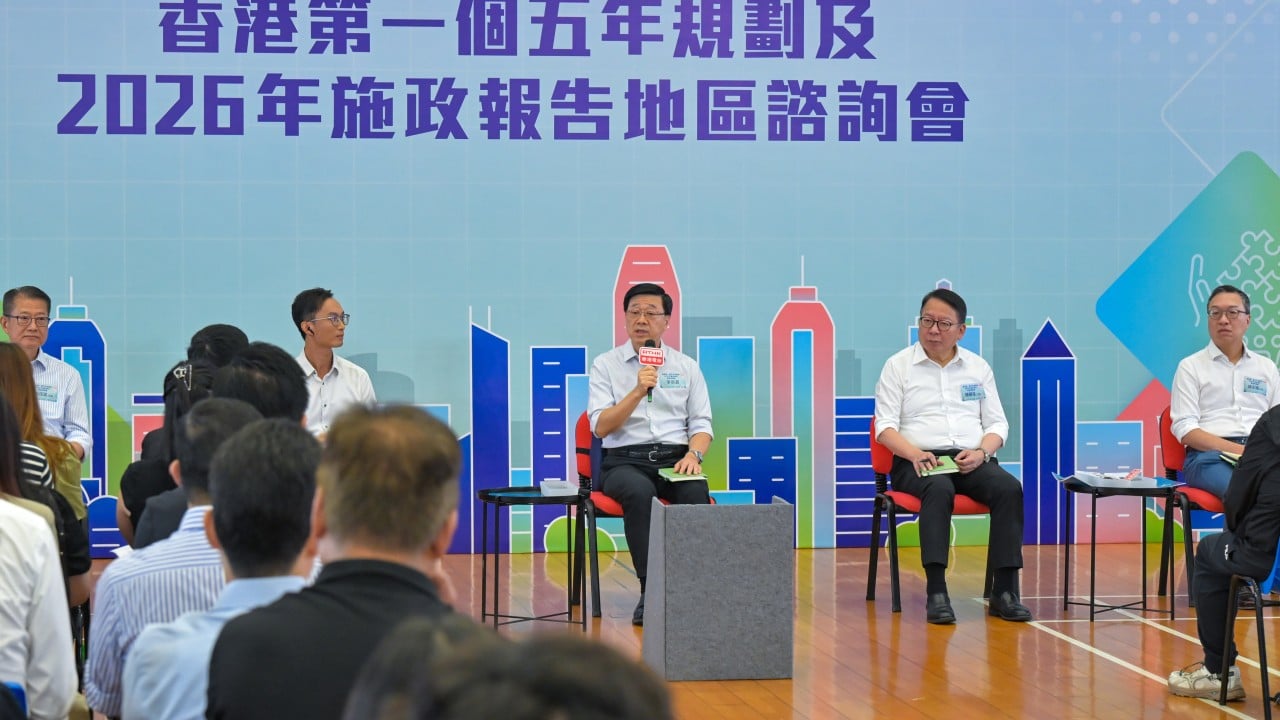
Chief Executive John Lee’s push to institute Hong Kong’s first-ever formal medium-term development blueprint alongside his annual policy addresses represents a profound structural shift for a territory historically defined by reactive governance. For decades, the local administration operated under a loose framework of short-term budgeting and annual policy targets, largely leaving macro-economic transformation to the whim of external market cycles. Now, as the city faces intense regional competition, shifting geopolitical currents, and the imperative to tightly integrate with national strategies like the 15th Five-Year Plan, that administrative comfort zone is officially closed.
The core mechanics of this strategy require balancing two distinct gears. On one side sits the macro blueprint, mapping out where the city intends to stand in five years. On the other side rests the annual policy address, translating those long-term goals into immediate execution milestones. Critics wonder if introducing a rigid planning layer will choke the financial hub's historic agility. Officials argue the exact opposite. They maintain that without a rigid destination, annual policy measures risk becoming disjointed firefighting exercises rather than steps toward structural renewal.
The Structural Anatomy of Medium-Term Planning
To understand why this shift matters, look past the political rhetoric and examine the mechanics of public administration in the Special Administrative Region. Historically, the executive branch relied on annual policy addresses to signal shifts in priorities, housing targets, and financial injections. If property markets slumped or capital outflows accelerated, the government adjusted its annual posture on the fly.
This short-term bias created blind spots. Major infrastructure projects, such as the Northern Metropolis or large-scale technological ecosystem build-outs, require multi-year capital allocation, talent pipeline generation, and regulatory overhauls that span multiple political cycles.
- Annual policy addresses set the immediate administrative task list.
- Medium-term blueprints establish fixed strategic positioning for international competitiveness.
- Advisory councils like the Chief Executive's Council of Advisers provide external validation from global industry leaders.
By instituting a five-year horizon, the administration attempts to bind future policy iterations to a shared trajectory. This relay-style governance model aims to prevent incoming administrations from abandoning complex structural initiatives mid-stream. Yet, binding future leaders introduces its own governance risks. If global capital markets experience a sudden, severe contraction, rigid adherence to a multi-year blueprint could delay necessary fiscal pivots.
Navigating External Headwinds and Traditional Strengths
Hong Kong’s traditional pillars—international finance, logistics, and professional services—no longer generate growth automatically. Regional competitors across Southeast Asia and the Middle East are aggressively courting the same capital, talent, and maritime trade routes that once treated the city as an exclusive gateway.
John Lee’s economic strategy explicitly targets the intersection of traditional financial dominance and emerging technology sectors. The administration is attempting to position the territory as a high-end talent magnet and an international innovation hub while simultaneously expanding commercial ties into markets along the Belt and Road initiative.
Consider the hypothetical challenge of transitioning a traditional trade-dependent enterprise into a digital asset or advanced manufacturing participant. Without state-backed coordination, individual small and medium enterprises lack the risk appetite to pivot entirely during a high-interest-rate environment. The five-year planning framework attempts to bridge this gap by signaling explicit state backing, directing capital resources, and streamlining regulatory approvals for targeted industries.
However, signaling state intent is vastly different from forcing market adoption. Private capital moves according to yield and risk assessment, not government white papers. If regulatory friction or geopolitical compliance hurdles continue to deter international institutional investors, public expenditure alone will not be enough to substitute for missing private liquidity.
The Accountability Test
The ultimate measure of this administrative pivot will not be found in the drafting of the blueprint itself, but in the execution discipline of department heads. Past policy initiatives frequently suffered from implementation bottlenecks at the middle-management level, where bureaucratic inertia often blunted top-down directives.
By tying departmental accountability systems directly to the outcomes outlined in the broader policy framework, the administration is betting that internal institutional reform can overcome historic bureaucratic sluggishness.
The transition from a laissez-faire posture to a proactive, plan-driven governance model marks a profound departure for Hong Kong. Success requires precise synchronization between long-term vision and operational flexibility. The window to prove that this dual-track strategy can deliver sustainable economic renewal is narrowing, and the execution phase will test whether structural planning can coexist with market adaptability
FULL PRESSER: Hong Kong Five Year Plan Unveiled John Lee Speaks on Global Tensions
This briefing details the broader context surrounding the economic policies and global market strategies implemented by the administration.