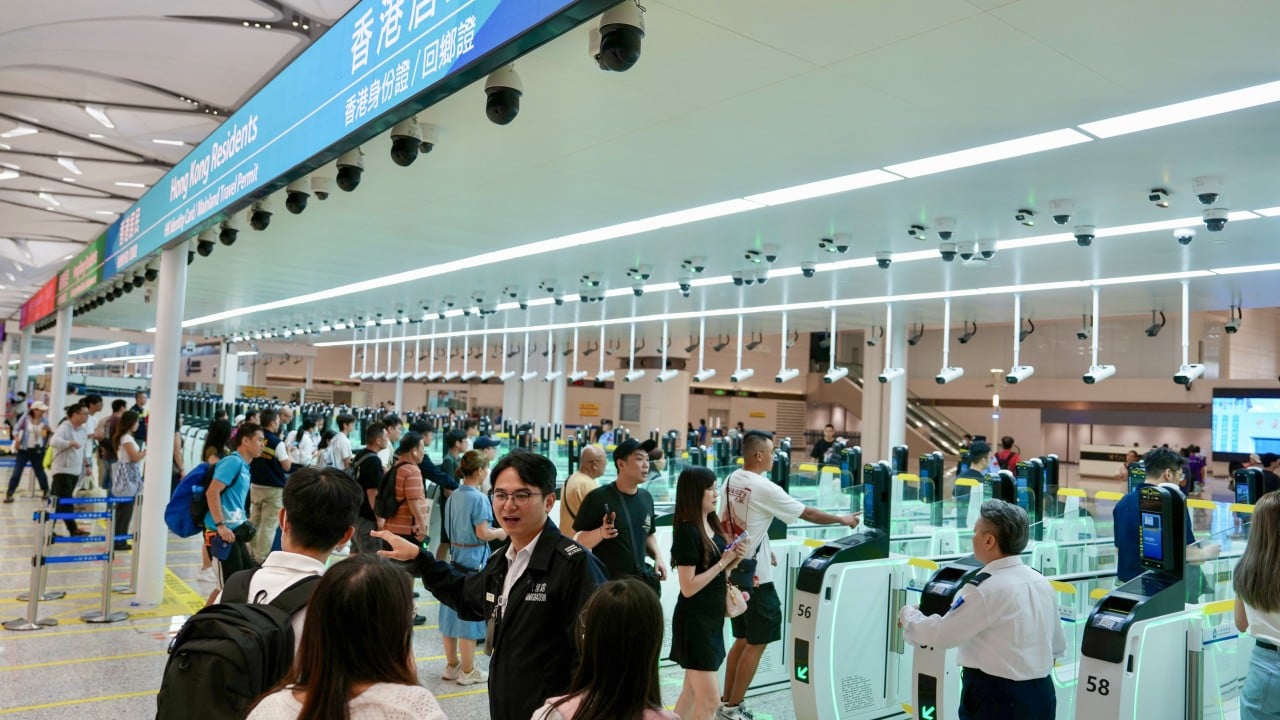
When the redesigned Huanggang Port opened its gates with promises of ultra-fast five-minute clearances, planners envisioned a futuristic artery connecting Hong Kong and Shenzhen. Instead, the modern facility ran face-first into an old and stubborn reality: human behavior during holiday periods. During recent long weekends, daily crossings surged past hundred-thousand marks, leaving travelers stranded in sprawling queues and turning a celebrated transit upgrade into a logistical bottleneck.
The immediate culprit is a familiar regional rhythm. Hundreds of thousands of Hong Kong residents routinely stream northward for weekend leisure, family visits, dining, and retail. Yet, pointing fingers solely at holiday volume ignores the deeper structural mechanics at play. The congestion at Huanggang is not merely a symptom of too many people trying to cross a border on the same day; it is a collision between cutting-edge terminal architecture and legacy transport feeder networks that cannot digest sudden surges.
The Architecture of a Bottleneck
To understand why a facility built for efficiency ends up paralyzed, one must look at how space is allocated outside the inspection counters. The new multi-story joint inspection building utilizes advanced biometric verification and automated e-channels designed to process individuals in seconds. Inside the hall, digital systems hum with precision.
The breakdown occurs the moment travelers step outside those glass doors.
Urban planners often commit a fatal error in transit design: they scale the terminal's internal processing capacity without equally scaling the surrounding road networks and public transport staging areas. Cross-border coaches, private hire vehicles, and local shuttle buses all converge on limited access lanes. When thousands of passengers clear customs simultaneously, they dump into localized staging zones that quickly reach saturation. A traffic queue forming outside forces vehicles to back up, which in turn restricts the arrival of incoming transport, creating a slow-motion ripple effect that paralyzes the entire precinct.
The Psychology of Mass Migration
Technology alone cannot alter the fact that human leisure time is deeply synchronized. Public holidays act as compressed pistons, forcing millions of people to make identical choices within a narrow window of forty-eight hours.
Travelers naturally attempt to optimize their time by heading north early on the first morning of a break and returning late on the final evening. This creates acute micro-peaks. During these hours, even a terminal operating at maximum technical capacity will experience severe queuing because the arrival rate drastically outpaces physical throughput.
Municipal authorities often respond by issuing advisory warnings, urging the public to stagger their journeys or utilize alternative checkpoints like Futian or Shenzhen Bay. Yet, these warnings frequently fall on deaf ears. For the average commuter, the proximity and 24-hour convenience of Huanggang remain an irresistible default. Relying on voluntary dispersal during high-stakes holiday periods is a flawed strategy, as travelers will always gravitate toward the path of least resistance until forced otherwise.
The Broader Greater Bay Area Dilemma
The strain at Huanggang reflects a wider friction point within the development of the Greater Bay Area. As regional integration deepens, policymakers actively encourage hyper-mobility. Cross-border life is marketed as a fluid, frictionless reality where living in one city and working or dining in another is as simple as taking a neighborhood subway ride.
However, infrastructure projects are static investments deployed against a rapidly accelerating dynamic. When regional travel barriers drop, demand does not merely increase linearly; it explodes exponentially. Building bigger ports only invites higher volumes, creating a perpetual race between capacity creation and consumer demand.
Solving chronic holiday congestion requires looking past the customs hall. Real mitigation demands synchronized scheduling of public holidays across jurisdictions, dynamic pricing for cross-border vehicle permits, and decentralized transport hubs that can siphon crowds away from primary arteries before bottlenecks form. Until regional authorities address the entire transit ecosystem rather than individual checkpoints, modern ports will continue to buckle under the weight of their own convenience.