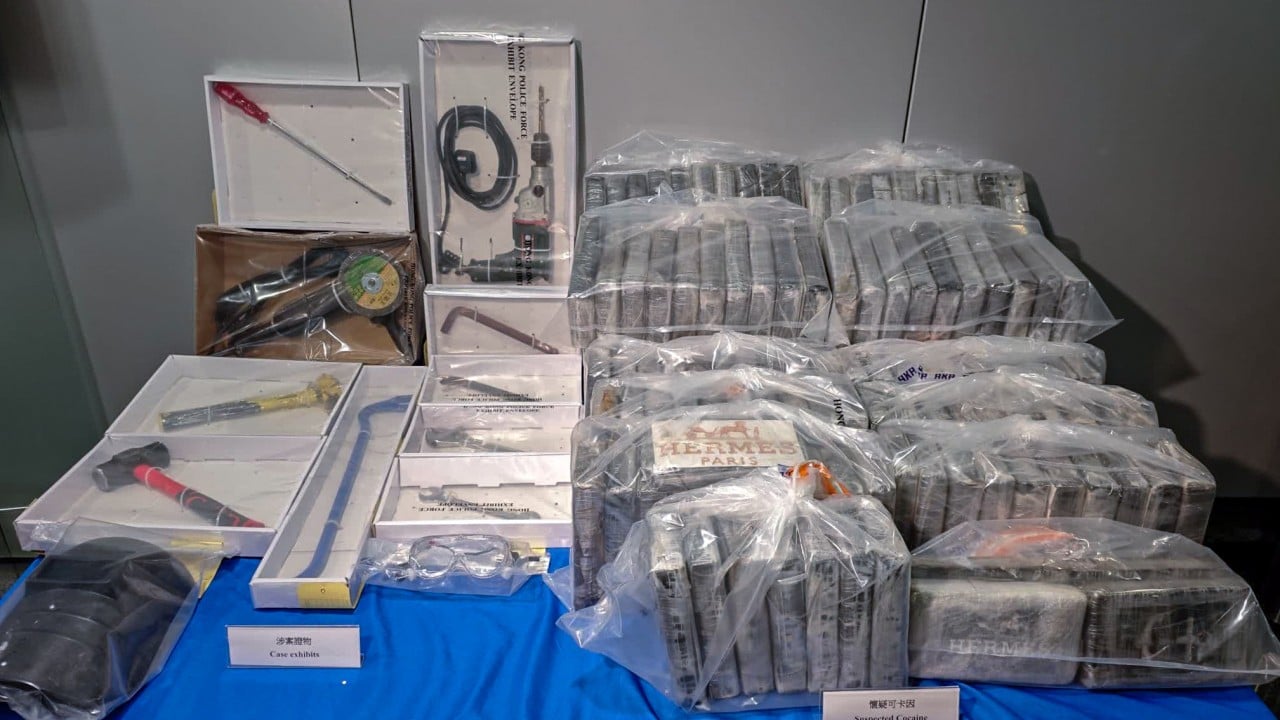
Hong Kong law enforcement recently intercepted a massive HK$128 million shipment of cocaine welded deep inside three-tonne industrial metal containers. Narcotics Bureau officers raided a remote warehouse in Yuen Long, arresting three men who were actively using industrial blowtorches to cut open the heavily shielded structures. This seizure of 172 kilograms of high-purity cocaine exposes a critical shift in how transnational cartels are breaching Asia's most secure ports. The standard customs checks are failing against these new, heavy-industrial concealment techniques.
For decades, international drug syndicates relied on relatively simple concealment methods to smuggle narcotics through global shipping channels. They hid bricks of cocaine inside shipments of frozen fruit, hollowed out timber logs, or stuffed them into the false bottoms of commercial luggage. Those days are gone. Today, the maritime smuggling industry has evolved into a highly sophisticated logistics operation that mirrors the legitimate heavy manufacturing sector.
The Yuen Long bust highlights a terrifying progression in criminal engineering. The narcotics were not merely hidden. They were entombed within massive, multi-tonne blocks of solid steel that required heavy industrial machinery to fabricate and gas-powered cutting tools to open. By lining these containers with specialized material designed to block X-ray penetration, the perpetrators successfully neutralized the primary defensive weapon used by modern port authorities.
Industrial Warfare on the New Silk Road
The sheer scale of the engineering involved in this shipment points directly to the involvement of ultra-wealthy South American cartels cooperating with entrenched local Triad networks. Fabricating a three-tonne metal container with internal lead or dense alloy lining requires a fully operational foundry or an advanced industrial workshop. This is not the work of amateur street dealers. It represents a massive capital investment by syndicates who view a million-dollar fabrication cost as a minor business expense.
A typical port container terminal processes thousands of steel boxes every single day. Security forces face an impossible mathematical challenge when trying to scan and inspect this endless deluge of steel. Customs officials rely heavily on automated large-scale X-ray imaging systems to peer inside containers without slowing down the global supply chain. The cartels know this. By wrapping cocaine blocks in multiple layers of heavy metal shielding, smugglers create a blind spot directly within the machinery meant to catch them.
When an X-ray scanner hits a heavily shielded object, the density of the material absorbs the radiation completely. On the operator's monitor, the object appears merely as a solid, impenetrable black mass, often indistinguishable from legitimate heavy industrial machinery like electrical transformers, generator parts, or solid engine blocks. If the manifest claims the container holds a three-tonne industrial component, the port inspector has little reason to question the solid black silhouette on their screen. The system is systematically exploited by the very nature of modern commerce.
Inside the Yuen Long Warehouse Raid
The tactical operation that brought down the Yuen Long network reveals the extreme physical dangers now associated with anti-narcotics enforcement. Acting on precise intelligence, undercover officers descended on a corrugated iron warehouse situated in a rural, poorly policed sector of the New Territories. Inside, they discovered a makeshift industrial workshop filled with hazardous materials. Three local men, aged between 28 and 35, were caught red-handed surrounded by heavy machinery and compressed gas tanks.
The suspects were using high-heat thermal cutting torches to slice through the thick metal shells enclosing the narcotics. This process generated immense heat and toxic fumes within an unventilated space. Law enforcement officials later expressed severe alarm over the complete lack of safety protocols inside the facility. A single spark hitting the compressed gas cylinders could have triggered an explosion powerful enough to level the entire warehouse and kill everyone inside, including nearby residents.
The profile of the arrested individuals fits a well-worn pattern in the global drug trade. They were foot soldiers. These young men were hired to do the dangerous, back-breaking labor of extracting the cargo, acting as a buffer for the high-level organizers who remain insulated from the physical risks of the operation. They face life imprisonment under Hong Kong law, yet their removal does little to disrupt the leadership hierarchy of the syndicate that employed them.
The Shift From West to East
The arrival of such a vast quantity of high-purity cocaine reflects a broader structural realignment in international drug trafficking. Historically, Hong Kong was primarily a consumption and transit market for Southeast Asian heroin and regional synthetic drugs like methamphetamine or ketamine. Cocaine was considered an expensive luxury item with a limited local footprint. That dynamic has changed completely as South American production levels reach historic highs.
The markets of North America and Western Europe are completely saturated. Prices have stabilized, and profits, while still enormous, have hit a ceiling due to intense law enforcement pressure and mature market conditions. Asia represents the new frontier for the multi-billion-dollar drug cartels. In cities like Hong Kong, Tokyo, and Sydney, a single kilogram of high-purity cocaine commands a street value three to four times higher than it does in New York or London.
Hong Kong occupies a dangerous position as the ultimate logistical gateway to this lucrative playground. The city boasts one of the busiest deep-water container ports in the world, coupled with an ultra-efficient customs system designed to facilitate rapid trade. The syndicates are not targeting Hong Kong solely for its domestic users. They are using the city's unparalleled maritime infrastructure to receive bulk shipments, break them down in remote rural warehouses, and then distribute smaller quantities across the Asia Pacific region.
| Region | Estimated Street Value per Kilogram (USD) | Primary Traffic Routes |
|---|---|---|
| North America | $28,000 - $35,000 | Overland via Central America |
| Western Europe | $40,000 - $50,000 | Transatlantic maritime freight |
| East Asia (Hong Kong Hub) | $90,000 - $120,000 | Transpacific heavy industrial cargo |
The Structural Illusion of Port Security
The public is frequently reassured by statements detailing the advanced technology deployed at international border checkpoints. We are told that radiation portals, automated license plate readers, and artificial intelligence algorithms protect our borders from illicit contraband. This is a comforting illusion. The reality on the ground is that technology is only as good as the physical laws it operates under, and those laws can be manipulated by anyone with an angle grinder and a sheet of lead.
When a cartel uses a three-tonne metal container to hide drugs, they are exploiting the inherent weaknesses of non-intrusive inspection technology. To truly verify the contents of that container without prior intelligence, customs officers would have to unseal the box, bring in heavy-duty cranes, and spend hours using industrial tools to cut the metal apart. Doing this for every suspicious shipment would bring the entire global economy to an absolute standstill within forty-eight hours.
[Port Entry] ---> [X-Ray Scan] ---> [Shielded Black Mass Image] ---> [Matches Manifest?]
                                                                             |
     +-----------------------------------------------------------------------+
     |
     v
[Passed as Industrial Gear] ---> [Transport to Hidden Warehouse] ---> [Industrial Extraction]
The cartels understand the economic pressure under which port authorities operate. They know that speed is the lifeblood of global trade, and they use that economic reality as a shield. The Yuen Long operation succeeded not because a machine caught the anomaly, but because human intelligence pierced the veil of the syndicate's operational security. Without informants, wiretaps, and deep financial tracking, these industrial containers walk right through the front door of the city completely undetected.
The Evolution of Local Syndicates
The logistics of receiving a three-tonne industrial component requires local infrastructure that goes far beyond the capabilities of a traditional street gang. It requires legitimate front companies, registered freight forwarders, and corrupt compliance officers who can forge shipping manifests and customs declarations. Local triads have transformed themselves from violent turf-war factions into sophisticated white-collar logistics operators.
These local networks handle the complex paperwork required to import heavy machinery from South America. They rent the remote warehouses in the New Territories under shell companies, arrange for heavy flatbed trucks to transport the containers from the docks, and recruit the specialized labor needed to operate industrial cutting machinery. The intersection of legitimate maritime commerce and transnational organized crime has become so blurred that distinguishing between the two is now the greatest challenge facing modern investigators.
This integration into the legitimate economy makes asset recovery and prosecution incredibly difficult. The money generated from these shipments does not sit in duffel bags under a bed. It flows through underground banking networks, trade-based money laundering schemes, and complex real estate investments across Southeast Asia. By the time the police raid a warehouse and seize the physical drugs, the capital that financed the shipment has already been cleaned and reinvested into legitimate businesses.
The Failure of Current Interdiction Strategies
The traditional strategy of measuring law enforcement success by the volume of narcotics seized is fundamentally flawed. A 172-kilogram bust is undeniably a significant blow to the specific cell that coordinated the shipment, but to the broader transnational organization, it is merely an anticipated cost of doing business. The cartels operate with profit margins that exceed ninety percent, allowing them to absorb massive losses while remaining extraordinarily profitable.
If law enforcement agencies continue to focus their energy on the physical interdiction of drugs at the border, they will remain trapped in an endless loop of reactive policing. The syndicates will simply adapt their engineering methods, finding even denser materials or more creative industrial disguises to shield their cargo. The only way to disrupt these networks is to shift the target away from the physical commodity and toward the structural pillars that support the trade.
This means targeting the specialized engineers who design the shielding, the corrupt port officials who facilitate the entry of unverified heavy cargo, and the financial institutions that look the other way when millions of dollars move through their systems. Until international law enforcement addresses the industrial and financial infrastructure that enables this high-volume trafficking, heavy metal containers filled with poison will continue to slide quietly through the global supply chain. The battle is no longer being fought on the streets by traditional drug dealers, but on the high seas and inside industrial shipyards by criminal syndicates operating with the efficiency of multinational corporations.