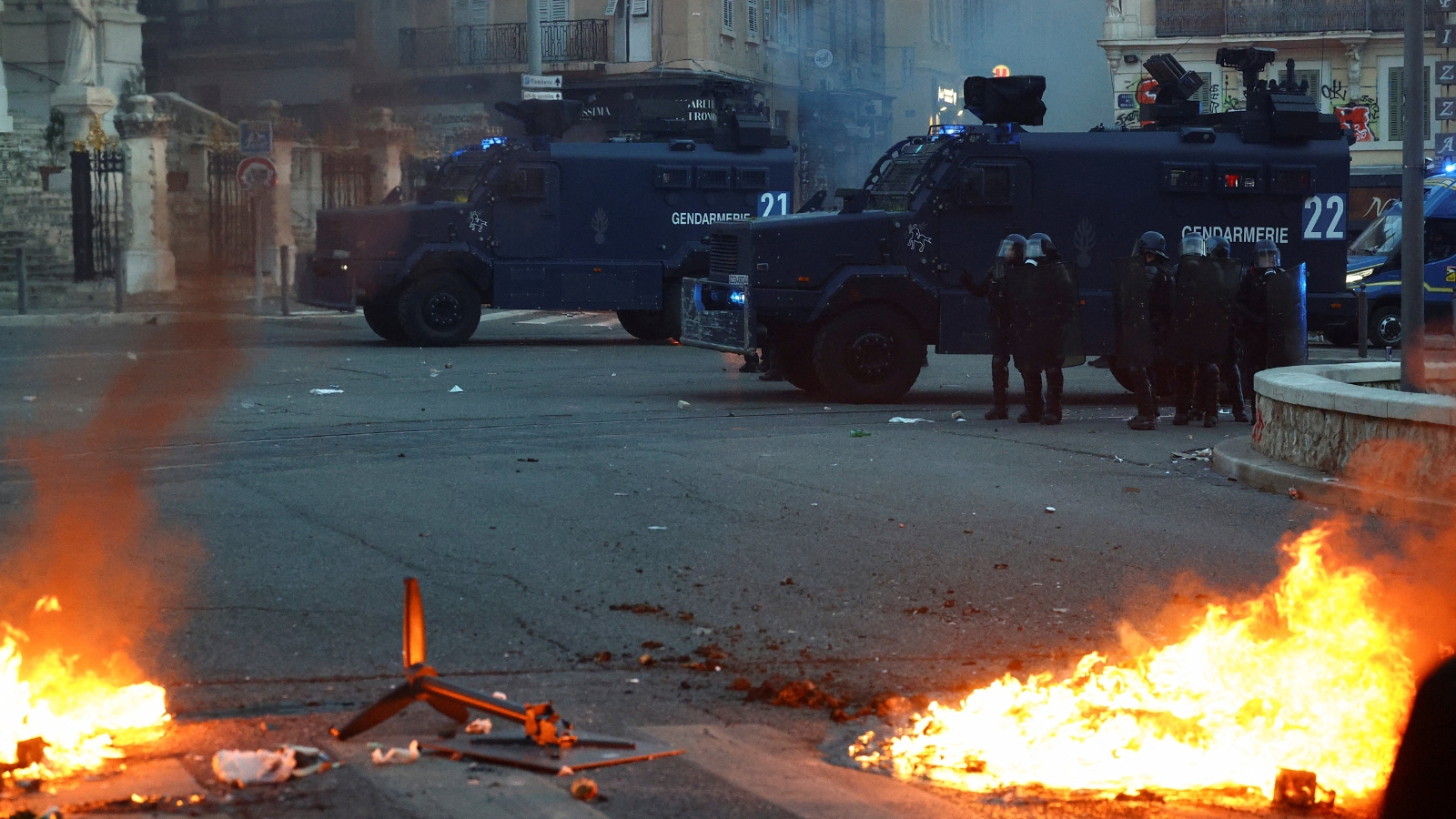
Hundreds of thousands of demonstrators flooded the boulevards of Paris, Lyon, Marseille, and Bordeaux, turning routine labor marches into running street battles with riot police. While surface-level breaking news reports fixated on the 400,000-person turnout, burning barricades, and clouds of tear gas, the real story lies beneath the broken glass. These France protests are not an isolated eruption of anger over a single piece of legislation or budget cut. They represent the predictable, structural collision between an executive branch determined to enforce fiscal austerity and a working class watching its purchasing power evaporate.
If you have covered European labor movements for any length of time, the choreography on the streets of Paris feels grimly familiar. Yet the underlying mechanics driving citizens onto the pavement have shifted. The traditional buffers that once absorbed public fury—strong union mediation, municipal safety nets, and predictable wage growth—have eroded. When institutional channels fail to register public pain, the street becomes the only functioning parliament left.
The Anatomy of the 400,000-Strong Mobilization
Numbers in French street demonstrations are always a battlefield of their own. Trade unions routinely publish figures double or triple those released by the Interior Ministry, and independent counting firms often land somewhere in the middle. Regardless of whether the true headcount sat at 350,000 or crossed the 400,000 threshold across regional hubs, the geographic spread tells the real story.
Protests concentrated solely in central Paris can be dismissed by technocrats as the work of professional agitators or narrow urban interest groups. That excuse evaporates when mid-sized industrial towns and agricultural centers see simultaneous shutdowns. From dockworkers in Le Havre to rail operators in Toulouse and teachers in Nantes, the mobilization cut across traditional demographic and class lines.
Why Peaceful Marches Fracture Into Violence
Mainstream headlines love the phrase "protests turn violent" because it implies a sudden, inexplicable madness taking over a crowd. That framing is lazy. On the ground, the escalation follows a distinct, recognizable pattern involving three separate actors.
First, there is the cortège de tête—the vanguard of the march. Historically, major trade unions like the CGT and CFDT policed the front of their own demonstrations with dedicated stewards. Over the last decade, radicalized youth, anti-capitalist groups, and loose networks of black bloc militants have seized that front-line real estate. Their objective is not to negotiate a better collective bargaining agreement; it is to provoke a state response that delegitimizes the government.
Second, there is the doctrine of maintien de l'ordre (public order policing). Unlike policing models in Northern Europe that prioritize de-escalation and dialogue, French crowd control relies heavily on territorial containment and aggressive dispersal. Units like the CRS and the motorized BRAV-M squads use tear gas, stun grenades, and baton charges to break up crowds before they reach sensitive government ministries. When tear gas blankets a tightly packed avenue, peaceful families and retirees panic, creating crush hazards and trapping non-violent demonstrators between advancing police lines and retreating militants.
Third, opportunistic looting occurs on the periphery once police resources are tied down in static clashes. By the time evening news broadcasts air footage of smashed bank windows and burning municipal bins, the original grievance of the 400,000 peaceful marchers has been entirely erased from the public conversation.
Economic Compression and the Illusion of Reform
To understand why ordinary civil servants, nurses, and factory workers are willing to risk inhaling tear gas, you have to look at the household balance sheet. France maintains one of the highest tax-to-GDP ratios in the developed world, coupled with a sprawling welfare state. For decades, the implicit bargain was simple: citizens accepted heavy taxation and rigid labor markets in exchange for ironclad social protections, affordable healthcare, subsidized energy, and a dignified retirement.
That bargain is fracturing under the weight of sovereign debt and sluggish productivity.
Successive administrations in the Élysée Palace have tried to square an impossible circle. Facing pressure from bond markets and European Union fiscal rules to rein in budget deficits, Paris has turned to supply-side reforms. Raising the retirement age, tightening unemployment insurance eligibility, and freezing public-sector wage scales are standard prescriptions from the orthodox economic playbook.
To an economist sitting in Brussels or Frankfurt, these adjustments look like necessary housekeeping. To a regional hospital worker in Brittany or a logistics driver outside Lyon, they look like unilateral theft. Inflation in food and energy costs has already eaten through nominal wage gains. When the state simultaneously asks workers to labor longer for smaller relative payouts while cutting public services, anger ceases to be ideological. It becomes personal.
The Regional Divide Nobody Measures
A critical blind spot in international coverage of France protests is the assumption that Paris dictates the national mood. In reality, the fiercest resentment brews in la France périphérique—the semi-rural towns, outer suburbs, and former manufacturing belts located far from the economic engines of the major metropolises.
In central Paris, public transit is dense, wages are higher, and the service economy absorbs shocks. Thirty miles outside any major city, a personal vehicle is a survival tool, not a luxury. Fuel taxes, low-emission urban driving zones, and the closure of local post offices, maternity wards, and train stations hit these communities directly. When residents of peripheral towns travel hours by bus to join regional protests, they are not marching over abstract political theory. They are protesting their own slow erasure from the national economy.
Executive Power and the Democratic Deficit
Why does political disagreement in France so reliably spill into violent street confrontation rather than resolving itself inside the National Assembly? The answer lies in the architecture of the Fifth Republic.
Drafted in 1958 to end chronic parliamentary instability, the French constitution grants extraordinary executive authority to the presidency. Through mechanisms like Article 49.3, a prime minister can push legislation through parliament without a direct vote, effectively daring the opposition to pass a motion of no confidence and trigger snap elections.
This constitutional design was built for an era of strong, stable two-party majorities. In a fragmented political landscape split between a centrist bloc, a fractured left-wing alliance, and a surging nationalist right, executive bypass mechanisms act like a pressure cooker with a welded shut safety valve.
When voters watch legislation pass without a parliamentary majority, the legitimacy of the law collapses before the ink dries. Unions lose their leverage at the negotiating table because the government knows it can simply decree its preferred outcome. Left with no institutional veto power, labor federations fall back on their only remaining weapon: economic disruption through mass strikes and street blockades.
The High Cost of Containment Policing
Every major flare-up on the streets of Paris triggers an immediate political debate over police tactics. Interior Ministry officials routinely defend their officers, pointing to hundreds of injured personnel struck by paving stones, fireworks, and Molotov cocktails. Those injuries are real, and the physical toll on rank-and-file officers deployed weekend after weekend is severe.
At the same time, human rights observers, legal associations, and European institutions have repeatedly flagged the disproportionate use of force by French riot units. The deployment of intermediate weapons—such as sting-ball grenades and kinetic impact projectiles—has resulted in severe, life-altering injuries to demonstrators and journalists alike.
The deeper problem is strategic. Aggressive containment policing creates a self-fulfilling prophecy. Anticipating violent clashes, moderate citizens stay home, shrinking the peaceful core of the protest movement. Those who remain are younger, angrier, and better prepared for confrontation. The state wins the tactical battle to clear a boulevard by nightfall, while losing the broader strategic battle for public trust.
What the Headlines Miss About Strike Resilience
A common misconception outside France is that mass protests automatically bring the entire country to a halt. In truth, modern French labor actions are highly targeted.
Private-sector union membership in France hovers near the bottom of OECD rankings, sitting below ten percent. You rarely see sustained, indefinite strikes inside private tech firms, retail chains, or financial institutions. Instead, power is concentrated in strategic chokepoints:
- Energy and Refineries: A small number of operators at fuel depots and nuclear power plants can create nationwide supply bottlenecks within days.
- Transportation Networks: Rail workers (SNCF) and urban transit operators (RATP) hold the power to disrupt commuter flows for millions of daily workers.
- Waste Management and Ports: Municipal sanitation strikes in Paris generate immediate visual chaos, while port blockades choke import-export supply chains.
Because strike days are unpaid, sustained mobilization requires deep financial stamina from individual workers. Unions rely on caisses de grève (strike funds) fed by public donations to subsidize lost wages. When a movement sustains turnout across multiple weeks despite lost paychecks, it signals a depth of grievance that cannot be waited out by simply letting the news cycle move on.
The Ripple Effect Across European Markets
Investors and policymakers across Europe watch French street protests with quiet anxiety. France is the eurozone's second-largest economy, and its ability to reform its labor market and stabilize its public finances is viewed as a bellwether for the broader bloc.
Each day of transport paralysis, refinery blockades, and retail closures shaves fractions of a percentage point off quarterly GDP growth. Tourism—a vital pillar of the French economy—takes an immediate hit when international travelers see footage of burning barricades near iconic landmarks. More importantly, prolonged civil unrest signals to bond markets that structural fiscal consolidation may be politically impossible. If Paris cannot pass modest spending adjustments without triggering nationwide riots, doubts inevitably grow over how the country will manage its debt load when interest rates remain elevated.
How This Cycle Actually Ends
History shows that French protest movements rarely end with a dramatic capitulation by either side. The government almost never withdraws flagship legislation outright once it has staked its political credibility on passage. Conversely, the street cannot maintain peak mobilization indefinitely against the financial attrition of unpaid strike days.
Instead, the confrontation typically grinds down through a combination of police exhaustion, union fragmentation, and quiet behind-the-scenes concessions. Minor adjustments are tucked into secondary decrees. Targeted wage bonuses are offered to specific sectors like rail workers or teachers to peel them away from the broader coalition. The barricades are cleared, the broken glass is swept up, and the immediate crisis fades from the front pages.
Yet nothing in the underlying equation has changed. The structural mismatch between what the French state promises its citizens and what its economy can actually afford remains unresolved. Until Paris finds a way to rebuild democratic consensus rather than governing by executive decree and tear gas, the calm that follows every cleared boulevard is merely an intermission before the next march begins.