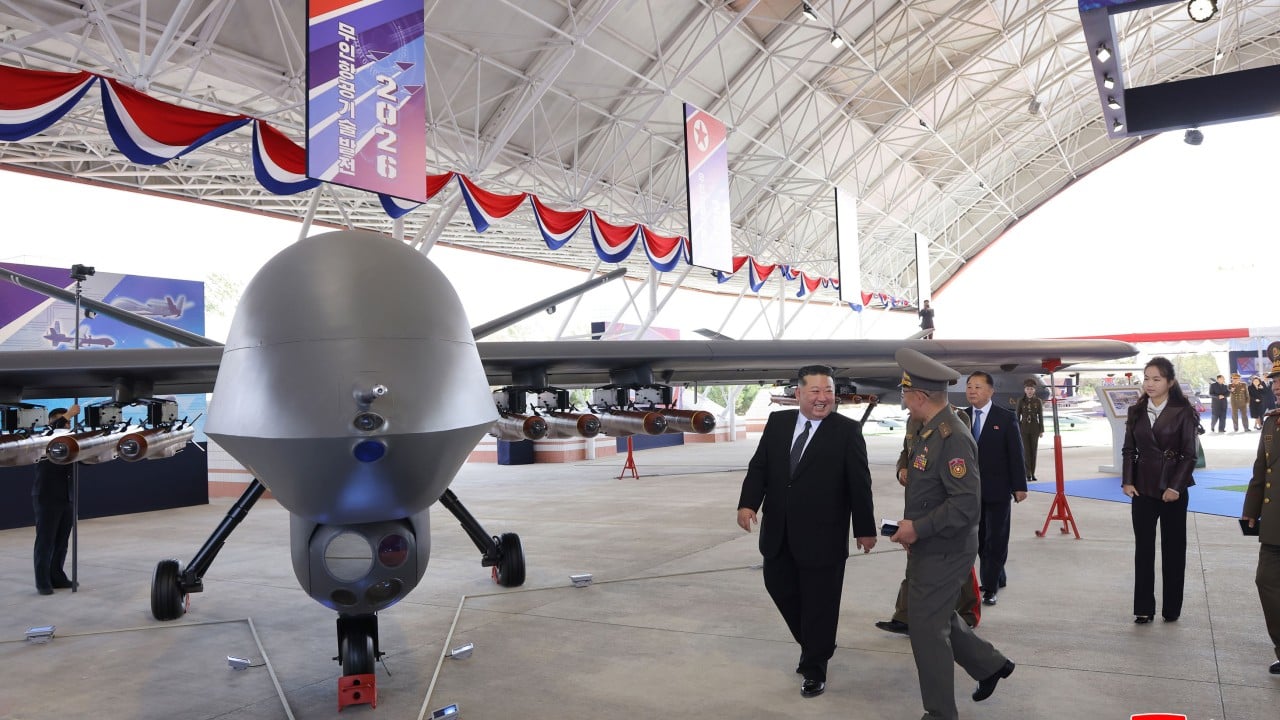
North Korea is flooding the Korean Peninsula with dirt-cheap, off-the-shelf drones, exposing a massive structural flaw in South Korea's high-tech military apparatus. While Pyongyang operates with agile, consequence-free improvisation using commercial parts and basic composites, Seoul's defense sector remains trapped in a multi-year procurement cycle governed by rigid safety regulations, strict airspace laws, and risk-averse bureaucracy. The result is an asymmetric mismatch where million-dollar interceptors and tangled approval chains are failing to counter thousand-dollar aerial threats.
For decades, South Korea built its military doctrine around deterring a conventional armored invasion or a ballistic missile barrage. The defense establishment poured billions into massive hardware platforms, stealth fighters, and complex radar arrays designed to track high-altitude threats. Then came December 2022. Five North Korean unmanned aerial vehicles crossed the Military Demarcation Line, with one flying directly into the restricted airspace over northern Seoul near the presidential office. South Korea scrambled fighter jets, attack helicopters, and fired roughly a hundred rounds from 20mm cannons. Not a single drone was shot down. One light attack aircraft even crashed during the response. For a more detailed analysis into similar topics, we suggest: this related article.
That incident was a wake-up call, yet the systemic machinery in Seoul continues to grind at a glacial pace. To understand why South Korea is struggling to match the speed of North Korean drone innovation, you have to look beyond the radar screens and examine the regulatory and industrial architecture holding back South Korean engineers.
The Anatomy of Asymmetric Airpower
Modern drone warfare is no longer about multi-million-dollar Predator variants operated via satellite links from half a world away. The real threat on the Korean Peninsula mirrors what has unfolded in Eastern Europe and the Middle East. It is defined by attritable mass—cheap, expendable airframes built from commercial off-the-shelf components, styrofoam, carbon fiber tubes, and small hobbyist engines. For broader context on this topic, extensive reporting is available at Al Jazeera.
North Korea understands this economics of warfare instinctively. Under severe international sanctions, Pyongyang cannot build fifth-generation fighter jets or modern naval destroyers. Instead, it has leaned into low-cost unmanned systems that bypass traditional defense economics. A basic reconnaissance or loitering munition drone built with smuggled commercial electronics, a standard Japanese or Chinese civilian engine, and a simple GPS module costs a few thousand dollars to assemble.
When you launch a swarm of fifty such systems, the defender faces a mathematical nightmare. South Korea's air defense network was engineered to detect fast, large metal objects with significant radar cross-sections. A small, slow-moving drone made of composite foam flying at low altitudes blends seamlessly into ground clutter and flocks of birds. Even when radar operators manage to isolate the target, engaging it with traditional surface-to-air missiles means firing a weapon worth hundreds of thousands—or millions—of dollars at a flying piece of plastic worth less than a used sedan.
Pyongyang has also demonstrated a willingness to iterate rapidly in the field. Because the regime answers to no civilian aviation authority, no environmental impact boards, and no safety committees, North Korean engineers can test, crash, modify, and redeploy airframes in a matter of weeks. Kim Jong Un has personally overseen tests of suicide drones and reconnaissance platforms, ordering mass production without waiting for five-year feasibility studies.
How Seoul Regulated Itself Out of the Sky
South Korea possesses one of the most advanced electronics, battery, and manufacturing ecosystems on the planet. Companies in Suwon, Pangyo, and Daejeon produce the world's finest semiconductors, sensors, and electric motors. On paper, South Korea should be the undisputed global superpower in unmanned aerial systems.
In reality, the country's domestic drone industry is suffocating under a blanket of well-intentioned but paralyzing regulations.
Consider the Aviation Safety Act and strict national security laws governing South Korean airspace. Because the country remains technically at war with the North, massive swaths of the peninsula are designated as no-fly zones or restricted airspace. For a South Korean startup or defense contractor to test a new autonomous flight algorithm or a long-range drone prototype, they cannot simply walk out to an open field and launch it. They must apply for flight clearances through multiple ministries, including the Ministry of Land, Infrastructure and Transport and the Ministry of National Defense.
Approval for a single test flight can take weeks. If the drone weighs over a certain threshold, carries specific optical sensors, or operates beyond visual line of sight, the paperwork multiplies. Recording aerial imagery requires separate security clearances to ensure sensitive military installations are not inadvertently captured. By the time a South Korean engineering team receives permission to test a firmware update, a rival team operating without red tape has already gone through ten iterations.
The Procurement Straitjacket
The bottleneck becomes even tighter when private innovators try to sell hardware to the South Korean military. The Defense Acquisition Program Administration (DAPA) operates on a procurement model built for ships, tanks, and artillery systems—platforms expected to last thirty years.
In the DAPA ecosystem, every component must undergo exhaustive validation, environmental stress testing, and bureaucratic sign-offs before a contract is awarded. This process routinely stretches from three to seven years. In the world of small unmanned aerial systems, a three-year development cycle is an eternity. A drone designed in 2023 and delivered in 2026 is obsolete before it leaves the shipping crate, because radio frequencies, electronic warfare countermeasures, and autonomous navigation software evolve every few months.
Furthermore, South Korean procurement rules heavily penalize failure. If a military official greenlights an experimental drone project and the prototype crashes during testing, that official faces career-ending audits and potential disciplinary action for wasting taxpayer money. The institutional culture rewards procedural compliance over operational speed. As a result, procurement officers gravitate toward established defense conglomerates—the chaebols—that know how to navigate the paperwork, rather than agile startups that actually understand rapid software-driven hardware development.
The Electronic Warfare Blind Spot
Even if South Korea clears its regulatory hurdles and builds thousands of drones tomorrow, a massive technical vulnerability remains on the battlefield. Most commercial and low-cost military drones rely on two external signals to function: radio frequency (RF) links for operator control and Global Navigation Satellite Systems (GNSS), such as GPS, for positioning.
Both are dangerously fragile on the Korean Peninsula.
North Korea has spent decades investing heavily in electronic warfare (EW) capabilities, fielding truck-mounted jammers along the Demilitarized Zone capable of blanketing the Seoul metropolitan area in radio noise. During several periods in recent years, Pyongyang has conducted sustained GPS jamming campaigns that disrupted civilian airliners and fishing vessels across the Yellow Sea.
If South Korea fields a fleet of drones that depend on uninterrupted satellite navigation or standard wireless frequencies, North Korean jammers can sever their links the moment they cross the border. A drone that loses its GPS signal without an alternative navigation method will either drift off course, hover helplessly until its battery dies, or fall straight out of the sky.
Countering this requires shifting away from remote-controlled aircraft toward true edge autonomy. A drone operating in a contested electronic environment must navigate using onboard visual odometry—comparing live camera feeds against pre-loaded terrain maps—and inertial measurement units that require zero external signals. It must use onboard artificial intelligence to identify, track, and engage targets independently if communications are cut.
Developing that level of machine vision and edge computing requires millions of hours of real-world flight data across varying weather conditions, terrains, and lighting environments. Yet South Korea's strict privacy laws, mapping restrictions, and flight bans make collecting that exact training data extraordinarily difficult within its own borders.
The Counter-Drone Trap
When policymakers discuss fixing the drone gap, the conversation usually defaults to buying more counter-drone systems. Following the 2022 incursions, Seoul established a dedicated Drone Operations Command and accelerated purchases of laser weapons, electronic jammers, and net-shooting interceptors.
While necessary, relying purely on defensive countermeasures is a losing strategy. Defense is always more expensive than offense in unmanned warfare.
Consider the physics and economics of directed-energy weapons, such as South Korea's Block-I laser system. Lasers offer a cheap cost-per-shot—essentially the price of the electricity required to fire the beam. However, lasers require clear line-of-sight, struggle in heavy rain, fog, or dust, and can only engage one target at a time for several seconds until the drone's airframe melts or ignites. If an adversary launches fifty low-cost drones simultaneously from multiple directions, a single laser battery is instantly overwhelmed.
Kinetic interceptors—drones designed to ram enemy drones out of the sky—offer better all-weather performance, yet they still require a massive sensor network to detect incoming threats early enough to launch. Putting radar and acoustic sensors on every high-rise building in Seoul and along every ridge of the 155-mile border demands staggering capital expenditure and maintenance manpower.
You cannot build an impenetrable dome against cheap, low-flying objects. The only viable deterrence is symmetrical capability—the ability to flood the adversary's airspace with an overwhelming, autonomous, low-cost unmanned force of your own.
What Breaking the Bottleneck Actually Requires
If South Korea wants to turn its world-class tech sector into a genuine asymmetric shield, incremental policy tweaks will not suffice. The defense establishment has to fundamentally separate small unmanned systems from traditional heavy weapons acquisition.
First, Seoul needs dedicated regulatory sandboxes—physical zones where accredited defense startups and researchers can fly autonomous drones freely without waiting weeks for multi-ministry permits. Treating a five-kilogram composite drone under the same aviation framework as a commercial passenger aircraft makes zero operational sense. In designated test corridors, innovators must be allowed to fly beyond visual line of sight, test electronic jamming, and collect terrain-mapping data without triggering national security violations.
Second, DAPA must adopt a spiral acquisition model for unmanned systems. Instead of locking in rigid technical specifications for a five-year contract, the military should buy small batches of commercial-grade drones every six months, deploy them to frontline units for aggressive field testing, and feed the failure data directly back to manufacturers for the next production batch. In this model, a crashed prototype is not a procurement scandal; it is a data point.
Third, the defense industry must decouple software from airframes. The true value of modern unmanned systems lies in the flight controller, the anti-jamming navigation stack, and the target-recognition algorithms. If South Korean engineers standardize open-architecture software that can be dropped onto any cheap, locally manufactured airframe—whether built by a major aerospace firm or a small plastics factory—production can scale from hundreds to tens of thousands of units in a crisis.
The Shrinking Window of Deterrence
The geopolitical clock on the Korean Peninsula does not pause for legislative reviews or committee hearings. Every month, North Korean engineers are refining their manufacturing pipelines, bolstered by deeper technical exchanges with Russia and access to battle-tested tactics from ongoing global conflicts. Pyongyang has realized that it does not need to match South Korea's F-35 fighter jets or K2 battle tanks to inflict strategic paralysis; it only needs to exploit the gap between Seoul's slow bureaucracy and the rapid pace of commercial technology.
South Korea has the engineers, the battery supply chains, the semiconductor foundries, and the capital to dominate the future of unmanned warfare. None of those industrial advantages matter if the hardware remains locked inside a testing hangar waiting for a stamp of approval.


