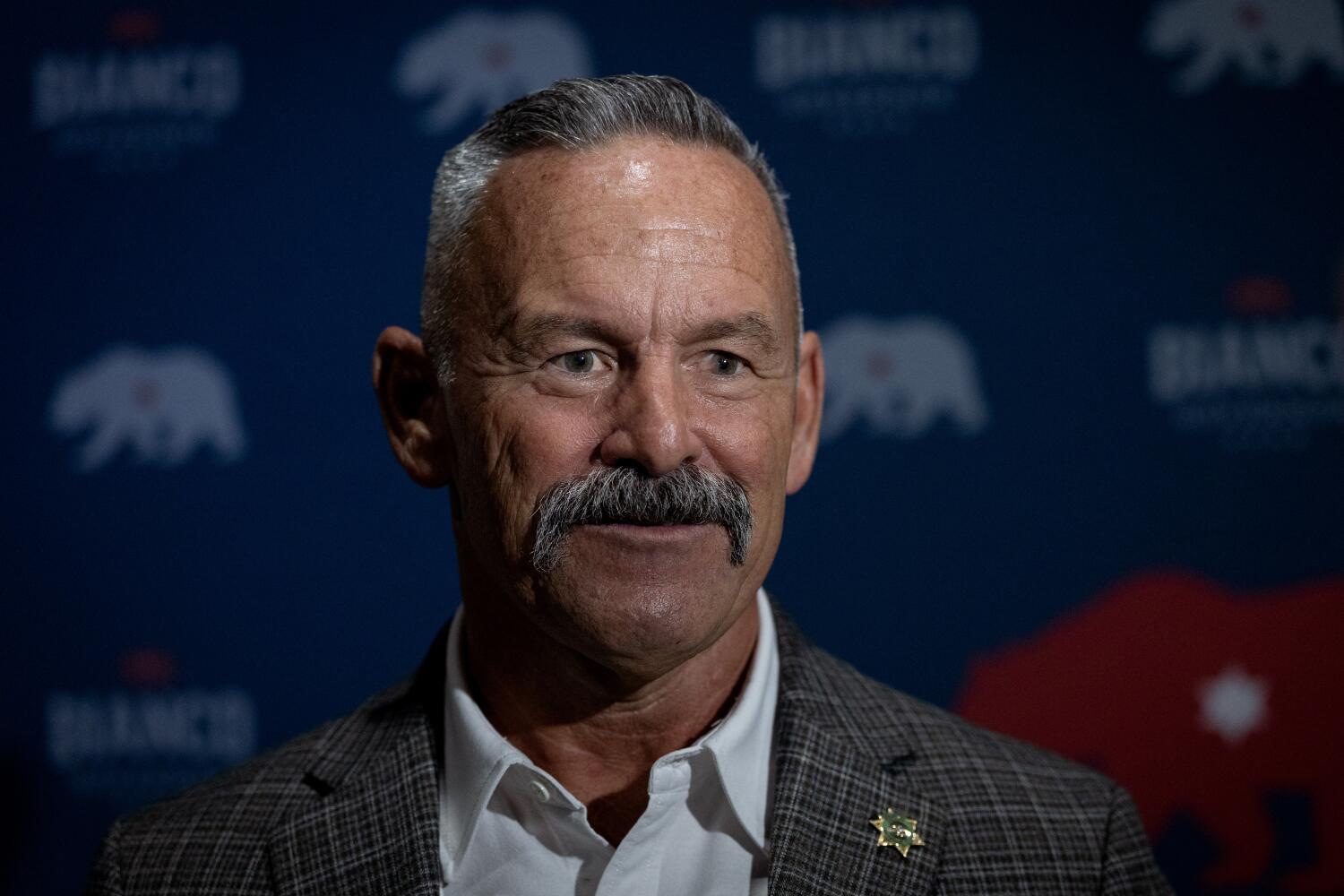
Law enforcement officers take an oath to uphold the statutes of the state, not to bend them into theatrical props for political campaigns. Riverside County Sheriff Chad Bianco has routinely blurred that foundational boundary, transforming his badge into an instrument for partisan performance art. When elected officials trade constitutional duties for headlines, the public interest suffers. Recent legal collisions involving Bianco and his aggressive posture toward state election administration reveal an alarming trend where local power is weaponized for broader ideological ambitions.
Understanding how a county sheriff manages to dominate statewide headlines requires looking past the surface noise of daily news cycles. Bianco has mastered the mechanics of modern political grievance. By positioning himself as a primary antagonist to California's dominant political establishment, he secures a steady stream of media attention. This visibility is currency in contemporary American politics. Every legal setback or judicial rebuke is quickly reframed by his camp as proof of institutional corruption, turning administrative accountability into fuel for his base.
The Mechanics of Performative Policing
The friction between local law enforcement and state judiciary bodies is not new, but Bianco has altered the playbook. Consider a hypothetical scenario where a municipal police chief decides to conduct an independent, unauthorized audit of federal tax returns because of a hunch about municipal embezzlement. That chief would face immediate professional ruin and likely criminal charges for overstepping statutory limits. Yet when Sheriff Bianco opted to seize mail-in ballots under the banner of investigating election fraud, the response was treated as ordinary political theater rather than an extraordinary breach of jurisdictional boundaries.
California Supreme Court justices did not mince words when evaluating the legal logic behind Bianco's ballot seizure, characterizing the rationale as bizarre and entirely lacking statutory grounding. In a functioning constitutional republic, law enforcement agencies operate within strictly defined legal parameters. A badge does not grant a sheriff the authority to freelance as an election inspector general simply because a conspiracy theory gains traction on social media.
This approach relies on a calculated inversion of accountability. When courts strike down unauthorized overreaches, the architects of those policies do not retreat to correct their legal interpretations. Instead, they double down. They leverage the judicial pushback to broadcast a narrative of persecution, convincing supporters that the legal system itself is rigged against ordinary citizens. It is a closed-loop system of political survival where negative outcomes are converted into campaign capital.
The Cost to Institutional Trust
Local governance depends entirely on public trust in foundational institutions. When the top law enforcement officer in a major California county treats judicial rulings as mere suggestions or political opinions, the entire framework of public safety is compromised. Citizens must trust that deputies and sheriffs enforce the law impartially, regardless of political affiliation or personal ideology.
When that trust is eroded by partisan posturing, public safety suffers tangible consequences. Communities need a sheriff focused on staffing shortages, violent crime rates, and the complex mechanics of jail administration. Riverside County faces severe institutional strains, from crowded correctional facilities to rising community safety demands. Every hour spent on legal battles over election procedures or media stunts is an hour diverted from core law enforcement duties.
Furthermore, this dynamic creates a dangerous precedent for departments across the country. If local commanders realize they can bypass statutory constraints with impunity and use the resulting backlash to fundraise or build a brand, the traditional separation between law enforcement and political campaigning dissolves completely. The badge becomes secondary to the brand.
Navigating the Judicial Check
The legal system possesses built-in mechanisms to correct administrative overreach, and the recent string of judicial checks against Bianco demonstrates those guardrails functioning as intended. Courts remain the ultimate arbiter of statutory authority. No matter how loud a public figure shouts from a podium or a television studio, a judge evaluating the actual text of the law remains unimpressed by political posturing.
The repeated legal rebuffs faced by Riverside County's top cop are not signs of bad luck. They are the natural consequence of pushing executive authority past legal breaking points. Accountability in a democratic society can feel slow, messy, and bureaucratic, but it is entirely necessary to prevent administrative tyranny.
When a public official consistently runs afoul of higher courts, the narrative of constant victimhood falls apart under scrutiny. It exposes a pattern of choosing confrontation over compliance, optics over operations, and personal ambition over public duty. The ongoing scrutiny is a necessary correction to an office operating far outside its proper lane.
As the political landscape continues to fracture under the weight of nationalized culture wars, local offices will remain prime targets for ideological capture. Guarding against this requires vigilance from journalists, taxpayers, and judicial overseers alike. The rule of law must remain anchored to statutes and evidence rather than the shifting whims of political performers seeking their next controversy.