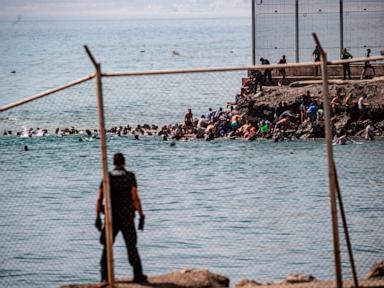
Thousands of desperate individuals breaching the border fences separating Morocco from Spain's Ceuta enclave represent far more than a sudden migration spike; they expose the fragile architecture of European Union border policy. When wave after wave of humanity converges on the double-fenced perimeter of Tarajal or the hillside barriers overlooking Fnideq, the event is routinely framed by mainstream outlets as a spontaneous humanitarian outburst. That framing is dangerously incomplete.
Years of covering North African geopolitics teach one immutable lesson: borders like Ceuta do not fall by accident. They collapse under the weight of precise economic strain, diplomatic leverage games, and structural hopelessness.
To understand why thousands breach these specific fences, one must look past the immediate footage of chaotic surges and examine the geography of desperation. Ceuta is a Spanish autonomous city grafted onto the northern coast of Africa. It shares a land border exclusively with Morocco. For sub-Saharan migrants, North Africans fleeing economic ruin, and minors caught in the crossfire of regional diplomacy, this border acts as a literal open door to European territory. Step foot in Ceuta, and you are effectively on European soil. You have bypassed the Mediterranean crossing, cheated the smugglers operating death-trap dinghies, and landed on the doorstep of the Schengen zone.
Yet, treating Ceuta as a mere transit point ignores the complex web of bilateral coercion that governs the region. Morocco holds the keys to this gate. When Rabat wants to signal displeasure to Madrid or Brussels over Western Sahara policy, diplomatic friction rises. Suddenly, police presence along the hills of Fnideq thins out. Intelligence sharing slows. The barriers become porous.
The mechanics of a mass breach are swift and coordinated, defying the myth of total spontaneity. Word travels fast through informal networks in towns like Tetouan and Tangier. Groups assemble in the surrounding forests, waiting for a signal or a perceived weakness in the patrols. Armed with rudimentary grappling hooks, homemade ladders, and sheer mass, they rush the perimeter simultaneously at multiple points. Spanish Civil Guard units and Moroccan auxiliary forces find themselves overwhelmed not by military precision, but by the sheer velocity of human momentum.
Security fencing has evolved into an industrial complex of steel, razor wire, and surveillance cameras, yet it remains fundamentally vulnerable to human mass. When three thousand people charge a six-meter barrier at once, physics dictates the outcome. Some make it over. Many fall, suffering severe lacerations and broken limbs from the razor wire designed to deter them. Those who successfully cross are funneled into temporary holding facilities like the Tarajal arrival center, which routinely operates far beyond its intended capacity.
The economic undercurrents driving these surges are equally stark. Morocco faces post-pandemic inflation, severe agricultural droughts, and soaring youth unemployment rates. For many young Moroccans, the social contract has shattered. When local fishing economies collapse and tourism fails to absorb the influx of young labor, the European dream transforms from an aspiration into a survival strategy. Despair replaces fear.
Madrid and Brussels respond with predictable cycles of financial aid and diplomatic appeasement. Millions of Euros flow southward to fund Moroccan border enforcement, upgrading surveillance tech and training security forces. But throwing cash at a perimeter wall fails to address the root drivers of migration. It merely shifts the pressure point from land to sea, or from one fence to another.
The legal limbo facing those who breach the fence is another layer of the crisis often glossed over. Under international law, asylum claims must be processed individually. Yet, bilateral readmission agreements between Spain and Morocco often result in expedited pushbacks, raising severe human rights concerns. Critics argue these rapid expulsions violate the principle of non-refoulement. Authorities counter that maintaining order at an external EU frontier requires swift administrative action to prevent total system collapse.
Human rights monitors walk a lonely beat in Ceuta. They document the injuries, the tear gas exposure, and the psychological toll on minors who slip through the cracks. Local aid organizations stretch thin budgets to provide food and blankets, while residents of the enclave watch their daily lives disrupted by geopolitical chess matches they have no voice in.
The broader implications for European foreign policy are profound. By outsourcing border management to Rabat, Brussels grants Moroccan authorities immense leverage. Every time diplomatic tensions flare, the threat of a loosened border hangs over Spanish diplomats like a sword of Damocles. It is transactional geopolitics written in human cost.
Solutions proposed by think tanks and policy analysts usually fall into two categories: militarization or managed mobility. More walls, more drones, more tear gas. Or conversely, expanded legal pathways, work visas, and regulated economic migration channels that strip smugglers of their business model. History suggests that neither extreme will be implemented in its pure form. Instead, Europe stumbles forward from crisis to crisis, managing symptoms while ignoring the structural disease.
The fence at Ceuta stands tonight under high-intensity floodlights. Patrol vehicles idle near the perimeter. Cameras hum, scanning the dark hills where groups are undoubtedly already waiting for the next shift change, the next diplomatic dispute, or simply the next break in the fog.
The barrier will hold until it doesn't.