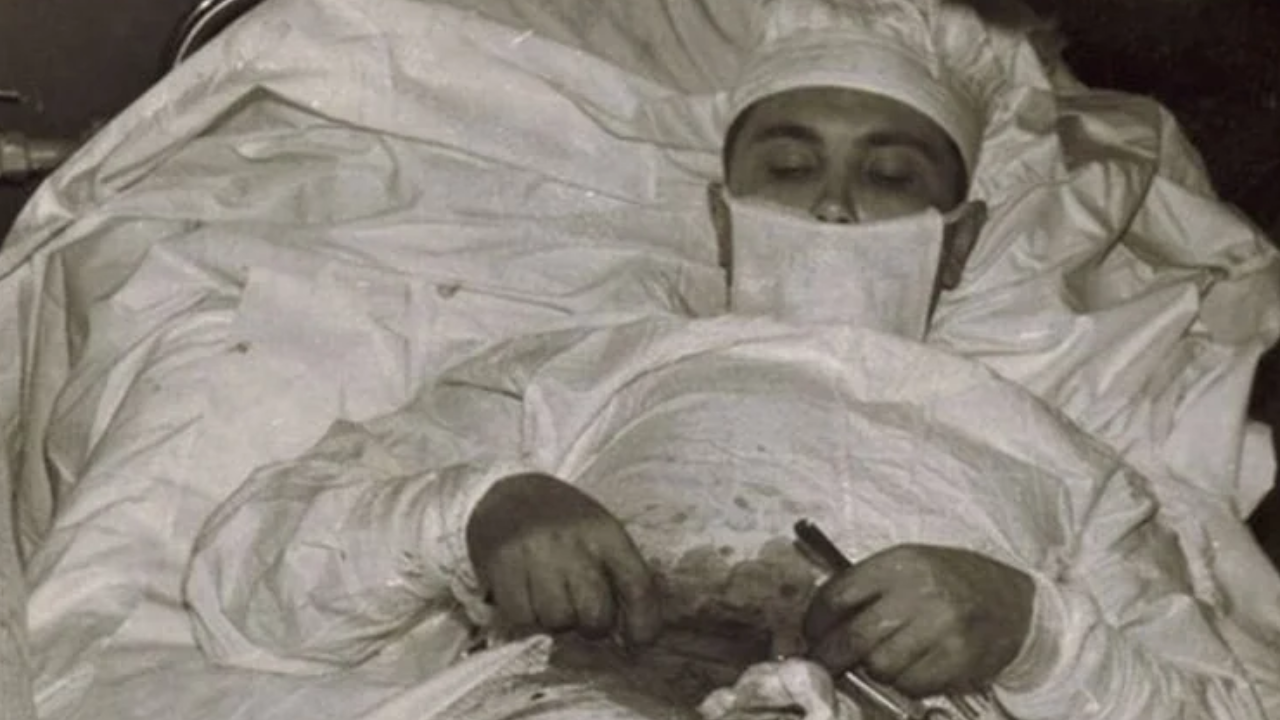
In April 1961, 27-year-old Soviet surgeon Leonid Rogozov performed an emergency appendectomy on himself at Novolazarevskaya Station in Antarctica. Trapped by the polar winter, blizzards, and sea ice with no possibility of evacuation, Rogozov was the only medical professional among 13 men. Facing fatal peritonitis from a rupturing appendix, he used local anesthesia, a small mirror, and two untrained assistants to slice open his own abdomen, locate the infected organ, and excise it in a grueling procedure lasting nearly two hours.
Popular retellings paint this event as a triumphant tale of pure grit. That framing misses the institutional negligence that put a young, relatively inexperienced physician in an impossible bind. While Rogozov’s composure under extreme physiological stress remains unmatched in medical history, his ordeal exposes the dark reality of Cold War polar exploration, where geopolitical prestige consistently outranked basic human survival protocols.
The Geopolitical Trap at Novolazarevskaya
To understand why a single doctor was left isolated on the edge of the Antarctic continent, you have to look at the Cold War race for territorial influence. The Sixth Soviet Antarctic Expedition was not merely a scientific mission. It was a projection of state power.
Novolazarevskaya Station, located in the Schirmacher Oasis of Queen Maud Land, had only been inaugurated in February 1961. Construction was rushed to beat the onset of the brutal southern winter. The station sat roughly 80 kilometers from the coast, separated from the sea by a treacherous, crevasse-ridden ice shelf.
Once the supply ship Ob departed in March, the 13-man crew was entirely severed from the outside world. Radio communications were spotty, hampered by solar flares and atmospheric interference. Overland travel was suicide in the pitch-black, sub-zero blizzards. Air rescue was technically impossible; the single-engine ski planes used by the Soviets lacked the range, navigation equipment, and de-icing capabilities to land in whiteout conditions during the polar night.
Rogozov was not a seasoned battlefield trauma veteran. He had only recently graduated from the Leningrad Pediatric Medical Institute and had interrupted his surgical residency to join the expedition. He was hired as the station's sole physician, meteorologist, and driver.
There was no redundancy. If the meteorologist got sick, someone else could read a barometer. If the doctor got sick, everyone was out of luck.
Anatomy of an Inevitable Crisis
On April 29, 1961, Rogozov woke up with a dull ache in his right lower quadrant, accompanied by nausea and a low-grade fever. As a trained clinician, he recognized the textbook presentation of acute appendicitis almost immediately.
Initially, he pursued conservative management. He administered heavy doses of antibiotics, applied local cooling to his abdomen, and kept himself on a starvation diet to slow bowel motility. For 24 hours, he hoped the inflammation would subside on its own.
It did not. By the evening of April 30, his temperature spiked. The localized pain sharpened, and his abdomen grew rigid—a classic sign of peritoneal irritation. His white blood cell count, which he likely estimated or inferred from his rapidly deteriorating systemic state, was climbing.
The math was simple and unforgiving. An untreated, perforated appendix spills fecal matter and virulent bacteria directly into the sterile peritoneal cavity. Without surgical intervention, septic shock and death follow within days.
Rogozov briefly considered asking one of his colleagues to perform the surgery while he talked them through it. He quickly dismissed the idea. Guiding an untrained mechanic or meteorologist through the delicate layers of the abdominal wall, avoiding the epigastric vessels, and identifying an inflamed retrocecal appendix would have resulted in fatal hemorrhage or bowel perforation.
If he wanted to live, he had to hold the scalpel himself.
Engineering an Improvised Operating Theater
Preparation began late on the night of April 30. Rogozov knew that once the surgery started, his cognitive function would degrade rapidly from blood loss, pain, and medication. Everything had to be choreographed in advance.
He drafted two crew members into his surgical team. Alexander Artemev, a meteorologist, was assigned to hand over sterile instruments and adjust the lighting. Zinovy Teplinsky, a mechanic, was tasked with holding a small round mirror and directing a desk lamp so Rogozov could see inside his own abdominal cavity. The station director, Vladislav Gerbovich, stood by in the room in case either assistant fainted—a very real possibility given the visceral horror of the scene.
Sterility was improvised under primitive conditions. The room was scrubbed down, and bedsheets were boiled. Rogozov washed his hands and forearms thoroughly, though he made a calculated, high-risk decision regarding gloves.
Operating through a mirror reverses left and right, completely scrambling hand-eye coordination. Wearing thick rubber surgical gloves would have robbed him of the tactile feedback necessary to distinguish healthy tissue from necrotic bowel. He opted to operate bare-handed, relying entirely on his fingertips to navigate his own anatomy by touch.
Two Hours of Controlled Trauma
At 2:00 AM on May 1, Rogozov propped himself up in a semi-reclining position on a makeshift operating table, tilted slightly to his left to help the intestinal loops shift away from the right iliac fossa.
He injected a 0.5% solution of novocaine into his abdominal wall. General anesthesia was completely out of the question; he needed to remain awake to perform the surgery. Even spinal anesthesia was too dangerous, as it could cause a sudden drop in blood pressure and paralyze his lower body, leaving him unable to brace himself.
This meant he would numb the skin and muscle layers, but once he breached the peritoneum—the sensitive membrane lining the abdominal cavity—and began pulling on the internal organs, he would feel intense, visceral pain.
He picked up a scalpel and made a 10-to-12-centimeter incision in his right lower abdomen.
Almost immediately, the limitations of his setup became apparent. Looking into the mirror held by Teplinsky, everything was inverted. Every movement of his right hand appeared backwards in the glass. After a few agonizing minutes of fighting his own visual cortex, Rogozov abandoned the mirror for the deeper work. He tilted his head forward, staring directly down into the wound, and worked primarily by tactile memory.
As he cut through the layers of muscle and fascia, bleeding obscured his vision. He had to pause repeatedly to swab the wound with gauze and clamp bleeding vessels with hemostats.
When he finally entered the peritoneal cavity, the hardest part began. Pulling the cecum—the pouch at the beginning of the large intestine—forward to expose the appendix triggered waves of nausea and profound vagal shock. His blood pressure plummeted. Cold sweat poured down his face.
In his personal diary, Rogozov later documented the sensation of impending collapse. His vision darkened, and his hands grew heavy. He forced himself to pause every four to five minutes, resting his head back for 20 to 30 seconds until the dizziness passed and his heart rate stabilized.
When he finally located the appendix, his worst fears were confirmed. The organ was swollen, dark, and showed a dark spot at its base. It was hours away from bursting.
With trembling fingers, he tied off the blood supply to the appendix, severed the organ, and applied antibiotics directly into the peritoneal cavity to stave off infection. Then came the tedious process of suturing the peritoneum, the muscle layers, the fascia, and finally the skin.
At 4:00 AM, exactly one hour and 45 minutes after making the first cut, Rogozov tied the final suture. He instructed his exhausted assistants on how to clean and store the surgical instruments, took a dose of sleeping pills and antibiotics, and collapsed into bed.
The Physiological Toll and Aftermath
Survival was not guaranteed once the skin was closed. Post-operative peritonitis, wound dehiscence, or internal bleeding could still kill him.
For the first four days after the surgery, Rogozov ran a high fever and experienced intense abdominal pain. He managed his own recovery from bed, dictating antibiotic regimens and monitoring his pulse. By day five, his temperature finally broke. Seven days after cutting himself open, he removed his own stitches. Within two weeks, he had returned to his regular duties at the station.
When news of the operation reached Moscow, the Soviet propaganda machine seized upon it immediately. Rogozov was awarded the Order of the Red Banner of Labour and celebrated alongside cosmonaut Yuri Gagarin—who had orbited the Earth just three weeks prior—as a symbol of Soviet heroism and scientific supremacy.
What the state media conveniently omitted was the systemic failure that necessitated the surgery. Sending a 13-man crew into total isolation with a single medical officer was an unacceptable gamble. Had Rogozov suffered a stroke, a severe concussion, or an appendix rupture at the back of his abdomen where he could not reach it, he would have died a slow, agonizing death while twelve healthy men watched helplessly.
How Rogozov Permanently Changed Extreme Medicine
The medical community took the lesson seriously, even if the politicians celebrated the miracle. Rogozov's ordeal exposed a massive blind spot in how nations staffed isolated outposts, submarines, and eventually space stations.
Today, the legacy of that night in Novolazarevskaya directly dictates the protocols for the world's most extreme environments:
- Mandatory Prophylactic Surgery: For decades, the Australian Antarctic Division required doctors wintering over at remote stations to undergo prophylactic appendectomies before deployment. If you are the only surgeon on the ice, you do not get to keep your appendix.
- Dual-Medical Staffing: Modern Antarctic bases with winter-over crews rarely rely on a single point of medical failure. Stations now cross-train non-medical personnel in advanced trauma life support, anesthesia administration, and basic surgical assistance.
- Spaceflight Protocols: Both NASA and Roscosmos studied Rogozov's case extensively when designing medical bays for the International Space Station and future Mars missions. Because a surgeon on a Mars transit cannot evacuate a patient to Earth, space agencies have invested heavily in autonomous ultrasound diagnostics, robotic surgical assistance, and strict pre-flight medical screening to eliminate acute surgical risks before launch.
Leonid Rogozov returned to Leningrad in 1962, completed his dissertation on esophageal cancer, and worked quietly as a hospital surgeon until his death in 2000. He never viewed himself as a mythic hero, repeatedly telling interviewers that he simply did what any doctor would have done to stay alive. Yet his makeshift operating table in the Antarctic dark remains the ultimate benchmark for human composure—and a permanent warning against sending explorers into the void without a backup plan.