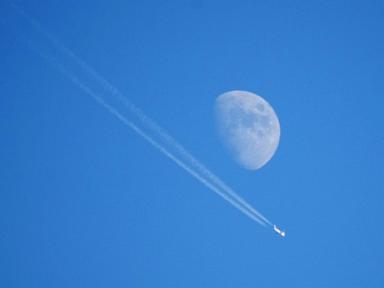
For decades, the aviation industry has viewed carbon dioxide as its primary enemy. Every gallon of jet fuel burned pumps roughly twenty-one pounds of carbon dioxide into the atmosphere, creating an accounting ledger of emissions that airlines have tried to offset through tree-planting programs or promises of futuristic sustainable fuels. Yet, carbon dioxide only accounts for roughly half of aviation's total global warming footprint. The other half floats silently behind commercial jets as a thin, white scar across the stratosphere.
Condensation trails, commonly known as contrails, are artificial cirrus clouds formed when hot, moist engine exhaust hits freezing, humid air at cruising altitudes. Under the right atmospheric conditions, these icy trails spread out, blanket the planet, and trap outgoing longwave radiation that would otherwise escape into space. Overnight and during specific winter windows, this heat-trapping effect creates a net warming impact that rivals the carbon burned to get the plane into the air. Fixing this problem does not require inventing a new battery chemistry or waiting decades for hydrogen combustion engines to mature. It requires convincing air traffic controllers to shift a plane up or down by two thousand feet.
Operation Blue Skies, a landmark thirty-month research initiative launched by the British government, Google UK, and a consortium of aviation heavyweights, aims to prove this theory on an airspace-wide scale. Centered over the Shanwick Oceanic Control Area—a high-traffic corridor across the northeastern Atlantic Ocean where roughly five percent of global contrail warming originates—the project will use artificial intelligence to predict contrail zones and dynamically reroute hundreds of flights.
The operational mechanics of the trial expose the hidden friction between climate science and air traffic management. The Shanwick Oceanic Control Area is one of the busiest highway networks in the sky, handling flights connecting European hubs to North America. Controlling this airspace requires rigid separation standards to prevent mid-air collisions. Introducing altitude deviations into this environment is not trivial.
During selected winter nights when traffic density dips, air traffic controllers from NATS, the United Kingdom's leading air navigation service provider, will instruct participating flights to deviate by up to two thousand feet from their optimal flight profiles to bypass predicted ice supersaturated regions. Google supplies the predictive horsepower, processing massive quantities of satellite imagery, weather data from the Met Office, and historical flight tracks to forecast exactly where contrails will form before planes arrive.
The numbers underlying the trial calculations reveal a fascinating economic and thermodynamic trade-off. Diverting a commercial airliner vertically to avoid a contrail zone requires a slight modification in engine thrust, resulting in a minor penalty in fuel burn. On average, a single diverted aircraft might burn an extra one hundred kilograms of fuel. However, thermodynamic modeling demonstrates that preventing a persistent, heat-trapping cirrus cloud yields a climate benefit hundreds of times greater than the minor penalty of that extra fuel.
Translating a localized thermodynamic win into a systemic operational reality requires overcoming institutional inertia. Airlines operate on razor-thin margins. Flight dispatchers optimize routes down to the exact pound of fuel to minimize operational costs, and pilots are trained to follow the most mathematically efficient paths provided by flight management computers. Asking an airline to accept an intentional efficiency penalty for a diffuse environmental benefit is a tough sell unless the regulatory framework or data accuracy provides absolute certainty.
Previous trials conducted by individual airlines, such as American Airlines partnering with Google, demonstrated that targeted avoidance is possible on an ad-hoc basis. Operation Blue Skies takes the concept out of the realm of corporate public relations and tests it across an entire shared corridor. By coordinating across hundreds of flights rather than isolated test runs, the consortium hopes to establish whether multi-plane avoidance strategies can alter regional warming without destabilizing air traffic control workflows.
Skeptics point out that predicting atmospheric moisture with absolute precision remains an elusive goal. If an artificial intelligence model misjudges a super-saturated humidity zone, an airliner could be forced to burn extra fuel and alter its vertical profile for no climatic gain whatsoever. Furthermore, scaling this practice globally means integrating predictive models into the legacy software systems used by air navigation service providers worldwide, a technological overhaul that could take decades.
Despite these hurdles, the urgency driving the initiative is palpable. The aviation industry faces mounting regulatory pressure to achieve net-zero emissions by mid-century, yet the technological pathways to get there remain bottlenecked by physics and infrastructure constraints. Sustainable aviation fuel is scarce and expensive, and electric or hydrogen propulsion systems are decades away from commercial viability for long-haul transatlantic routes. Contrail mitigation represents the only low-hanging fruit in the entire decarbonization portfolio.
Independent academic validators from Imperial College London and the University of Cambridge will scrutinize the data generated over the next two winters to ensure the trial's claims withstand scientific scrutiny. If the metrics prove that minor altitude adjustments can systematically strip the warming blanket from the North Atlantic corridor without causing operational gridlock, the blueprint will be ready for export to other crowded skies across Europe, Asia, and North America.
The white lines stretching across the sky have been ignored as an aesthetic byproduct of modern travel for nearly a century. As the data from Shanwick flows into Whitehall and Silicon Valley server rooms, those ephemeral clouds are finally being recognized for what they truly are: a massive climate crisis hiding in plain sight, waiting for someone willing to adjust the altitude.