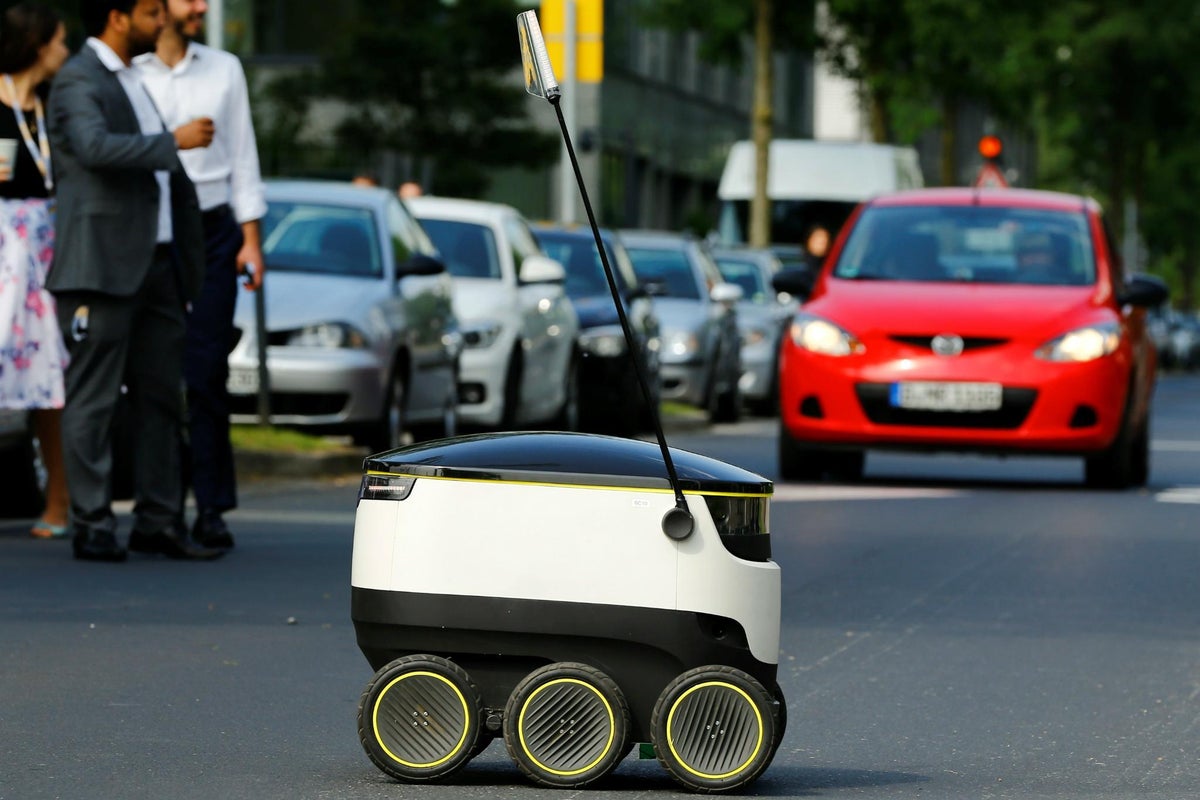
A 73-year-old parking attendant in California has filed a lawsuit against a prominent robotics manufacturer, alleging that an autonomous sidewalk delivery drone knocked her down and caused severe injuries. The incident highlights an escalating tension on public walkways as corporate tech tests real-world automation directly alongside vulnerable pedestrians. While manufacturers pitch these electrical rovers as quiet, eco-friendly logistics fixes, the reality on the asphalt tells a much more chaotic story. Municipal infrastructure was never built to host heavy, self-navigating machinery alongside human foot traffic.
When a standard delivery machine weighs over 100 pounds and navigates crowded urban centers, mechanical or software miscalculations carry immediate physical consequences. Tech firms often describe these machines as harmless, slow-moving helpers. Yet, when an unexpected object, a sudden glare, or a blind spot throws off their optical sensors, their fallback routines often fail to prevent low-speed collisions.
Public Sidewalks Have Become Unregulated Beta Testing Grounds
Companies deploying ground-based delivery robots operate under a patchwork of local ordinances. In many jurisdictions, urban planners scrambled to approve pilot programs without establishing clear safety baselines. The result is a wild-west environment where private corporations use public footpaths to train neural networks.
Every time a pedestrian steps around an idle rover or maneuvers past a confused bot blocking a crosswalk, they participate in an unprompted safety test. The sensor arrays on these devices—typically a combination of LiDAR, cameras, and ultrasonic rangefinders—struggle with edge cases. High-contrast shadows, reflective surfaces, glass doors, and unpredictable human movements, such as a worker stepping backward while monitoring a parking lot, routinely push these navigation systems past their operational limits.
Software engineers design pathfinding algorithms around statistical probabilities. The robot evaluates five potential paths, selects the route with the lowest calculated risk, and proceeds. But statistical improbability does not mean impossibility. When a rare event occurs, the machine's primary directive is usually to come to a hard stop. If that stop happens two feet too late, a pedestrian ends up on the ground.
The Myth of Remote Human Oversight
Marketing materials regularly emphasize that human supervisors monitor these fleets remotely, ready to take manual control at a moment's notice. What these pitches omit is the operational reality of human-to-machine ratios.
A single remote operator does not watch a single robot. In standard commercial deployments, one supervisor oversees a dashboard managing dozens of autonomous units simultaneously.
- Signal latency can delay emergency stop commands by crucial milliseconds.
- Video feeds from peripheral cameras often compress or drop frames during cellular network handoffs.
- Tele-operators face cognitive overload when managing multiple passive alerts across a city grid.
By the time a human operator notices an obstacle flag on their monitor, evaluates the camera angle, and depresses an emergency override, the physical interaction has already taken place.
Corporate Liability Shields and the Accountability Void
When a commercial automobile strikes a pedestrian, centuries of legal precedent establish a clear framework for liability. Insurance policies kick in, police reports document physical evidence, and driver responsibility is evaluated under established traffic law. Ground delivery drones exist in a regulatory grey zone that leaves victims facing legal walls.
Robotics firms typically structure their operations through layered sub-entities. The company manufacturing the hardware is rarely the entity operating the delivery service, which in turn is distinct from the merchant hiring the bot. When an injury occurs, each entity points toward the other. The software vendor blames hardware sensor drift; the operator claims external environmental interference; the merchant disclaims all operational control.
Pedestrians injured by autonomous equipment encounter a legal labyrinth designed to diffuse responsibility until the cost of litigation outweighs the potential recovery.
Victims often discover that basic incident data—telemetry logs, internal sensor readings, camera footage—remains proprietary corporate property. Unlike standard vehicular accidents where dashcam footage or third-party witness statements suffice, proving negligence in an automated strike requires accessing closed-source code and redacted telemetry files.
The Physical Reality of Low-Speed Impacts
Supporters of urban automation point to the low speed limits imposed on sidewalk bots, usually capped between three to six miles per hour. They argue that at these speeds, severe physical trauma is virtually impossible. That argument ignores basic physics and human kinematics.
An impact from a dense, heavy object does not need to occur at high speed to cause catastrophic damage, especially to older adults or individuals with pre-existing mobility challenges.
Consider a standard kinetic scenario. A robot weighing 120 pounds traveling at 4 miles per hour strikes an unsuspecting pedestrian from behind or from a side angle. The initial impact does not need to shatter bones directly. Instead, the unexpected lateral force throws the human body off balance. The primary injury occurs when the individual hits the concrete curb or asphalt roadway.
For a senior citizen, a sudden fall to hard pavement frequently leads to hip fractures, subdural hematomas, and long-term loss of independence. Framing these machines as harmless because they do not operate at highway speeds ignores how fragile human balance actually is when caught off guard.
Urban Density and the Failure of Shared Spaces
Cities were built for people, then retrofitted for cars. Forcing a third category of motorized commercial transport onto narrow footpaths creates structural friction that software updates cannot solve.
Sidewalks serve as essential refuges from vehicular traffic. They accommodate strollers, wheelchairs, service animals, construction scaffolding, and foot traffic of varying speeds. When corporate fleets claim right-of-way on these surfaces, they restrict physical accessibility for everyone else.
- Wheelchair users report being trapped on ramps because a stalled robot blocked the cutout.
- Service dogs become distracted or agitated by the high-frequency acoustic noise emitted by robotic drive motors.
- Delivery drivers pushing hand trucks find their paths obstructed by idling units waiting for crosswalk signals.
Rather than solving logistics bottlenecks, sidewalk automation simply transfers the physical burden of the last-mile delivery problem onto the public infrastructure. Companies save on driver wages while taxpayers absorb the physical friction and structural wear of commercial machinery occupying public walkways.
Software Limits in Unstructured Environments
The core assumption behind sidewalk robotics is that machine learning models will eventually adapt to every human environment. Industry executives claim that with enough mileage data, edge cases will disappear.
This reflects a fundamental misunderstanding of public life. A sidewalk is an inherently unstructured environment. Unlike highways, which feature standardized lanes, predictable signage, and uniform rules, a public footway contains endless randomness. Children drop toys; dogs bolt on retractable leashes; outdoor dining chairs shift; maintenance workers step backward without looking.
Writing code that accurately predicts every human interaction across a single city block is an impossible engineering task. Deterministic software requires structured inputs. Human public spaces are the absolute opposite of structured inputs.
When an algorithm encounters a scenario that falls outside its training parameters, it defaults to pre-programmed fallback states. Sometimes that state is an immediate freeze. Other times, the system misidentifies a human leg as a soft obstacle, like high grass or trash, and attempts to push through. That algorithmic misclassification is where physical harm occurs.
Municipal governments face a choice. They can continue treating their public walkways as free test tracks for venture-backed logistics experiments, or they can enforce strict mechanical, weight, and operational limits before a preventable collision turns fatal. Until regulators mandate real-time public telemetry access, mandatory independent safety audits, and primary liability frameworks on machine operators, pedestrians remain unwitting participants in an industrial experiment.
Every time a municipal board grants a sidewalk operation permit without requiring full public safety disclosures, they risk the safety of the very citizens those footpaths were built to protect.