Federal and local authorities dismantled a sprawling, multi-state organized crime ring responsible for stealing over $23 million worth of high-value merchandise directly from moving and idling freight trains across the American Southwest, arresting 14 primary suspects in a coordinated crackdown. Operating primarily along remote stretches of track in Arizona, California, and New Mexico, the syndicate systematically targeted intermodal containers carrying high-end electronics, designer apparel, and power tools, exploiting predictable rail bottlenecks, understaffed private railroad police forces, and vast stretches of unmonitored desert track.
The headline figure of $23 million grabs immediate attention, yet the real story lies beneath the surface of those numbers. For decades, modern supply chain logistics relied on an unspoken assumption that once cargo was sealed inside a steel intermodal container and loaded onto a railcar, it was effectively untouchable until it reached a secured yard. That assumption is dead.
Train robberies did not vanish with the end of the nineteenth century; they simply traded horses and six-shooters for angle grinders, encrypted messaging apps, and fleet-footed spotter networks.
How Modern Syndicates Crack Rolling Fortresses
To understand how fourteen individuals managed to extract millions of dollars in consumer goods from the nation’s rail network, you have to look at the physical reality of American freight infrastructure. Hundreds of thousands of miles of track crisscross the country, much of it running through desolate, uninhabited terrain where law enforcement response times are measured in hours rather than minutes.
Criminal syndicates do not strike randomly. They conduct rigorous surveillance on major rail corridors, particularly the routes feeding out of the Ports of Los Angeles and Long Beach, which handle roughly forty percent of all containerized imports entering the United States. Spotters positioned near port exits and inland intermodal yards log container numbers, identify high-value shippers through shipping manifests or subtle visual cues on the packaging, and relay that intelligence down the line.
Once a targeted train departs, the mechanics of the heist rely on basic physics and operational predictability. Freight trains cannot stop on a dime, nor can they accelerate quickly. Heavy trains climbing steep mountain grades—such as the Cajon Pass in California or the high desert stretches crossing into Arizona—slow down to a crawl. At speeds between ten and fifteen miles per hour, an agile crew can board a moving railcar without specialized equipment.
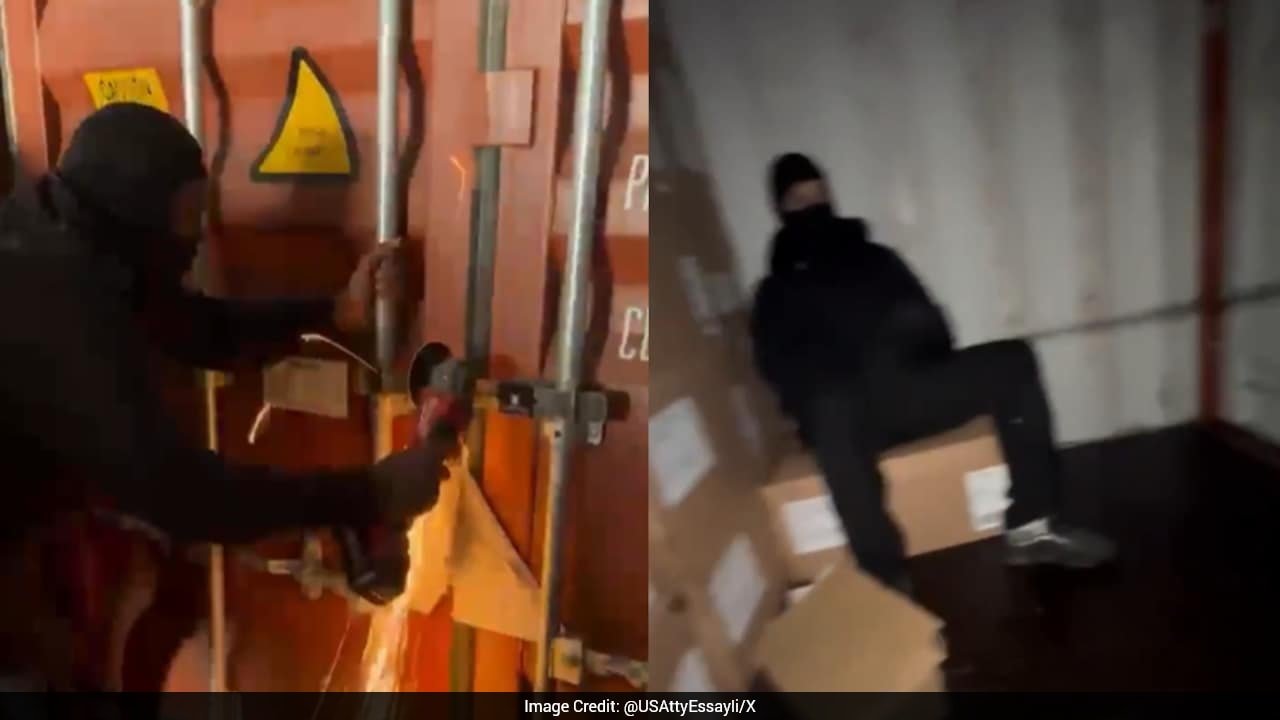
The actual breach takes less than two minutes. Using battery-powered angle grinders or heavy-duty bolt cutters, thieves shear off standard high-security steel cable seals and container latches. Once the doors swing open, crew members toss boxes of merchandise out onto the gravel ballast along the right-of-way while the train continues rolling forward.
A few miles back, follow-up teams driving box trucks, cargo vans, and pickup trucks pull onto dirt access roads running parallel to the tracks. They load the discarded pallets into waiting vehicles and vanish onto the interstate system before the train crew even realizes a container has been compromised. In instances where trains are forced to idle on sidings to let higher-priority traffic pass—a frequent occurrence in congested rail networks—the thieves have even more time to selectively strip the most lucrative cargo.
The Structural Blind Spots of Private Rail Policing
When a typical retail store gets robbed, municipal police respond. When a freight train gets hit in the middle of the Mojave Desert, jurisdictional reality becomes vastly more complicated.
Unlike highways, which are patrolled by state troopers and local sheriffs, the railroad right-of-way is private property. Under federal law, Class I railroads maintain their own commissioned police forces, such as the BNSF Railway Police and the Union Pacific Police Department. These officers hold full arrest powers across state lines, a unique legal authority dating back to the nineteenth century.
However, the sheer ratio of officers to track mileage creates an insurmountable enforcement gap. Over the past decade, the freight rail industry aggressively adopted Precision Scheduled Railroading (PSR), an operational model designed to maximize profit margins by running longer, heavier trains with leaner workforces. While PSR drove operating ratios down and boosted shareholder returns, it also resulted in significant headcount reductions across maintenance, operations, and internal security teams.
A single railroad special agent is often responsible for patrolling hundreds of miles of track. Local sheriff’s departments, already stretched thin by rural patrol duties and tight municipal budgets, frequently lack the resources or the immediate legal mandate to proactively patrol private rail corridors unless explicitly called in for backup.
This jurisdictional friction creates a gray zone that organized crime exploits with ruthless efficiency. By the time a conductor notices a warning light on a distributive power unit, or a sensor triggers at a distant dispatch center, the thieves are already fifty miles away, sorting stolen televisions and sneakers in a rented suburban storage unit.
Why High-Value Cargo Sits Unprotected in Plain Sight
If you want to understand why this specific $23 million ring thrived for so long, follow the economics of container security.
Most international shipping containers are secured with a single bolt seal or cable seal compliant with ISO 17712 standards. In the logistics world, these are classified as "high-security" seals. In reality, they are tamper-evident devices, not physical barriers. A $150 cordless grinder from any hardware store slices through an ISO-compliant bolt in roughly eight seconds.
Shippers and railroads know this. Yet upgrading the physical locking mechanisms across millions of globally circulating containers is cost-prohibitive and logistically nightmarish. Containers change hands dozens of times across oceans, ports, rail yards, and trucking fleets; introducing proprietary, heavy-duty locking systems slows down terminal dwell times and disrupts global standardization.
Furthermore, insurance structures quietly disincentivize radical security overhauls. Cargo losses are routinely absorbed through layered marine and inland transit insurance policies, with costs ultimately baked into the retail price consumers pay at the register. For a massive retailer or a Class I railroad moving billions of dollars in freight annually, a $23 million loss over an extended period represents a statistical rounding error rather than an existential threat—until the sheer scale of the thefts begins attracting federal task forces and congressional scrutiny.
Inside the Underground Fencing Pipeline
Stealing a pallet of high-end electronics or limited-edition athletic footwear is only half the equation. Turning hot merchandise into clean cash requires a sophisticated fencing operation, and the 14 suspects arrested in this case operated a remarkably streamlined liquidation pipeline.
Unlike petty street thieves who offload stolen goods at local pawn shops or flea markets, organized cargo rings operate like legitimate wholesale distributors. Stolen goods are immediately transported to staging warehouses in major metropolitan hubs—frequently in the greater Los Angeles or Phoenix areas—where the shipping labels, barcodes, and manufacturer tracking tags are systematically stripped or altered.
From there, the merchandise enters the gray market through multiple channels:
- Third-Party E-Commerce Marketplaces: Front companies set up seemingly legitimate storefronts on major online retail platforms, undercutting authorized dealers by ten to twenty percent to move volume quickly.
- Complicit Liquidators and Discount Wholesalers: Unscrupulous middlemen purchase bulk pallets with cash or cryptocurrency, mixing stolen goods with legitimate overstock and salvaged freight to obscure the paper trail.
- Cross-Border Export: High-demand consumer electronics and power tools are routinely loaded into outbound trucks heading south across the Mexican border, where serial number blacklists enforced by U.S. telecoms and manufacturers have little to no practical impact.
Investigators cracking the $23 million ring relied heavily on traditional detective work combined with modern digital forensics—tracking burner phones pinging near remote rail sidings, subpoenaing records from online marketplace sellers, and executing controlled buys from suspected fences. The paper trail left by moving tens of thousands of individual retail units eventually exposed the central organizers who rarely, if ever, set foot near a railroad track.
The Myth of the Technological Silver Bullet
Whenever a major cargo heist makes national headlines, industry consultants immediately pitch high-tech solutions: GPS-enabled smart locks, AI-driven predictive analytics, drone surveillance along remote corridors, and blockchain-verified manifests.
Every single one of these technologies works well in a pitch deck. In the dirt and heat of the American Southwest, they run straight into hard operational limits.
GPS trackers placed inside containers frequently lose cellular connectivity in deep desert canyons and mountain passes—precisely the areas where trains slow down and thieves strike. Even when a tracker successfully transmits an alert that a container door has been breached in rural Arizona, knowing a theft is occurring does not magically teleport an armed officer to a dirt road forty miles from the nearest paved highway.
Drone surveillance faces strict Federal Aviation Administration (FAA) regulations regarding Beyond Visual Line of Sight (BVLOS) operations. Maintaining continuous aerial coverage over thousands of miles of track requires massive capital expenditure, battery-swapping infrastructure, and dedicated human operators—costs that railroads are fiercely reluctant to absorb unless mandated by federal regulators.
Even the deployment of heavier, reinforced steel locking bars on container doors introduces unintended consequences. When thieves encounter heavy-duty locks they cannot quickly cut, they often resort to cutting directly through the corrugated steel walls or roofs of the container itself, turning a repairable door latch into a totaled shipping container and causing far worse structural damage to the freight inside.
An Escalating Arms Race on the Rails
The arrest of 14 suspects and the recovery of millions in stolen goods marks a significant tactical victory for federal prosecutors, the FBI, and railroad police task forces. It removes a major operational cell from the Southwest corridor and disrupts established fencing networks that relied on their steady supply of stolen inventory.
Yet veteran cargo security investigators harbor no illusions about what happens next. Organized theft rings are modular by design. When law enforcement dismantles one crew in Arizona or Southern California, rival groups quickly step in to claim the territory, adapting their tactics to counter whatever investigative methods led to the previous arrests.
Railroads are gradually responding by increasing physical patrols in known chokepoints, deploying undercover surveillance teams, and lobbying state legislatures for harsher mandatory minimum sentences specifically targeting organized retail and cargo crime. Prosecutors have also begun leaning more heavily on federal statutes—including charges under the Hobbs Act and interstate transportation of stolen property—to ensure suspects face federal prison time rather than quick releases on county bail.
Still, the fundamental vulnerabilities remain baked into the physical geography of American commerce. As long as billions of dollars in unguarded consumer goods roll slowly through vast stretches of empty desert inside thin steel boxes secured by eight-second locks, the financial math will continue to draw organized crime straight to the tracks.