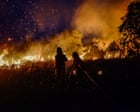
Step outside in Indonesian Borneo right now, and you won't see the horizon. You will see a wall of yellow-grey soup. Every breath tastes like an ashtray, burning the back of your throat with the distinct weight of a cigarette.
In West Kalimantan alone, emergency rooms are drowning in patients. Respiratory cases have surged past five thousand visits a week. Children cough on their way to school, and delivery drivers wrap damp cloths around their faces just to survive a shift.
It is an annual nightmare returning with a vengeance. Driven by a punishing dry season and an intensifying super El Niño pattern, massive forest and peatland fires are chewing through thousands of acres of land. The resulting smoke refuses to respect borders. It has drifted across the Malacca Strait, choking parts of Malaysia and forcing hundreds of school closures.
The Anatomy of a Peatland Disaster
Why do these fires spiral so violently out of control every few years? The answer lies beneath the surface. Much of Indonesia's burning landscape isn't standard timberland. It is ancient peat.
Peat is essentially compressed, decayed organic matter built up over thousands of years. Think of it as a massive carbon sponge. When water tables remain high, peat is naturally fire-resistant. But decades of draining these wetlands for palm oil and pulp plantations have dried out the soil, turning vast tracts of carbon-rich earth into tinderboxes.
When drained peat catches fire, standard firefighting is nearly useless. The flames burn deep underground. You can dump thousands of gallons of water from a helicopter onto the surface, making the top look black and safe, only for the embers to smolder underneath for weeks. Then, a stray gust of wind revives the blaze.
Justin Sentian, a climate change researcher at Universiti Malaysia Sabah, puts it bluntly. If authorities only mobilize after hotspots light up satellite maps, they are forever chasing a ghost. True survival means fixing the soil hydrology itself by blocking drainage canals and re-wetting the landscape.
Follow the Money and the Arrests
Indonesian police recently arrested seventy-two individuals tied to nearly ninety separate land fire investigations across Borneo and Sumatra. Most suspects are local actors accused of using fire as a cheap, shortcut method to clear vegetation for small-scale farming or plantation expansion.
Yet local farmers taking the fall rarely tell the whole story.
Investigators from the National Police's Criminal Investigation Agency are tracking financial trails to see which corporate entities or larger syndicates financed the land clearing. Mohammad Irhamni, a senior crime director within the agency, made it clear that law enforcement plans to target those who ultimately profit from the destruction rather than stopping at manual laborers on the ground.
President Prabowo Subianto flew directly into central disaster zones, pledging an aggressive surge of water-bombing helicopters, cloud-seeding operations, and heavy machinery to suppress the spread. Critics argue these emergency deployments happen too late. Smoke blankets cities first, public health collapses second, and political promises arrive third.
Protecting Yourself When the Air Turns Toxic
If you live anywhere near the smoke zones of Sumatra, Borneo, or parts of peninsular Malaysia, waiting for government air quality alerts to improve isn't an option. The particulate matter concentration during these peak El Niño months regularly shatters safe exposure limits defined by the World Health Organization.
Protect your health with practical steps:
- Upgrade your mask immediately: Standard cloth masks or surgical covers let ultra-fine particles straight through. Switch to a fitted N95 or KN95 respirator whenever you step outdoors.
- Seal indoor spaces: Keep windows firmly shut. If you have an air purifier, swap out the HEPA filter and run it on high in your primary living and sleeping areas.
- Monitor local data closely: Track real-time air quality indexes instead of relying on visual clarity. Smoke density shifts rapidly depending on wind direction.
- Hydrate aggressively: High particulate pollution inflames mucous membranes. Drinking water helps your body clear out minor irritants, though it won't stop systemic exposure.
The haze will eventually lift when the long-awaited seasonal rains finally break the dry spell. Until then, millions of people across Southeast Asia are left holding their breath, waiting for structural land reform that treats the root cause instead of treating the smoke.