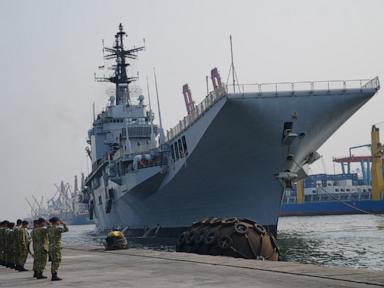
When the decommissioned Italian navy aircraft carrier Giuseppe Garibaldi docked at Tanjung Priok port in Jakarta, it instantly changed the strategic balance of Southeast Asia. Indonesia isn't building a blue-water navy to chase phantom empires across global oceans. Instead, Jakarta just bought a massive 41-year-old floating Swiss Army knife. Recommissioned as the KRI Sriwijaya, this heavy-hitter gives the Indonesian military a colossal mobile deck to handle its staggering geography.
If you look past the standard defense-blog handwringing over maintenance costs and fiscal budgets, the operational logic becomes crystal clear. Indonesia is an archipelago stretching across thousands of islands prone to volcanic eruptions, earthquakes, and seasonal peatland fires. Traditional land-based logistics choke up instantly when disaster strikes remote regions. A ship capable of hauling up to ten medium helicopters, deploying drones, and acting as a floating command center is a practical tool for disaster relief disguised as a warship.
What the Critics Miss About the Purchase
Defense commentators love to point out that Indonesia isn't buying vertical takeoff fighter jets to turn the Sriwijaya into a power-projection strike carrier like the US Nimitz-class behemoths. That criticism completely misses the point. President Prabowo Subianto’s administration didn't acquire the Italian veteran to fight carrier-vs-carrier duels in the Pacific.
They bought it because Indonesia sits squarely on the Pacific Ring of Fire. When severe natural disasters hit distant islands, logistics win or lose the response. Having a movable platform that can steam toward a crisis zone carrying heavy transport helicopters, water-dropping aircraft supplies, and medical units solves a massive logistical bottleneck. Navy Chief of Staff Admiral Muhammad Ali made it clear that while combat operations remain an option, humanitarian assistance and disaster relief drive the primary mission profile.
Of course, the price tag brings legitimate controversy. The finance ministry initially backed significant funding for the acquisition program, but local lawmakers and economists have argued that retrofitting and daily maintenance bills will skyrocket. Operating a former Italian flagship isn't cheap, especially when the state balances massive domestic social programs against tightening fiscal constraints.
The Regional Ripple Effect
Southeast Asia doesn't have many aircraft carriers for a reason. Until now, Thailand’s HTMS Chakri Naruebet—procured from Spain back in 1997—stood alone as the region's sole flat-top. Indonesia is now only the second country in the region to operate a carrier-class aviation ship.
This move fits neatly into a broader, aggressive modernization push by Jakarta. Between locking in defense cooperation agreements, securing long-range missile supplies, and upgrading naval patrols with new offshore patrol vessels like the KRI Brawijaya, Indonesia is quietly turning its navy into a serious regional force. When the Sriwijaya sailed through the Malacca Strait escorted by domestic patrol craft and maritime surveillance planes, it signaled a loud message about maritime sovereignty.
You have to wonder how neighboring nations view this secondhand acquisition. While Western analysts debate whether aging European hulls are smart investments for developing economies, Indonesian planners are looking at immediate utility. They needed a high-capacity sea base right now, and buying a proven hull saved years of shipyard wait times.
Looking at the Operational Reality Ahead
Getting the ship home to Jakarta was the easy part. Keeping it operational at a high tempo will test the Indonesian Navy's technical chops. Crew training, supply chains for spare parts, and fuel logistics require sustained funding that must survive future political shifts.
If Jakarta manages to keep the platform active and responsive, the Sriwijaya will transform how Indonesia manages its maritime borders and emergency responses. Stop viewing this acquisition through the lens of Cold War naval projection. It's an emergency response base built for a nation that spans an ocean.