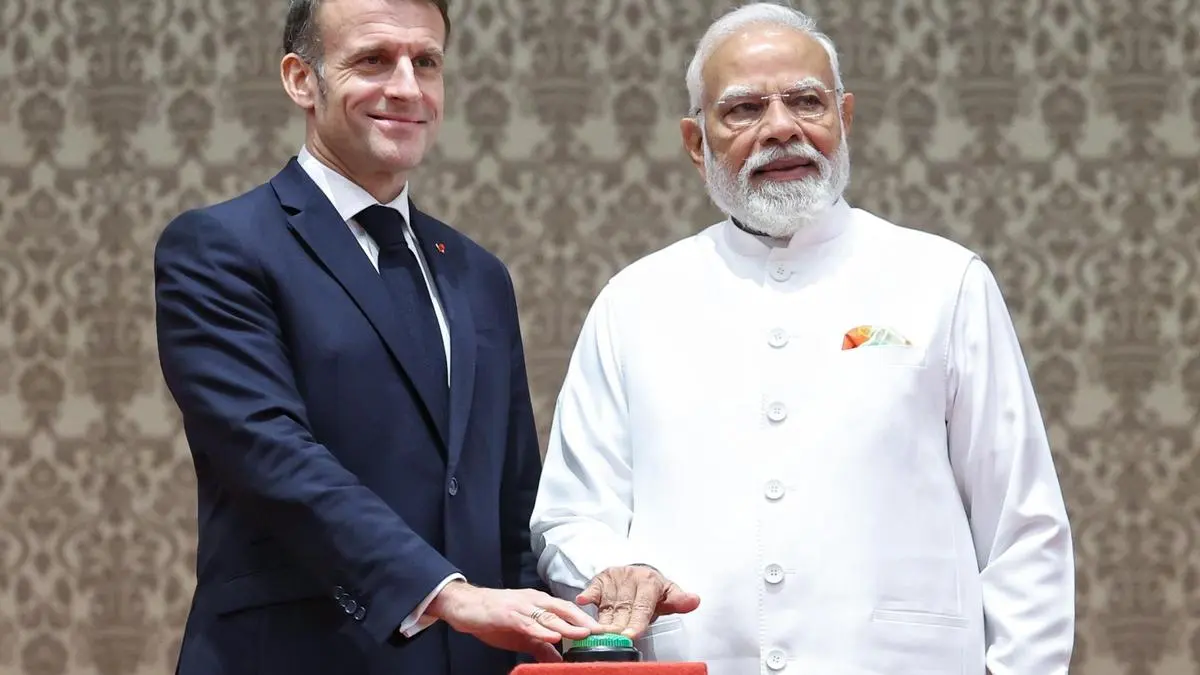
When Emmanuel Macron picked up the phone to call Narendra Modi this week, the conversation wasn't about diplomatic pleasantries or the usual talk of "shared democratic values." It was about survival. Specifically, the survival of the global energy supply and the increasingly fragile maritime routes that keep the gears of the world economy turning. The two leaders issued a blunt demand for the restoration of the freedom of navigation in the Strait of Hormuz, a narrow strip of water that has become the world’s most dangerous choke point.
This isn't just another headline about a high-level phone call. It represents a fundamental shift in how middle powers are reacting to the breakdown of the old world order. For decades, the United States Navy was the de facto guarantor of safety in these waters. That era is over. Washington is distracted, and the vacuum is being filled by a chaotic mix of non-state actors, drone technology, and regional rivalries. By aligning their voices, France and India are signaling that they can no longer wait for a superpower to solve their security dilemmas.
The Throat of the World Economy
To understand why a French president and an Indian prime minister are losing sleep over a specific stretch of water, you have to look at the math of oil and gas. The Strait of Hormuz is roughly 21 miles wide at its narrowest point. Through that tiny gap flows about one-fifth of the world’s total oil consumption every single day.
If the Strait closes, the global economy doesn't just slow down; it breaks. India, which imports over 80% of its crude oil, is uniquely vulnerable to any price shock or physical blockade in the Persian Gulf. For France, the concern is twofold: energy security for Europe and the protection of French naval assets and commercial interests that have been increasingly targeted by regional proxies.
The current threat isn't coming from traditional battleships. It’s coming from "asymmetric" warfare—cheap drones, naval mines, and fast-attack boats that can disable a multi-billion dollar tanker in minutes. This is why the Macron-Modi call matters. They aren't just talking about trade; they are talking about a joint military and intelligence framework to counter high-tech piracy that the current international system is failing to stop.
Why India is Moving Beyond Neutrality
India has long practiced a policy of "strategic autonomy," essentially trying to be friends with everyone while avoiding entangling alliances. But the reality of the Strait of Hormuz is forcing New Delhi to pick a side. India can no longer afford to be a passive observer when its energy lifeline is at the mercy of Iranian-backed militias or geopolitical grandstanding.
The collaboration with France offers India a "third way." It allows New Delhi to project power in the Western Indian Ocean without looking like a junior partner to the United States. France, with its permanent military bases in the UAE and Djibouti, provides the logistical backbone that India needs to sustain long-term naval patrols far from its own shores.
The Technology Gap in Maritime Defense
The biggest challenge facing these two nations isn't a lack of will; it's a lack of specific hardware. Defending a tanker against a $20,000 suicide drone requires more than just a deck gun. It requires integrated electronic warfare suites and AI-driven tracking systems that can distinguish a fishing boat from a threat.
- Satellite Intelligence Sharing: France and India are now discussing the live-linking of their maritime surveillance satellites to provide 24/7 coverage of the Gulf.
- Underwater Security: The threat isn't just on the surface. Protecting undersea cables that carry 90% of the world's data is now part of the "freedom of navigation" mandate.
- Joint Exercises with Teeth: We are seeing a move away from "photo-op" drills toward high-intensity combat simulations designed to reclaim seized vessels.
The French Connection to the Indo-Pacific
France likes to remind the world that it is an Indo-Pacific power, thanks to its overseas territories and nearly two million citizens in the region. For Macron, India is the "resident power" that serves as the southern anchor of French influence. By securing the Strait of Hormuz, France secures its own relevance in a theater that is increasingly dominated by the U.S.-China rivalry.
This partnership is built on the hard reality of defense contracts. From Rafale jets to Scorpene-class submarines, India is France’s biggest customer. When Macron calls Modi, he isn't just a head of state; he is the chief executive of a defense ecosystem that wants to see India become a maritime hegemon. If India can't protect the ships coming out of the Gulf, it can't sustain the economic growth required to keep buying French hardware. It is a symbiotic relationship of necessity.
The Iranian Variable
We cannot ignore the elephant in the room. The primary source of tension in the Strait of Hormuz is the friction between Iran and the West. India has historically maintained a delicate balance with Tehran, investing in the Chabahar Port as a gateway to Central Asia. However, the recent escalation of drone attacks on commercial shipping—some of which have occurred uncomfortably close to Indian waters—has soured that relationship.
France is taking a harder line. Macron knows that European energy prices are tied to the stability of the Gulf. If Iran uses the Strait as a bargaining chip in its nuclear or regional negotiations, France wants the military capability to ensure that "freedom of navigation" isn't just a suggestion. The joint call between Modi and Macron was a clear warning to Tehran: India’s patience is not infinite, and its strategic interests now outweigh its historical ties.
Economic Costs of Inaction
What happens if this diplomatic push fails? The costs are already being felt in the insurance industry.
- War Risk Premiums: Shipping companies are seeing their insurance costs skyrocket, a cost that is passed directly to consumers.
- Re-routing Delays: If tankers are forced to avoid certain zones, the extra days at sea consume more fuel and disrupt "just-in-time" supply chains.
- Global Inflation: A $10 spike in the price of oil can shave half a percentage point off the GDP of developing nations like India.
A New Era of Mini-Lateralism
The Macron-Modi alliance is the perfect example of "mini-lateralism"—small groups of capable nations working together on specific issues because large organizations like the UN are paralyzed by gridlock. These two leaders are betting that a French-Indian maritime axis can do what the broader international community cannot: create a credible deterrent in the world's most volatile shipping lane.
The era of relying on a single global policeman is over. The safety of the Strait of Hormuz now depends on the ability of regional powers to arm themselves, share intelligence, and act with a level of ruthlessness that was previously reserved for superpowers.
France and India have realized that in the current geopolitical climate, you don't get the rights you deserve; you only get the rights you can defend. The "freedom of navigation" they are calling for won't be granted by a treaty; it will be secured by the destroyers and drones they deploy to the mouth of the Gulf. The world is watching to see if this new alliance has the stomach for the long, expensive, and dangerous patrol that lies ahead.
Stop looking at the diplomacy. Watch the naval deployments. That is where the real story is written.