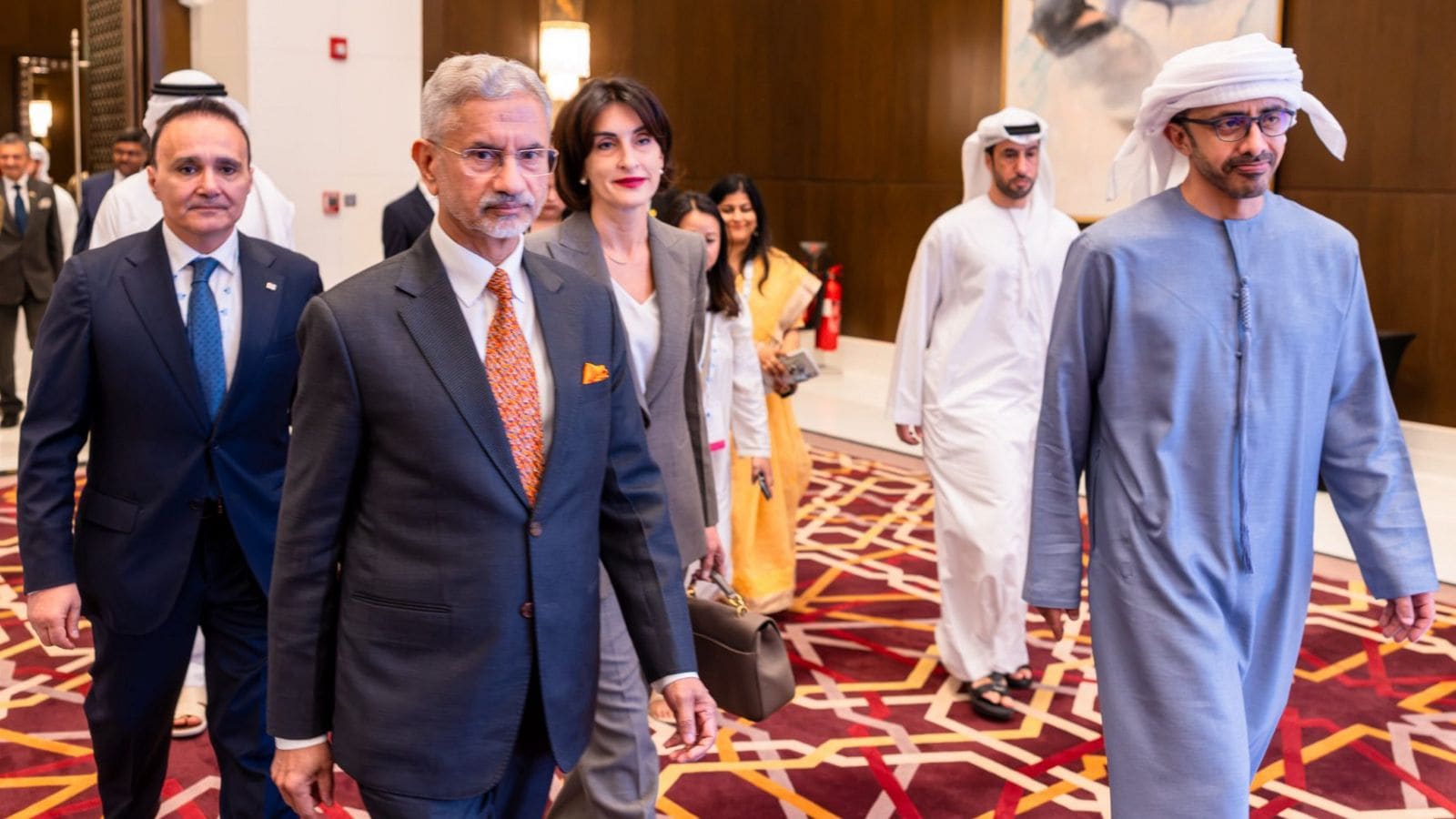
Standard diplomatic dispatches treat high-level meetings between Indian External Affairs Minister S. Jaishankar and UAE Deputy Prime Minister and Foreign Minister Sheikh Abdullah bin Zayed Al Nahyan as routine protocol exercises. That framing misses the structural mechanics underneath. When senior diplomats from New Delhi and Abu Dhabi confer amid West Asian volatility and shifting global supply chains, they are managing a high-throughput economic corridor that crossed US$101 billion in bilateral trade in FY 2025-26 while simultaneously hedging against maritime and geopolitical shockwaves.
Typical wire stories flatten this complexity into two superficial moves. First, they catalog surface-level formalities: who greeted whom, which city hosted the talks, and generic pledges to deepen cooperation across trade, energy, and regional stability. Second, they treat bilateral trade numbers and diplomatic visits as self-explanatory proofs of momentum rather than outputs of specific institutional incentives and risk constraints. If you liked this piece, you should check out: this related article.
To read these meetings analytically, practitioners need a clear blueprint of what actually drives the relationship:
- The Four-Engine Bilateral Architecture: Merchandise trade, sovereign and private capital flows, energy and food security, and labor and remittance mobility operate as coupled subsystems rather than isolated silos.
- The Shock-Resilience Function: High-frequency diplomatic engagements function as risk-hedging mechanisms when regional flashpoints threaten shipping lanes, energy supplies, or financial clearing.
- The Execution Bottleneck: Ambitions such as doubling bilateral trade to US$200 billion by 2032 or scaling transit corridors face concrete friction points in customs compliance, logistics insurance, and currency settlement.
Deconstructing Competitor Logic and Structural Blind Spots
A standard wire report follows a predictable sequence: headline announcement, bilateral goodwill summary, mention of regional tension, and closing reference to people-to-people ties. As a baseline record of an event, that structure works. As a strategic briefing, it leaves three major blind spots. For another look on this event, check out the recent coverage from The New York Times.
The first blind spot is conflating volume with structural durability. Reporting that bilateral trade has surged past US$100 billion since the Comprehensive Economic Partnership Agreement (CEPA) entered into force in 2022 tells you the corridor is large, not whether its growth is insulated from commodity price swings or re-export dynamics. A spike in gold or crude oil valuation can inflate nominal trade figures without expanding domestic manufacturing value-add in either economy.
The second blind spot is treating global and regional issues as background noise rather than a direct transmission channel. When West Asian security tensions escalate or maritime chokepoints face disruption, the cost function of trade changes immediately. Freight war-risk premiums, rerouting delays, and supply interruptions hit energy importers, food supply chains, and port operators directly. Diplomatic talks address these risks by aligning positions on unimpeded transit and keeping crisis communication channels open.
The third blind spot is omitting the institutional scaffolding that turns political intent into commercial execution. High-level visits by top leaders—including Prime Minister Narendra Modi's visits to the UAE, UAE President Sheikh Mohamed bin Zayed Al Nahyan's visit to India in January 2026, and Crown Prince Sheikh Khaled bin Mohamed bin Zayed Al Nahyan's participation in major New Delhi summits in 2026—set strategic direction. Yet commercial scale depends on legal instruments like the Bilateral Investment Treaty, financial hubs such as GIFT City, and sector-specific supply agreements.
The Four Engines of the India-UAE Corridor
Understanding why New Delhi and Abu Dhabi invest sustained diplomatic bandwidth in each other requires disaggregating their relationship into four interdependent engines. Each engine carries distinct strengths and distinct vulnerabilities.
Merchandise Trade and Tariff Compression
CEPA reduced tariffs across a wide array of goods and established an institutional framework for market access. In FY 2025-26, bilateral merchandise trade reached roughly US$101.25 billion, with Indian exports exceeding US$37.35 billion and the UAE ranking among India's top trading partners while India ranks as a top trading partner for the UAE.
The composition of this trade reveals two underlying mechanics:
- Complementarity in inputs and finished goods: India supplies engineering goods, electronics, petroleum products, gems and jewellery, chemicals, and textiles, while importing crude and petroleum products, gold, precious stones, chemical materials, and transport equipment from or through the UAE.
- Hub-and-spoke re-export leverage: The UAE functions both as a final consumer market and as a logistics and re-export hub linking South Asia, the Gulf, Africa, and Europe.
The primary limitation of this engine is composition sensitivity. Heavy weightings in gold and petroleum mean headline trade values can fluctuate sharply with global commodity prices and bullion flows even when non-oil manufactured exports grow steadily.
Capital Mobilization and Financial Plumbing
Diplomacy between India and the UAE increasingly operates through balance-sheet integration rather than aid or concessional lending alone. Cumulative UAE foreign direct investment into India reached US$25.59 billion between April 2000 and March 2026, placing the UAE seventh among overseas investors in India. Sovereign wealth funds, institutional investors, and logistics operators—including entities establishing presence in Gujarat's GIFT City—anchor long-horizon capital deployment in infrastructure, energy, real estate, financial services, and industrial zones.
A critical operational variable here is transaction friction. Cross-border trade and investment face currency conversion costs, settlement delays, and regulatory differences. Initiatives promoting local-currency settlement, payment network interoperability, and offshore-onshore financial bridges at GIFT City aim to lower transaction friction over time. However, full currency convertibility constraints and global banking compliance rules limit how fast local-currency settlement can scale across every trade line.
Energy, Food, and Supply Chain Security
Energy security in this corridor is no longer a one-way oil transaction. While crude and petroleum products remain central, the relationship has expanded into liquefied natural gas supply agreements, renewable energy, grid integration, and broader supply chain resilience. Food security and agricultural logistics form a parallel track, given India's agricultural production base and the UAE's import-dependent food system and logistics infrastructure.
Consider a practical supply chain scenario. Suppose a regional security flare-up slows tanker transit or raises marine insurance rates in the Gulf. A long-term bilateral supply arrangement paired with coordinated port and logistics planning does not eliminate physical geography, but it gives buyers and suppliers clearer allocation rules and faster diplomatic troubleshooting than spot-market reliance alone.
Human Capital and Remittance Flows
Roughly 4.3 million Indians live and work in the UAE, making them the largest expatriate community in the country. That workforce is not a passive demographic fact; it is a foundational macro-stabilizer for both economies.
- For the UAE: Skilled professionals, engineers, healthcare workers, construction labor, and entrepreneurs support service delivery, infrastructure buildout, and commercial operations.
- For India: Remittances from the UAE account for nearly a fifth of India's total inward remittances, providing steady foreign exchange inflows that support household consumption and external balance stability.
The vulnerability in this engine is cyclical and policy-sensitive. Shifts in Gulf labor demand, visa rules, automation, or regional economic slowdowns can alter remittance growth or return migration patterns, making consular protection and workforce mobility a permanent fixture of bilateral diplomacy.
Cause-and-Effect Chains Behind Regional and Global Talks
When Jaishankar and Abdullah bin Zayed discuss global and regional issues alongside bilateral ties, three cause-and-effect chains explain why those agenda items belong in the same room.
First, geopolitical fragmentation raises the cost of single-point dependencies. As global trade realigns and regional conflicts test maritime routes, both countries prioritize multi-alignment and supply redundancy. India needs reliable energy, fertilizer, and trade arteries as well as Gulf capital; the UAE needs large, fast-growing markets, food and manufacturing partners, and diversified security and economic ties across Asia.
Second, connectivity corridors depend on diplomatic alignment before physical steel and fiber are laid. Frameworks such as the India-Middle East-Europe Economic Corridor (IMEEC) and port-to-port logistics partnerships span multiple jurisdictions and maritime zones. Without steady political coordination between New Delhi and Abu Dhabi, cross-border customs harmonization, port concessions, and transit guarantees stall.
Third, emerging technology and defense cooperation change the strategic floor of the partnership. Expanding collaboration in space, defense, artificial intelligence, and digital infrastructure shifts the relationship from transactional commerce toward long-term technological interdependence. That shift is an educated hypothesis based on observed agreements and summit agendas rather than a guarantee of full industrial co-production; technology transfer rules, export controls, and commercial return hurdles still govern how fast pilot projects become scaled systems.
How Analysts and Operators Should Evaluate Bilateral Progress
Relying on diplomatic communiqués to gauge whether India-UAE ties are advancing produces false positives. Every high-level meeting produces warm language. Analysts, corporate planners, and policymakers should instead track five concrete operational indicators across the next 12 to 24 months:
- Non-oil, non-bullion export growth: Check whether Indian exports of engineering goods, electronics, chemicals, and processed foods into the UAE grow faster than volatile commodity lines.
- Conversion of MoUs into funded projects: Separate signed memoranda of understanding from deployed capital, joint ventures, and operational facilities in industrial parks, ports, and GIFT City.
- Logistics and transit metrics: Monitor port turnaround times, shipping route reliability, and concrete milestone announcements on regional connectivity corridors rather than aspirational statements alone.
- Payment and settlement adoption: Look for measurable usage of rupee-dirham settlement and cross-border payment links by mid-sized exporters and importers, not just headline announcements.
- Crisis-response coordination during shocks: Observe how quickly consular, maritime, and trade channels respond when regional shipping or energy disruptions occur.
No single metric captures the full picture, and none of these tools eliminates external shocks. Regional conflicts, global interest rates, and domestic regulatory shifts on either side can slow execution even when political goodwill is high.
For organizations operating between India and the Gulf, the immediate strategic play is to build dual-track commercial resilience: pair CEPA tariff and investment advantages with contingency routing, multi-currency invoicing options, and compliance readiness for shifting sanctions, insurance, and maritime rules. Treat diplomatic summits as early-warning signals of where regulatory and infrastructure support will flow next, then verify execution through hard trade, capital, and logistics data.