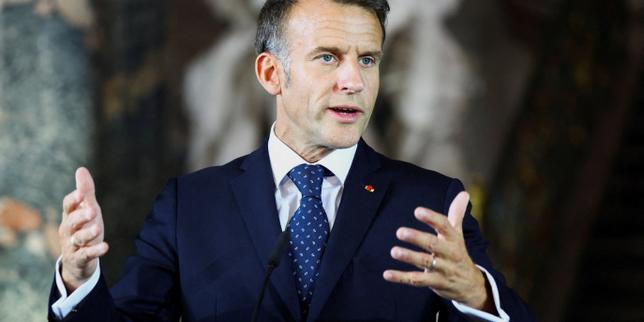
The Elysée Palace has a way of absorbing sound. Behind the thick, double-glazed windows overlooking the Faubourg Saint-Honoré, the chaotic roar of Paris melts into a muffled hum. Inside, the air smells of beeswax, old paper, and the distinct, invisible tension that accumulates around power when it feels itself slipping.
Emmanuel Macron sat in this quiet, looking at numbers on a page.
They were not good numbers. They were the kind of numbers that make political advisors speak in hushed, urgent tones outside half-closed doors. Poll after poll, charted out in cold, geometric lines, pointed toward a singular, devastating conclusion: in 2027, Marine Le Pen would take the keys to the palace.
To the casual observer, it looks like a done deal. The media treats it as a slow-motion car crash we are all forced to watch. The narrative is set, the obituaries for French liberalism are written, and the populist wave feels less like a political movement and more like a law of physics.
But Macron, a man whose entire career was built on defying political gravity, isn't buying it. He knows something about numbers. He knows they lie.
The Ghost in the Machine
Consider a hypothetical voter. Let’s call her Sandrine.
Sandrine runs a small, fiercely independent bookstore in Lyon. She is tired. She is tired of the rising cost of paper, the astronomical electricity bills, and the vague, persistent feeling that the people in Paris do not know she exists. When a pollster calls her cell phone on a rainy Tuesday evening, she is angry.
"If the election were held today, who would you vote for?" the voice asks.
Sandrine doesn't hesitate. "Le Pen," she says, slamming down the receiver.
It is a cathartic moment. A tiny, long-distance act of rebellion. But here is the secret that keeps pollsters awake at night: Sandrine hasn't actually decided. Her answer wasn't a vote; it was a scream. She wanted to hurt the status quo, to leave a bruise on the establishment.
When Emmanuel Macron warned his cabinet to "beware" of these early predictions, he was thinking of Sandrine. He was reminding his allies that a poll taken years before an election is not a map of the future. It is a mirror of the present's frustration.
History is littered with the corpses of "sure things." In the spring of 1994, standard political wisdom dictated that the French left was dead for a generation. In 2016, every sophisticated data model in Washington gave Hillary Clinton a 90% chance of winning the presidency. The numbers were robust. The methodologies were pristine.
They were also entirely wrong.
The human mind craves certainty. We look at a graph pointing upward and we assume it will keep climbing until it pierces the clouds. It is a cognitive shortcut, a way to make sense of a world that feels increasingly volatile and terrifying. But politics is not math. It is chemistry. It is volatile, reactive, and prone to sudden, catastrophic explosions when the right elements mix.
The Danger of the Self-Fulfilling Prophecy
There is a psychological phenomenon known as behavioral fatigue. When people are told, day after day, that an outcome is inevitable, their behavior changes.
Some slide into apathy. They figure the game is rigged, the result is pre-ordained, so why bother showing up? Others, driven by a desire to be on the winning side, drift toward the frontrunner. The prediction creates the reality.
This is the real battle Macron is fighting. He isn't just fighting Le Pen; he is fighting the creeping sense of resignation among his own ranks. The moment a political party begins to believe its own defeat is inevitable, it stops fighting to win. It starts fighting for a comfortable place to die.
The strategy of the National Rally has been brilliant in its passivity. They don't need to propose radical, sweeping reforms. They don't need to win every debate. All they have to do is stand still, look respectable, and let the ambient anger of the country drift into their sails. They are positioning themselves as the only logical alternative to a system that many feel has failed them.
But logic has very little to do with the final walk to the ballot box.
When you step into that curtained booth, the noise of the media fades. The pundits are gone. It is just you, a piece of paper, and a choice that will define the next five years of your life. In that moment, the anger that felt so satisfying on a rainy Tuesday evening often gives way to a deeper, colder question: What happens on Monday morning?
The Architecture of Doubt
To understand why the current data is deceptive, you have to look at how it is constructed.
Polling has become an existential crisis in the digital age. Landlines are gone. Younger voters don't answer calls from unknown numbers. The samples are weighted, adjusted, and massaged through algorithms designed to correct for these biases, but every adjustment introduces a new layer of human guesswork.
We are relying on flawed instruments to measure an invisible fluid: human emotion.
Macron’s warning was an appeal to intellectual humility. He was reminding a room full of panicked politicians that the electorate is not a monolith. It is a swirling, chaotic mass of conflicting desires. The same voter who wants stricter immigration controls might also be terrified of a policy that destabilizes the Euro. The voter who hates the pension reform might dread the international isolation that a far-right victory could bring.
The current numbers reflect a desire for change, but they do not yet reflect a consensus on what that change should look like. That is where the opening lies. That is the space where the narrative can still be rewritten.
The Final Movement
The sun sets late over Paris in the summer. The stone buildings turn the color of honey, and for a few hours, the city looks exactly as it did a century ago. It feels permanent. Unshakeable.
But history moves fast.
The mistake we make is treating the future as an destination we are passively traveling toward, rather than a structure we are actively building. The polls are not a prophecy. They are an alarm clock.
Whether that alarm wakes up a sleeping establishment to offer a genuine, empathetic alternative, or simply counts down the hours to a historic shift, depends entirely on what happens when the quiet of the palace is broken by the reality of the street.
The page with the numbers sits on the desk. The ink is dry, but the story is still being written.