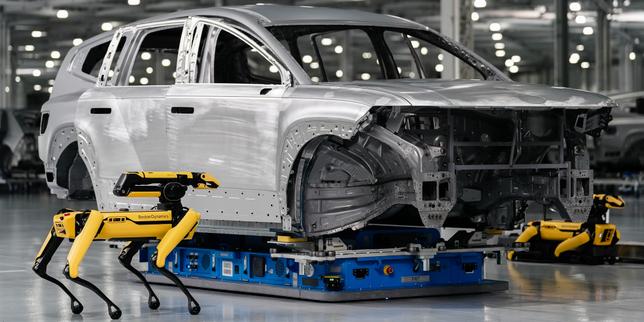
Walk into the sprawling new auto factory in Ellabell, Georgia, and your first reaction might be a slight sense of unease. Car bodies slide across polished floors without a single driver in sight. Overhead, massive mechanical arms lift entire steel doors like they weigh nothing, snapping them into place with terrifyingly perfect precision. Look down another aisle, and you will spot a robotic quadruped—the famous Boston Dynamics mechanical dog—stretching its metal joints as its sensor-laden head sniffs around for tiny structural defects.
This is Hyundai Motor Group Metaplant America, or HMGMA. It represents a $7.6 billion bet on the concept of a software-defined factory, scaled up across a massive 2,900-acre site just outside Savannah.
The casual observer might look at this mechanical dance and assume that human auto workers are a dying breed. You have probably read the sensational headlines suggesting factories will soon run themselves in total darkness. But if you talk to the engineers running the floor or watch how cars are actually finished here, you realize the internet has it all wrong. Automation is everywhere at the Metaplant, but the machines are hitting a hard wall. They simply cannot do everything.
The True Scale of Automation in Ellabell
Most legacy automotive plants use automated systems for heavy welding and painting. It is standard industry practice. But what Hyundai built in Georgia takes mechanical independence to a completely different level.
While a standard vehicle assembly facility might utilize roughly 30 specialized automated units, the Metaplant features over 300 active robotic systems scattered throughout the main assembly floor alone. The entire facility operates on an integrated data network where order collection, part procurement, and logistical routing are handled by central algorithmic platforms.
- Autonomous Mobile Sleds: Forget traditional conveyor belts. Vehicles move through the final assembly stages on automated guided vehicles (AGVs) that calculate their own paths across the facility floor.
- The Battery Marriage: Installing a heavy electric vehicle battery pack requires immense precision. The underbody feeding and fastening system autonomously aligns front suspensions, drive mechanisms, and battery enclosures to the chassis, applying exact torque specifications without human physical intervention.
- Rapid Line Reconfiguration: Because the logistical lines rely on software rather than rigid physical tracks, the plant can alter its workflow in record time. It took the company a mere two weeks to integrate its first hybrid model, the Kia Sportage, into an existing electric vehicle line. Traditional factories often spend months rebuilding physical infrastructure for that kind of transition.
Yet, if you look past the spinning metal grippers, you see hundreds of human employees standing in the middle of this tech oasis. Hyundai refers to them as Meta Pros. The facility currently plans to scale its human workforce to 8,500 people as production ramps up.
Where the Metal Meets the Wall
Why does an ultra-automated facility need thousands of flesh-and-blood workers? Because machines excel at repeatable, high-force actions but fail miserably at tasks requiring tactile intuition.
Take the simple act of installing a seat belt. It sounds incredibly basic. But a seat belt is a flexible, floppy piece of fabric that twists, bends, and behaves unpredictably when handled. To a computer vision system, a dangling strap changes shape every single second. A robotic arm trying to grasp it usually requires complex programming just to find the buckle, and a tiny variation can jam the system.
A human worker grabs the strap, flips it with a thumb, feels the tension, and clicks it into place in under three seconds without thinking. The same goes for weather stripping, snapping plastic interior trim together, or checking the tension of electrical wire harnesses.
Humans possess an innate sense of touch that mechanical grippers cannot replicate without millions of dollars in experimental sensors. In Georgia, humans handle these nimble, finicky tasks while standing right next to the machines that just lifted the car frame into position. The technology is not replacing the worker; it is removing the exhausting, backbreaking labor that used to destroy an assembler's joints over a twenty-year career.
The Next Boundary for Humanoid Systems
Hyundai is openly prepping the Metaplant to host the next phase of industrial mechanics: bipedal humanoids. Through its ownership of Boston Dynamics, the automaker plans to run field deployments of its updated, all-electric Atlas robot at the Georgia facility.
[RMAC Virtual Training] ---> [SDF Software Engine] ---> [Real-World Factory Floor]
This is not about putting a sci-fi character on the payroll. The deployment follows a highly deliberate, multi-year validation strategy:
- Parts Sequencing: Initial field usage involves moving components and sorting roof racks within designated, controlled kitting zones.
- Complex Assembly: Over time, these bipedal units will transition into tighter spaces to handle heavy component manipulation that standard fixed arms cannot reach.
- Cross-Station Mobility: Unlike traditional industrial robots bolted to a concrete foundation, humanoids can move between different bays, adapting to changing production bottlenecks on the fly.
To train these machines, engineers use virtual reality headsets to guide the mechanical arms through manual tasks, capturing behavioral datasets. This data feeds into specialized training platforms like the Robot Metaplant Application Center (RMAC), allowing the system to learn how to adapt when a part is slightly out of alignment.
But do not mistake this for total displacement. Even when these humanoids arrive, they will operate under the direct oversight of human supervisors wielding tablets and monitoring systemic diagnostic feeds. The job profile is shifting from pure manual labor to technical systems management.
Actionable Takeaways for Manufacturing Teams
The operational blueprint established at the Georgia Metaplant offers clear lessons for industrial operators trying to figure out their own automation budgets.
- Automate by Weight and Repetition, Not by Complexity: Use mechanical assets to manage heavy component lifting, repetitive torque application, and dangerous material transport. Leave soft trim installation, fine wiring, and sensory quality checks to human operators.
- Prioritize Software Over Physical Tracks: Fixed tracks lock your factory floor into a single configuration. Utilizing autonomous mobile platforms lets you pivot your manufacturing line to handle new models or hybrid variants without tearing up concrete.
- Redesign Training for Your Current Workforce: As automation levels climb, your floor assemblers need to learn basic data literacy and software interface navigation. Shift your training focus away from brute force techniques and toward equipment intervention and software monitoring.
To see this dynamic in action, check out this behind-the-scenes look at the factory floor layout and automated transport systems: Hyundai Metaplant America Grand Opening. This footage clearly shows how the bipedal systems operate alongside human assembly teams in a real industrial setting.