Modern Formula One operational success is determined by margin minimization across three distinct vectors: strategic foresight, resource allocation under pressure, and driver execution consistency. The Hungarian Grand Prix provided a clinical study in how organizational friction compounds into catastrophic failure for one constructor while precision engineering delivers a masterclass in control for another.
To understand the divergent outcomes between McLaren and Ferrari at the Hungaroring, one must abandon surface-level narratives of momentum and look strictly at the mechanical and strategic feedback loops that governed the race distance. The structural difference between a winning team and a floundering one is rarely raw pace alone. It is the velocity of decision-making when variables shift mid-race.
The McLaren Operational Matrix
McLaren approached the weekend with a clear structural advantage rooted in tyre preservation and aerodynamic efficiency across medium-speed corners. The Hungaroring demands high downforce, but its technical layout punishes rear tyre thermal degradation due to continuous traction events out of slow-speed turns.
Thermal Management and Degradation Vectors
The primary driver of McLaren's dominance was their capacity to operate within the optimal thermal window of the Pirelli compounds without inducing surface graining. When ambient and track temperatures fluctuate, teams face a binary choice: protect the rear axle by managing traction application or push for immediate lap-time delta and accept thermal decay.
McLaren mitigated this trade-off through a setup philosophy that prioritized mid-corner rotation, allowing their drivers to straighten the steering wheel earlier on exit. Straightening the wheel sooner reduces lateral load combined with longitudinal acceleration, which is the primary catalyst for rubber shearing.
Intra-Team Execution Dynamics
Managing two competitive drivers at the front of the grid introduces a high-entropy variable into race operations. McLaren's strategy execution relied on pre-determined mathematical thresholds rather than emotional pitwall appeals.
- Track Position Priority: The leading car dictates the initial pit stop window to neutralize undercut threats from trailing constructor entries.
- Stint Length Optimization: Splitting tyre strategies was rendered unnecessary by superior tyre life, allowing both cars to run converged optimal strategies.
- Communication Protocols: Radio exchanges minimized cognitive load on the drivers, prioritizing deterministic lap-time targets over ambiguous pacing instructions.
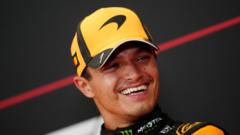
When the dust settled, the execution gap between Lando Norris, Oscar Piastri, and the chasing pack was a product of a predictable chassis balance matched with disciplined pitwall telemetry reading.
The Ferrari Failure Cascade
Ferrari’s race weekend disintegrated not through a single catastrophic error, but through a cascade of compounding operational misjudgements. In high-stakes motorsport, a suboptimal decision early in the strategic timeline forces the team into a defensive posture, multiplying vulnerability at every subsequent safety car or pit stop phase.
Strategic Paralysis and Reactivity
Ferrari operated from a reactive posture for the majority of the race distance. Reactive strategies inherently surrender initiative to competitors, forcing the pit wall to guess opponent telemetry rather than dictating the rhythm of the Grand Prix.
When track evolution favoured a shift in tyre compounds, Ferrari’s hesitation created a cascading delay.
- Information Lag: The time delta between telemetry indicating a drop-off in compound performance and the pit wall issuing a directive exceeded optimal thresholds.
- Traffic Management: Delayed pit stops routinely released Ferrari drivers into dirty air behind lower-tier constructors, incurring aerodynamic penalties that destroyed tyre life within three laps.
- Compound Mismatches: Selecting the wrong tyre subset for the middle stint locked the cars into an unrecoverable deficit in sector two traction zones.
The Cost of Organizational Friction
Beyond strategy, the operational friction within the Scuderia manifested in execution errors during stationary phases. Slow pit stops and ambiguous pre-race setup directions destabilize driver confidence. When a driver cannot trust the mechanical platform beneath them or the tactical decisions originating from the pit wall, driving styles compensate by over-driving entry phases, which immediately triggers front-left thermal degradation and locks the system into a downward performance spiral.
Comparative Mechanics of Race Control
To rigorously evaluate why McLaren succeeded while Ferrari floundered, we can map their respective performance variables against operational constraints.
+---------------------------+-----------------------------------+-----------------------------------+
| Metric Vector             | McLaren Execution                 | Ferrari Execution                 |
+---------------------------+-----------------------------------+-----------------------------------+
| Strategic Posture         | Proactive / Threshold-Driven      | Reactive / Consensus-Seeking      |
| Tyre Degradation Profile  | Linear / Controlled               | Exponential / Unstable            |
| Pit Stop Velocity         | Consistent Sub-3.0s Execution     | Variable / Error-Prone            |
| Driver Cognitive Load     | Minimized via Clear Directives    | Elevated via Ambiguous Radio      |
+---------------------------+-----------------------------------+-----------------------------------+
This structural divergence highlights a fundamental truth of contemporary motorsport engineering. The car is only as fast as the decision-making apparatus that deploys it. A constructor can possess competitive downforce and adequate horsepower, but if the operational loop from data ingestion to tactical execution contains latency, the physical asset underperforms.
The Mechanics of Track Position Protection
A critical misunderstanding among casual observers is the belief that raw lap time cures all strategic deficits. At the Hungaroring, overtaking is notoriously difficult due to the dirty air wake disrupting aerodynamic load in the high-speed corners preceding braking zones.
McLaren understood that track position is a compounding asset. By maintaining clean air at the front of the field, they preserved aerodynamic downforce, which in turn protected the floor and diffuser from turbulent flow. Clean air directly correlates with stable tyre temperatures.
Conversely, Ferrari spent the afternoon operating in dense aerodynamic wake. Running within three seconds of another car reduces downforce by up to thirty percent in medium-speed turns. This loss of downforce causes sliding, sliding causes friction, and friction induces thermal degradation. Ferrari’s strategic errors forced their cars into this vicious cycle, transforming minor pace deficits into insurmountable race-time gaps.
Resource Allocation and Championship Implications
As the season progresses, the operational lessons from Hungary dictate the trajectory of both development races and championship standings. McLaren’s systematic approach signals an organization capable of executing under championship pressure. Their upgrades functioned within predicted simulation parameters, proving that their wind tunnel and computational fluid dynamics correlation is robust.
Ferrari faces a diagnostic challenge that extends far beyond a single weekend. Fixing a strategic breakdown requires restructuring internal communication channels, removing bureaucratic layers from real-time decision-making, and enforcing strict accountability metrics on race day operators. Until those structural fixes occur, flashes of raw pace will continue to be neutralized by operational inconsistency.
Implement a strict telemetry-driven trigger system for pit stop windows, removing subjective debate from the pit wall during high-pressure race phases.