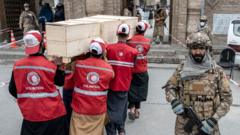
Families in Afghanistan are demanding answers after a devastating strike by Pakistani forces hit a drug rehabilitation center, leaving 269 people dead. This wasn't a hidden militant outpost. It was a facility filled with people trying to reclaim their lives from addiction. Now, the dust has settled, but the grief is just starting to boil over into a massive diplomatic and humanitarian crisis. You've got to wonder how a target this specific, filled with vulnerable civilians, ends up in the crosshairs of a military operation.
The Night the Khost Rehab Center Became a Graveyard
Imagine being a father who finally convinced his son to get help. You send him to a facility in Khost, thinking he’s finally safe from the streets. Then, overnight, that sanctuary turns into a pile of rubble. This isn't a hypothetical scenario for the families of the 269 Afghans killed. Witnesses describe a scene of absolute chaos. There was no warning. Just the screaming of jets and the thud of munitions hitting a building that housed patients, not soldiers. Read more on a connected issue: this related article.
The scale of this loss is hard to wrap your head around. We're talking about nearly 300 lives snuffed out in a heartbeat. Pakistani officials often cite "intelligence-based operations" when they cross the border, claiming they're hunting TTP (Tehrik-i-Taliban Pakistan) militants. But the math doesn't add up here. If the goal is counter-terrorism, hitting a rehab center is a catastrophic failure of intelligence at best, and a blatant disregard for civilian life at worst.
Why the Border is a Powder Keg Right Now
Relations between Kabul and Islamabad have been sliding down a steep hill for months. It's messy. Pakistan claims the Afghan Taliban provides a safe haven for militants who cross over to carry out attacks on Pakistani soil. The Taliban denies this, or at least claims they're doing their best to manage a porous, mountainous border that's basically impossible to police perfectly. More analysis by BBC News explores similar perspectives on the subject.
When Pakistan decides to take matters into its own hands with airstrikes, the blowback is immediate. You can't drop bombs in another country and expect a handshake. This specific strike on the Khost facility has pushed things to a breaking point. It validates the fears of many Afghans who feel their sovereignty is just a suggestion to their neighbors.
The Intelligence Gap
How does a military with sophisticated surveillance tools mistake a medical facility for a terror camp? That’s the question haunting every survivor.
- The Facility Location: The center wasn't hidden. It was known to local authorities and the community.
- Patient Profiles: Those inside were recovering addicts, many of them weakened by years of substance abuse. They weren't combat-ready insurgents.
- Zero Warning: Standard deconfliction protocols—if they even exist in this shadow war—were clearly ignored.
Military experts often talk about "collateral damage" as a clinical necessity. It's a cold phrase. It ignores the fact that every one of those 269 people had a name, a family, and a chance at a future that was stolen. When intelligence is "actionable" but wrong, the price is paid in blood by people who have nothing to do with the conflict.
A Pattern of Escalation and Denials
This isn't an isolated event. Over the last year, we've seen an uptick in cross-border skirmishes and drone strikes. Pakistan feels pressured by internal security threats and thinks kinetic action is the only language the Taliban understands. On the flip side, the Afghan government sees these strikes as an act of war.
The rhetoric from Islamabad usually follows a set script. They mention "terrorist hideouts" and "neutralizing threats." But when the smoke clears and you see rows of bodies that clearly aren't fighters, that script falls apart. The Taliban’s Ministry of Defense has been uncharacteristically blunt this time, calling the strike a "cruel act" and warning of consequences. Honestly, both sides are playing a dangerous game of chicken, and the people in the middle are the ones getting crushed.
What the Families are Demanding
If you talk to the elders in Khost, they aren't just sad. They're livid. They want an independent investigation, though they know they probably won't get one. They want to know who signed off on the coordinates. They want to know why a rehab center was on a target list.
There’s a deep sense of betrayal here. Many of these families have lived through decades of war. They're used to hardship, but the targeted destruction of a place of healing feels like a new low. It’s not just about the deaths; it’s about the message it sends. It says that in the eyes of regional powers, Afghan lives are cheap.
The Role of International Observers
Where is the rest of the world? Usually, when 269 people die in a single strike, there's an international outcry. But because this happened in the dusty borderlands of South Asia, the response has been relatively muted. Human rights organizations are starting to collect data, but without access to the military logs from the Pakistani side, the full truth stays buried.
We need more than just "concerns" expressed in press releases. We need:
- Verification of Targets: An objective look at what the "intelligence" actually claimed.
- Accountability: If this was a mistake, who is being held responsible?
- Compensation: The families left behind have lost breadwinners and loved ones.
The Long Road to Recovery
The destruction of the rehab center also leaves a massive hole in the local social fabric. Afghanistan is dealing with a massive drug epidemic, a grim legacy of decades of instability. Places like the Khost center are rare. They are essential. By destroying it, the strike didn't just kill people; it killed a vital resource for a community already on the edge.
The survivors who weren't in the direct blast zone are now displaced and traumatized. They were already fighting a battle against addiction. Now they’re fighting to stay alive in a zone that feels like a permanent battlefield. It’s a double tragedy.
What Happens Next
Expect the border to get even more tense. You’ll likely see more troop movements and harsher rhetoric. But for the families in Khost, the politics don't matter. They’re busy digging graves. They’re looking for any scrap of information that explains why their sons, brothers, and fathers were sacrificed for a "security objective" that clearly missed its mark.
The international community needs to stop looking at this as just another border dispute. It's a mass casualty event involving civilians in a protected facility. If we let this slide without a real demand for transparency, we're basically saying that these strikes are acceptable. They aren't. They never should be.
Keep an eye on the official reports coming out of Kabul in the next week. If the Taliban decides to retaliate, this could spiral into a full-blown regional conflict. For now, the focus remains on the families who just want to know why.
Monitor the updates from humanitarian groups on the ground. Support organizations like the Red Cross or Doctors Without Borders who often pick up the slack when local infrastructure is blown apart. Demand that your representatives acknowledge the civilian toll of these "counter-terror" operations. Don't let the 269 victims become just another statistic in a forgotten war.