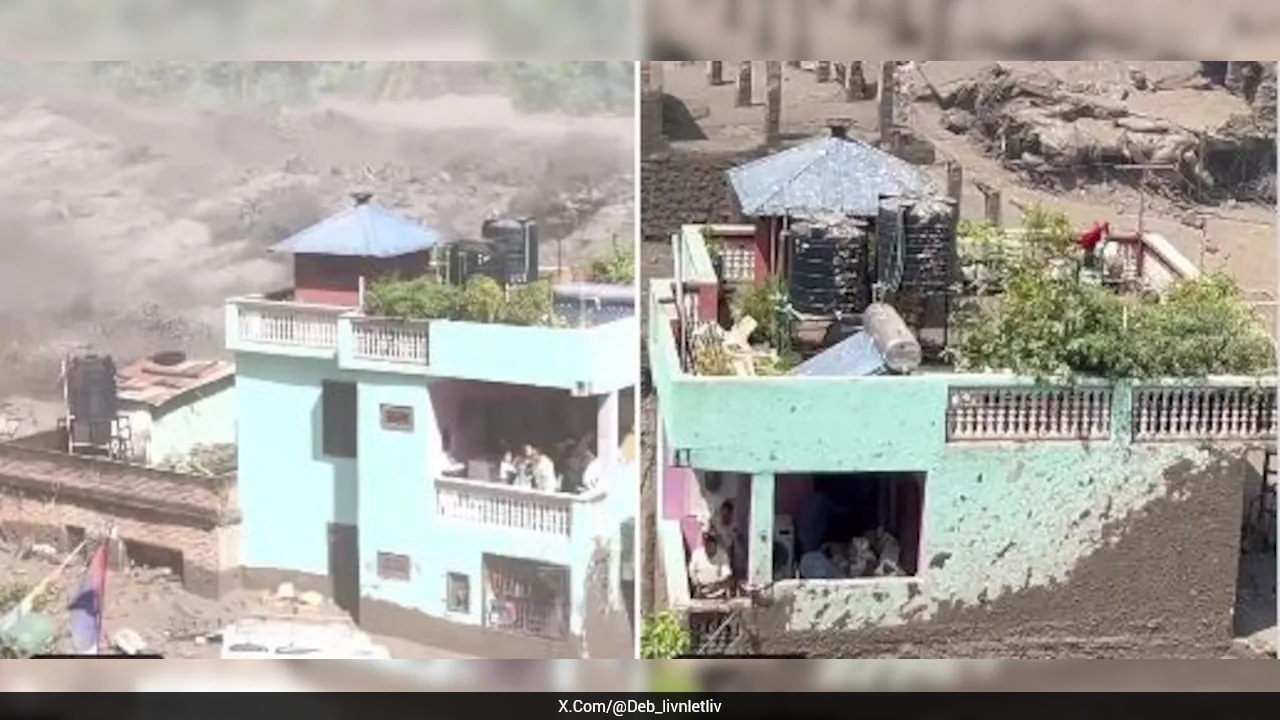
The water came down the valley with a sound like tearing metal.
It was not a clean blue tide. It was a churning slurry of liquefied hillside, uprooted pine trees, and crushed boulders, thick as wet cement and moving at thirty miles an hour. In a matter of minutes, the river swelled past its banks, rising up to swallow entire streets in central Nepal.
Then came the video that stopped millions of scrolling thumbs in their tracks.
In the middle of a roaring, chocolate-brown sea, neighboring houses were dissolving. Brick by brick, floor by floor, three-story homes tilted forward into the torrent and vanished like sugar cubes dropped into hot coffee. Yet right in the center of the destruction stood one lone house. A painted concrete home, completely surrounded by the flood, taking the full brunt of a deadly hydro-dynamic battering ram.
It did not shake. It did not tilt. It stood motionless while the world around it disintegrated.
On social media, the footage seemed almost supernatural. Commenters spun theories about lucky geometry, divine intervention, or secret military construction. But the truth behind why one home survived while a dozen fell around it is far more human, far more grounding, and infinitely more unsettling.
It was a story about decisions made in the daylight years before the storm ever arrived.
The Hidden Violence of Moving Water
To understand why buildings collapse in a flood, you have to abandon the idea that water merely pushes against a wall. Water is heavy. A single cubic meter of fresh water weighs two thousand pounds. When saturated with mud and gravel, that weight swells significantly.
When a river bursts into a neighborhood, it subjects a structure to three distinct forces of destruction simultaneously.
First is hydrostatic pressure—the sheer, dead weight of water piling up against the exterior walls. Second is hydrodynamic force—the energy of the moving current, multiplied by every drifting log and floating vehicle striking the foundation like a siege engine.
The third, and most lethal, force is scouring.
Scouring does not attack the walls. It attacks the earth underneath them. As high-velocity water rushes around a building, it creates powerful eddies. These underwater tornadoes dig into the soft dirt at the base of the foundation, sweeping away the soil millimeter by millimeter.
Think of a castle built on sand. You do not need to blow up the towers if you can simply wash away the ground beneath the moat.
Most homes in rapidly growing river corridors are built on shallow footings. Builders dig down three or four feet, pour a thin layer of concrete, and begin laying brick. It is cheap. It is fast. Under normal conditions, it works perfectly fine.
When the river rises, however, the water sweeps away those four feet of soil in seconds. The foundation is left floating in midair. Unsupported, gravity takes over. The house snaps under its own weight and slips into the river.
The Concrete Roots Beneath the Mud
Why did the viral home refuse to budge? The answer lies buried under dozens of feet of mud, where no camera could reach.
Consider a hypothetical builder named Ramesh. When Ramesh set out to construct his family home on the bank of a monsoon-prone river, he faced a choice that every landowner faces. He could spend his budget on visible luxuries—tiled floors, wide balconies, decorative paint—or he could spend it under the dirt.
Ramesh chose the dirt.
While his neighbors dug shallow trenches, Ramesh brought in heavy equipment to drill deep into the earth. He drove structural piles straight down through the soft topsoil, through the riverbed silt, until the reinforced concrete legs struck dense, unyielding bedrock.
When the floodwaters tore through the neighborhood, scouring cleared away the topsoil around Ramesh's house just as it had everywhere else. The dirt vanished. But his house was not resting on the dirt. It was anchored directly to the mountain underneath.
The mud tried to pull the ground out from under the home, but the home was locked into the planet itself.
The Web of Steel
Anchor legs alone are not enough to survive a flash flood. If the upper structure is weak, the force of the river will simply shear the house off its legs at ground level.
This is where the internal framing becomes a matter of life and death.
Many low-rise buildings are built with load-bearing masonry. Bricks are stacked on top of bricks, bound together by mortar, carrying the weight of the roof. Brick is wonderful for compressive loads, holding things up against gravity. But brick is notoriously weak against lateral forces—the side-to-side shoving of a raging river.
When heavy debris strikes a brick wall, the wall cracks. Once one wall breaks, the box loses its structural integrity. The roof falls in, and the entire structure collapses like a house of cards.
The surviving Nepal house was built using a continuous reinforced concrete frame, known in engineering as a monolithic structure.
Vertical columns and horizontal tie-beams were poured as a single, uninterrupted unit, laced internally with thick grids of steel rebar. The walls were not holding up the roof; the structural steel skeleton was holding up everything.
When the river struck, the house did not behave like a pile of stacked bricks. It behaved like a single, solid iron vault. The steel inside the concrete absorbed the massive kinetic energy of the water, distributing the strain across the entire frame rather than letting a single point shatter.
The river pushed with thousands of pounds of pressure, but the skeleton held its shape.
The Geometry of Survival
There was another, quieter factor at play in the survival of the house: positioning and shape.
Water, like electricity, follows the path of least resistance. When a fluid hits a broad, flat plane head-on, it releases maximum force against that surface. If a building faces the incoming current directly with a broad, flat wall, it absorbs a catastrophic amount of drag.
The standing house was positioned at a subtle angle to the main channel of the flood. Instead of acting as a dam, its leading corner cut into the current like the prow of a ship.
The water split. It lost a fraction of its concentrated kinetic energy as it was forced to flow around the sides of the structure rather than smashing directly into a flat obstacle.
Furthermore, the ground floor of the house was not fully enclosed with decorative glass or weak partition walls. As the flood reached its peak, water blew through the lower doors and windows, filling the ground floor.
It sounds counterintuitive, but letting water inside saved the house.
When water fills the lower level of a heavy concrete structure, two things happen. First, it equalizes the pressure on the inside and outside of the exterior walls, preventing them from imploding inward. Second, the sheer weight of the water sitting inside the ground floor acts as extra ballast, pinning the house even more firmly to its deep foundations.
The house became heavier, more grounded, and harder to move precisely when the river was at its most aggressive.
The Cost of What We Cannot See
It is easy to watch a fifteen-second video on a phone screen and treat it as a miracle. It is easy to point at a standing house and talk about luck.
Calling it luck misses the point entirely.
The standing house survived because someone made a series of expensive, invisible decisions long before the sky turned grey. They paid for extra tons of steel rebar that no visitor would ever compliment. They paid engineers to survey subsoil geology that no one would ever see. They chose heavy concrete over cheaper, faster brickwork.
In human societies, we tend to reward what is visible. We applaud the fresh coat of paint, the modern facade, the quick build time, the low price tag. We construct entire towns on the assumption that tomorrow’s weather will look exactly like yesterday’s.
Building for the worst case scenario feels paranoid right up until the moment the river breaks its banks. Then, it looks like genius.
When the flood finally receded in Nepal, the landscape was left unrecognizable. Where a bustling street had been, there was only a grey expanse of river mud, shattered timber, and twisted scrap metal.
And right in the middle of the waste stood the solitary house.
Its ground floor was caked in dried silt. Its walls were scarred by floating debris. Its paint was stained brown up to the second story. But the roof was level. The frame was straight.
It stood in absolute silence, a stark monument to the invisible work that keeps us safe when the world dissolves around us.