The dirt road outside the university gate was baked hard by the afternoon sun, smelling faintly of exhaust, dust, and cheap fried dough. Students spilled out in cheap polyester gowns bought online, clutching rolled-up pieces of cardstock that promised a future nobody could quite afford. Parents sweated through Sunday church clothes, holding up smartphones with cracked screens to capture a moment of brief, hard-won triumph.
Then came the goat.
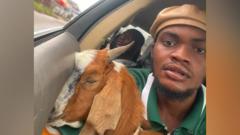
It wasn't a stuffed mascot or a clever prank dreamed up by an engineering fraternity. It was a living, breathing, four-legged ruminant with amber-colored eyes, an insatiable curiosity for plastic tassels, and a white coat dusty from the back of a pickup truck. Tied to a pale blue tether, the animal stood calmly amid the sea of academic achievement, chewing something that looked suspiciously like an uncollected parking ticket.
When twenty-one-year-old Marcus lifted the goat into the air by its midsection for a photo op, the internet collectively stopped scrolling.
We live in a culture saturated with predictable milestones. The posed coffee-shop laptop shot. The LinkedIn announcement written with the enthusiasm of a hostage video. The generic bouquet of grocery store roses wrapped in cellophane that will wilt before the lease is signed. We are drowning in a sea of manufactured perfection, scrubbing our lives until they gleam with the sterile sheen of corporate optimization.
Which is precisely why a horned farm animal wearing a miniature mortarboard detonated across social feeds like a lightning strike.
To understand why this bizarre graduation gift went viral, you have to look past the instant dopamine hit of the double-tap. You have to look at the quiet desperation of the modern graduate. Gen Z and millennial young adults are stepping off stages into an economic landscape where entry-level jobs require three years of experience, housing costs swallow entire paychecks, and the traditional American Dream feels less like a promise and more like an elaborate practical joke.
Marcus didn't want another plaque. He didn't need a mug. His family, scraping by in a rural county where practicality is a survival mechanism, understood something profound about the nature of higher education today. A degree is expensive. A degree is abstract. A degree, by itself, cannot produce milk, clear brush, or provide a tangible return on investment before the interest on student loans kicks in.
So they gave him a goat.
Let's call her Daisy. Daisy didn't care about GPA cutoffs or cumulative credits. Daisy cared about clover, shade, and whether Marcus was going to scratch behind her left ear. When the photo hit TikTok and X, the algorithms did what algorithms do. They fed the anomaly to millions of exhausted eyes. But the reason it stuck—the reason people saved it, shared it, and wrote thousands of comments ranging from uproarious laughter to sudden, unexpected tears—was the raw, unfiltered authenticity of it.
Humor is often just tragedy that has had time to put on a funny hat.
Think about the sheer absurdity of modern coming-of-age rituals. We spend four years and tens of thousands of dollars learning how to parse data streams and write algorithmic code, only to graduate into an economy driven by gig work and algorithmic whims. Against that backdrop, gifting livestock isn't just a quirky rural joke. It is a brilliant, subversive protest. It is a return to utility.
Within forty-eight hours, the post had accumulated millions of views. Media outlets came sniffing around like stray dogs, looking for a quick, quirky human-interest story to pad their morning feeds. They wanted a soundbite. They wanted Marcus to say it was just a prank. They wanted the viral moment to be hollow.
Instead, Marcus leaned into the truth. The goat wasn't a joke. It was an asset.
In the weeks following graduation, Daisy became an unexpected local celebrity. She lived in a shaded pen behind Marcus’s family home, munching away at invasive weeds and keeping the grass neatly trimmed without the aid of a fossil-fuel-guzzling lawnmower. She became a living anchor to a lifestyle that capitalism has spent decades trying to eradicate: self-sufficiency, slow living, and a connection to the earth that doesn't require a subscription model.
Viral fame is a fickle, hollow god. It builds castles out of cloud vapor and tears them down with a single refreshed feed. Most viral stars fade within a week, replaced by the next dancing cat or public meltdown. But Marcus and Daisy survived the spotlight because their story wasn't manufactured in a content incubator. It was rooted in dirt, sweat, and genuine family love.
There is a lesson hidden in the hooves of that graduation goat.
We spend so much of our lives chasing symbols of success that look good on a digital dashboard. We buy things we don't need with money we don't have to impress people we don't even like. We chase titles, badges, and metrics that evaporate the moment the platform updates its terms of service.
We need fewer metaphors. We need more goats.
As the sun sets over the small-town pasture, casting long, golden shadows across the grass, Marcus sits on an overturned plastic bucket, watching Daisy nibble on a patch of dandelion weeds. His college diploma is tucked away in a cardboard box somewhere inside, gathering dust next to old notebooks. But the goat is real. The grass is short. The evening air is cool and quiet. And out there in the vast, noisy digital ether, millions of people are still scrolling, searching for something—anything—that feels like it was touched by a human hand instead of a machine.