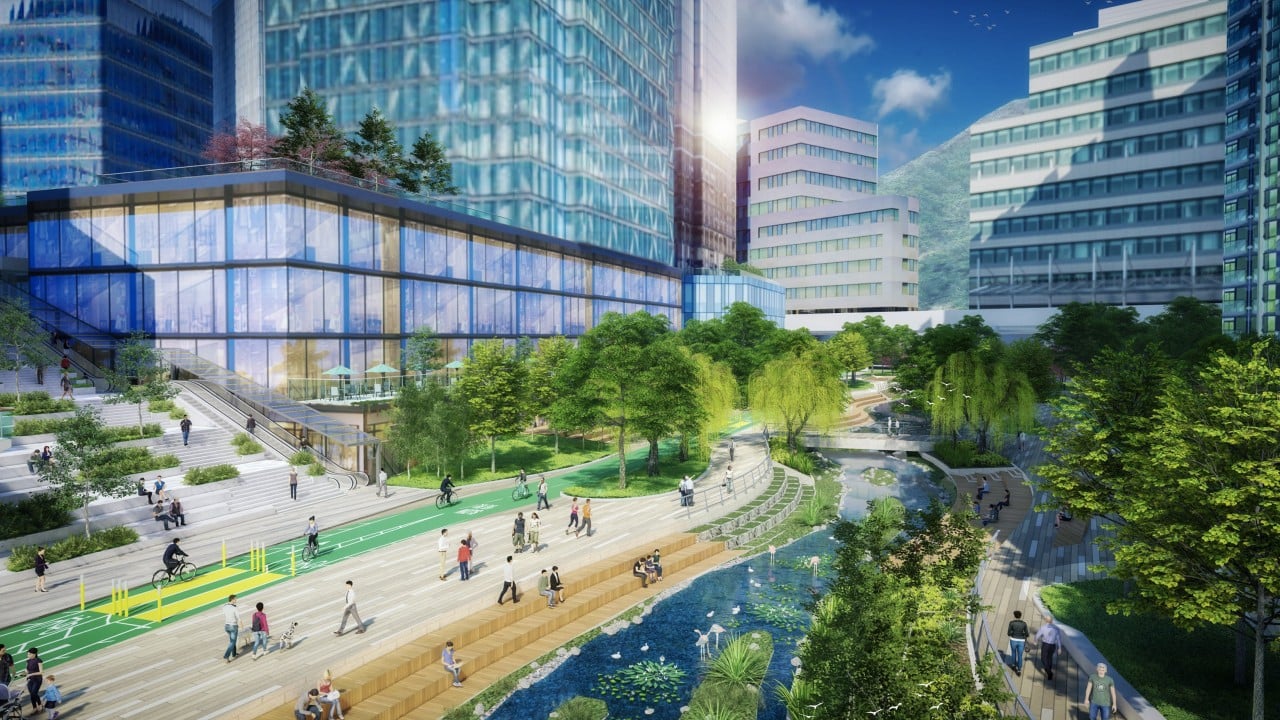
Everyone in Hong Kong real estate and higher education is applauding the government's HK$10 billion loan scheme for the Northern Metropolis university town. And when officials casually suggest they might seek even more funding if that pot runs dry, the local press treats it like an act of visionary generosity.
It isn't. It is a symptom of a fundamental misunderstanding of how world-class innovation hubs are actually built. In similar developments, take a look at: Why Copper Prices Are Dropping Over AI Backlash Fears.
When bureaucrats talk about throwing another few billion dollars at campus infrastructure, they are operating on a 20th-century industrial playbook. Pour concrete. Erect glass towers. Subsidize the debt. Wait for Nobel Prizes and unicorns to magically appear.
They won't. Not like this. Investopedia has analyzed this fascinating subject in extensive detail.
If you look closely at the mechanics of the HK$10 billion loan scheme—designed to help self-financing post-secondary institutions build campuses and student hostels in the Northern Metropolis—the "lazy consensus" is obvious. Policymakers and commentators assume the bottleneck is capital expenditure. They believe that if the initial HK$10 billion proves insufficient due to construction inflation or high demand, simply topping up the credit line will guarantee success.
That logic is backwards. Throwing more subsidized debt at universities does not create an intellectual powerhouse. It creates over-leveraged landlords.
The Infrastructure Trap in Higher Education
I have watched municipal governments across Asia and Europe burn billions on "innovation districts" and "knowledge cities" that ended up as gleaming, half-empty office parks. The failure mode is always identical. Planners obsess over physical square footage while ignoring the economic and regulatory friction that prevents talent from actually colliding.
Let's define what a university town actually is in economic terms. It is not a zoning designation. It is a high-density agglomeration of human capital where the transaction costs of collaboration—between researchers, venture capitalists, corporate R&D labs, and students—drop close to zero.
A loan scheme, even one priced at concessionary or interest-free rates, does not lower transaction costs. It shifts construction financing onto the public balance sheet while leaving institutions holding massive long-term liabilities.
Consider the math facing Hong Kong's self-financing institutions. Under the scheme, institutions borrow to build facilities in Hung Shui Kiu, Ha Tsuen, Ngau Tam Mei, or New Territories North. Even with favorable repayment terms, those loans must be serviced. How does a self-financing college service hundreds of millions in capital debt?
Only two ways exist:
- Raise tuition fees.
- Aggressively expand student enrollment, primarily by recruiting non-local students.
When an institution's survival depends on maximizing headcount to pay off a government construction loan, academic rigor becomes secondary to occupancy rates. You end up optimizing for dorm beds filled rather than breakthroughs commercialized. If the HK$10 billion fund runs short and the government simply injects more loan capital, it amplifies that exact distortion. More concrete. More debt. More pressure to turn universities into diploma mills just to service the interest.
Why Subsidized Loans Distort Institutional Incentives
To understand why topping up the loan scheme is the wrong move, look at how real capital allocation works in top-tier academic ecosystems.
In places like Kendall Square in Cambridge, Massachusetts, or the Stanford Research Park in Palo Alto, the government did not hand out massive, state-backed construction loans to mid-tier teaching colleges and hope a tech ecosystem would sprout. Instead, anchor research universities partnered directly with private developers and institutional investors.
Look at the difference in risk allocation:
- The Hong Kong Loan Model: The government acts as a retail bank, lending money directly to schools to build bespoke campuses. If construction costs overrun—a chronic certainty in Hong Kong, where construction labor and material costs rank among the highest globally—the school asks for more loan money, and the taxpayer absorbs the credit risk.
- The Endowment and Ground-Lease Model: Universities monetize land through long-term commercial ground leases with private life-science and tech developers. The private sector bears the construction risk, builds multi-tenant wet labs and flexible workspaces, and captures upside only if the ecosystem actually attracts paying corporate tenants.
When Hong Kong's Education Bureau hints that more funding could be sought if the HK$10 billion falls short, they are signaling to institutions and contractors alike that the budget constraint is soft. In public finance, a soft budget constraint is fatal. As Hungarian economist János Kornai famously demonstrated when analyzing state-backed enterprises, when organizations know a bailout or a funding top-up is waiting in the wings, cost discipline evaporates immediately.
Contractors pad their bids. Institutions design bespoke, non-transferable vanity buildings instead of modular, adaptable spaces. And the final bill balloons well past HK$10 billion without adding a single square foot of actual research capacity.
Answering the Questions Nobody Is Asking
Whenever this topic surfaces in Legislative Council panels or local business forums, the conversation gets stuck on predictable, surface-level questions. Let's dismantle the flawed premises behind them.
Will HK$10 billion be enough to build the Northern Metropolis university town?
Asking whether HK$10 billion is "enough" is like asking how much gasoline you need for a car with no engine. It is the wrong metric entirely.
Hong Kong consistently ranks among the most expensive construction markets in the world, frequently trading the top spot with New York, San Francisco, and Zurich according to Turner & Townsend's International Construction Market Survey. A single mid-sized academic building with specialized laboratories and student housing easily runs into the billions of Hong Kong dollars. Spread across multiple self-financing institutions, HK$10 billion will barely cover site formation, basic podiums, and a handful of residential towers.
Of course it will fall short. That isn't a surprise; it is basic arithmetic. The real question is why taxpayers should act as the sole mezzanine lender for real estate development in an unproven peripheral district.
How does the university town compete with Shenzhen's innovation hubs?
It doesn't—not if it relies on real estate subsidies. Just across the Shenzhen River, districts like Nanshan and Guangming Science City already possess massive, state-backed R&D infrastructure, cheaper land, and direct proximity to hardware supply chains in Dongguan and Huizhou.
Trying to out-build Shenzhen in physical square footage is a losing game. Hong Kong's structural advantage has never been cheap concrete. Its advantage is the common law system, unrestricted capital flows, global academic credibility, and intellectual property protection recognized in New York and London.
If the Northern Metropolis university town focuses on physical expansion funded by government loans rather than regulatory arbitrage—such as streamlined cross-border data flows, fast-track clinical trial approvals, and tax-free IP licensing—it becomes a slightly more expensive, slower version of Shenzhen.
Should the government offer grants instead of loans?
No. Direct capital grants are even worse than loans because they remove all market discipline. If an institution gets free money to build a campus, it has zero financial skin in the game regarding whether its graduates get hired or its research gets cited.
The solution is neither bigger loans nor free grants. It is changing the financing mechanism entirely.
What Actually Builds a Global Education Hub
If policymakers want the Northern Metropolis to become a genuine magnet for global talent rather than a debt-laden suburban sprawl, they need to stop acting like a mortgage lender and start acting like a market maker.
1. Replace Direct Construction Loans with Blended Public-Private Infrastructure Vehicles
Instead of lending HK$10 billion (or HK$20 billion) to individual schools to build isolated campuses, pool that capital into a dedicated infrastructure co-investment fund. Require private institutional capital—pension funds, sovereign wealth funds, and real estate investment trusts—to match every public dollar at a 2:1 or 3:1 ratio.
Private investors will enforce ruthless cost control. They will demand shared facilities—centralized auditoriums, multi-institution wet labs, shared student housing blocks—rather than letting five different colleges build five redundant libraries and five half-empty gymnasiums. Shared infrastructure cuts capital expenditure by up to 30% while forcing students and faculty from different institutions to interact daily.
2. Tie Capital Access to Commercialization and Employer Co-Funding
Stop underwriting real estate based on projected student headcount. Tie any public financing or land concession to hard output metrics:
- Percentage of curriculum co-designed and co-funded by industry partners.
- Number of corporate R&D labs physically co-located on campus.
- Track record of patent licensing and spin-out company formation.
If a tech giant or pharmaceutical firm is willing to sign a 10-year lease for research space inside a university building, that private lease revenue becomes the collateral that unlocks private bank financing. The government doesn't need to expand its loan scheme at all.
3. Build Transit and Housing First, Academic Towers Second
Imagine a scenario where three self-financing institutions finish their shiny new Northern Metropolis campuses on schedule, only for students and professors to face a grueling 75-minute multi-transfer commute from Kowloon or Hong Kong Island, with zero nightlife, scarce dining options, and limited healthcare nearby.
What happens? Enrollment targets miss. Faculty refuse to relocate. The buildings sit underutilized while the loan repayment clock ticks down.
Urban economist Edward Glaeser has spent decades proving that cities succeed because of density, amenities, and connectivity—not isolated monumental buildings. People do not move to university towns for the classrooms; they move for the neighborhood. Until the Northern Link railway is fully operational and private residential and retail zoning is activated simultaneously, pouring more loan money into standalone academic blocks puts the cart miles ahead of the horse.
The Honest Downside of Market Discipline
Taking the government's hand off the loan tap is not painless. Let's be clear about the trade-offs.
If you replace a soft-budget government loan scheme with strict private co-investment requirements and shared-facility mandates, smaller self-financing institutions will struggle. Many lack the balance sheets, endowment reserves, or corporate relationships to attract private institutional partners. Some expansion plans would inevitably be delayed, scaled back, or consolidated.
Politically, that is uncomfortable. Saying "we are expanding the HK$10 billion loan fund to support education" makes for a clean press release. Saying "we are forcing institutions to share facilities and prove commercial viability before touching public capital" invites pushback from school boards and local stakeholders.
Yet comfort in the short term guarantees mediocrity in the long term. Hong Kong does not suffer from a shortage of concrete, nor does it suffer from a shortage of public credit. It suffers from an obsession with hardware over software—believing that if you just finance a big enough building, greatness will move in.
Stop asking how many more billions to add to the loan scheme. Fix the incentives, bring in private risk capital, and make the institutions earn the concrete.