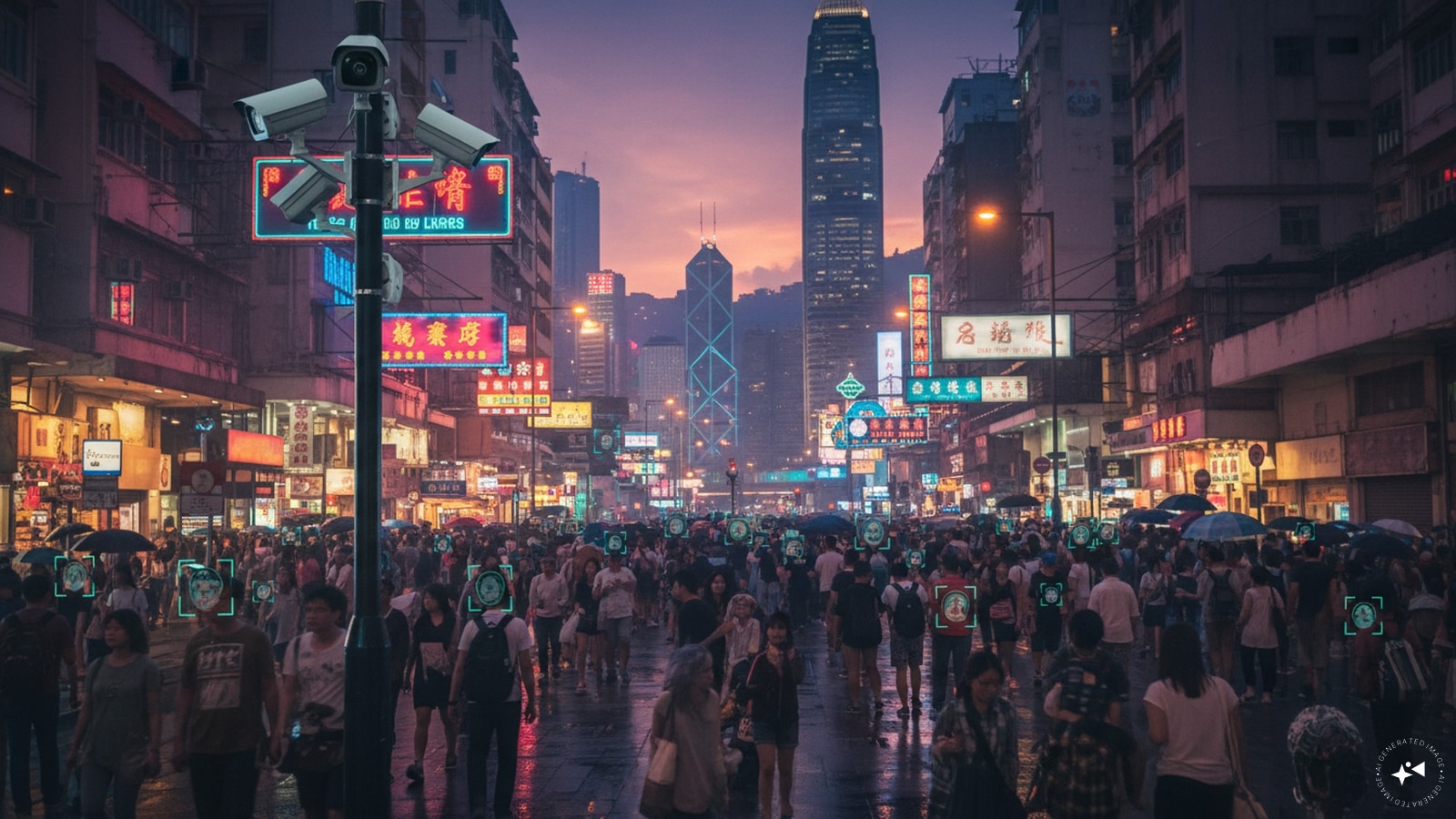
Every tech journalist in the Western hemisphere just copy-pasted the exact same press release about Hong Kong scaling its closed-circuit television network toward 60,000 AI-enabled cameras. They all dusted off the same tired George Orwell quotes, slapped a stock photo of a glowing blue biometric grid over a blurred crowd, and called it a day.
They missed the entire story.
The lazy consensus says that bolting facial recognition onto 60,000 municipal lenses creates an omniscient, inescapable digital panopticon. That narrative makes for great dystopian clickbait, and it is practically a wet dream for enterprise surveillance vendors trying to inflate their valuation multiples. In reality, anyone who has actually architected, deployed, or audited municipal-scale computer vision knows the truth. Scaling facial recognition to 60,000 cameras in a hyper-dense, subtropical metropolis does not create an all-seeing eye. It creates a thermodynamic, mathematical, and operational nightmare.
If you want to understand what is actually happening on the streets of Kowloon and Hong Kong Island, stop reading privacy panic pieces and start looking at edge-compute bottlenecks, base-rate fallacies, and network bandwidth physics.
The Hardware Fallacy of 60,000 Lenses
Let us define our terms precisely so we stop confusing marketing brochures with engineering reality. When municipal governments talk about "AI-powered CCTV," they are almost never talking about real-time, continuous, 4K facial identification across every single frame of every single camera simultaneously.
Do the math.
A single 1080p video stream running at 30 frames per second requires roughly 4 to 8 megabits per second of bandwidth depending on compression codecs like H.265. Multiply that by 60,000 cameras, and you are trying to push upwards of 300 to 480 gigabits of continuous raw video data per second back to a centralized data center. Even with Hong Kong’s world-class fiber infrastructure, backhauling that volume of raw video solely to run convolutional neural networks on a central GPU cluster would melt the utility budget before a single warrant was ever served.
I have sat in war rooms where municipalities and massive retail conglomerates blew tens of millions of dollars learning this exact lesson the hard way. They bought the cameras, mounted them on poles, and realized they lacked the backhaul capacity and GPU inference compute to actually process the feeds.
To get around this, vendors push "edge AI"—putting low-power neural processing units directly inside the camera housing so the device extracts facial embeddings locally and only sends lightweight metadata packets back to the server. Sounds clean on a pitch deck. In the real world, stuffing a heat-generating AI chip inside a sealed, weatherproof aluminum housing in a city where summer humidity regularly hits 90 percent and temperatures sit at 33 degrees Celsius is a recipe for silicon degradation. Thermal throttling kicks in, frame rates drop, sensor noise spikes, and the expensive AI camera quietly reverts to being a dumb, overheated webcam.
The Base-Rate Trap That Ruins Mass Surveillance
Even if every single one of those 60,000 cameras stayed ice-cold and streamed crystal-clear video, facial recognition still collides head-first with basic probability theory.
Computer vision engineers measure facial recognition accuracy using two metrics: False Match Rate (FMR) and False Non-Match Rate (FNMR). Under pristine, controlled laboratory conditions—like a well-lit border control kiosk where a traveler stands still, looks straight into a lens at eye level, and removes their glasses—modern algorithms achieve astonishingly low error rates. The National Institute of Standards and Technology (NIST) Face Recognition Vendor Test regularly documents top-tier algorithms hitting error rates below 0.1 percent in one-to-one verification.
Street-level CCTV is not a border kiosk.
Cameras mounted on utility poles look down at steep angles. Hong Kong’s urban canyons create harsh, uneven backlighting from neon signage and skyscrapers. Pedestrians wear surgical masks, hats, and sunglasses, look down at their smartphones, and move through dense crowds where faces are partially occluded every half-second. Under those uncontrolled "in-the-wild" conditions, algorithm performance degrades precipitously.
Now apply the base-rate fallacy. Imagine a scenario where a system has a 99.9 percent accuracy rate—meaning a 0.1 percent false positive rate—and it scans a watchlist of 1,000 wanted individuals against the millions of daily pedestrian passes across 60,000 cameras. Even a microscopic false positive rate, multiplied across hundreds of millions of daily face detections, generates tens of thousands of false alarms every single week.
Human operators have to verify those alerts. When an alert dashboard lights up every four seconds with a false match—flagging an innocent grandmother buying vegetables because the lighting angle warped her facial geometry—operator fatigue sets in within hours. Law enforcement stops trusting the feed, turns down the sensitivity thresholds, and suddenly the multi-million-dollar AI system misses actual targets because the threshold was tuned so strictly that anyone wearing a baseball cap goes undetected.
Why Competitors Are Asking the Wrong Question
When readers search for news about Hong Kong’s surveillance expansion, they are usually asking one of two questions: "Can Hong Kong's cameras track everyone in real time?" or "How do you defeat AI facial recognition?"
Both questions miss the mark because they assume the primary function of a 60,000-camera grid is live, real-time tracking of the general population.
It is not.
The real power of a massive camera network is not live facial recognition; it is retrospective forensic indexing.
If you want to understand how modern urban policing actually uses these systems, forget the Hollywood fantasy of a red box locking onto a target's face while an operator drinks coffee and watches a live map. That happens in targeted, high-priority operations with a small, tightly curated watchlist—perhaps a few dozen high-value suspects—where false positives can be manually triaged.
For the other 99 percent of operations, facial recognition is too brittle, too expensive, and too legally and technically noisy. Instead, municipal operators rely on two much simpler, far more reliable computer vision techniques:
- Automated License Plate Recognition (ALPR): License plates are standardized, high-contrast, flat geometric rectangles designed specifically to be read by machines. OCR (Optical Character Recognition) on license plates works at night, in rain, and at highway speeds with near-perfect reliability.
- Soft Biometrics and Re-Identification (Re-ID): Instead of trying to match a blurry face, modern video analytics index clothing color, gait, backpack shape, height, and trajectory. If an incident occurs at 2:14 PM outside a Wan Chai MTR station, investigators do not need a facial match to track the suspect. They draw a bounding box around a person wearing a yellow jacket and carrying a black messenger bag, and the system queries the indexed metadata across nearby cameras to stitch together their path backward and forward in time.
That is the nuance the mainstream tech press completely missed. By obsessing over facial recognition—the flashiest, most controversial, and least reliable layer of the stack—critics are fighting yesterday's battle while ignoring the boring, hyper-efficient metadata indexing that actually does the heavy lifting.
What Security Architects and Privacy Engineers Should Actually Do
If you are an enterprise security director, a municipal planner, or a systems architect watching Hong Kong’s rollout and thinking about how to build—or defend against—large-scale visual intelligence, stop buying into vendor hype. Here is what actually works in the field:
- Ditch real-time facial matching for broad watchlists. If you are deploying commercial video analytics for a transit authority, airport, or corporate campus, cap your live facial watchlist at under 500 high-priority profiles and mandate strict two-person human verification before any physical intervention occurs. Anything larger will drown your security operations center in false positives and expose your organization to massive liability.
- Invest in metadata indexing, not raw storage. Storing 30 days of continuous high-definition video from tens of thousands of endpoints is financial suicide. Configure your architecture to extract structured, anonymized object metadata (timestamps, bounding boxes, vector trajectories, vehicle classifications) at the edge, and purge raw video buffers on an aggressive 7-to-14-day rolling cycle unless an incident tag locks the file.
- Audit the glass, not just the neural network. I have seen teams spend six figures licensing top-ranked NIST facial recognition algorithms only to feed them footage from cheap, low-dynamic-range sensors behind dirty polycarbonate domes. A $200 increase in optical sensor quality and infrared illumination beats a $200,000 software upgrade every single time. Garbage pixels in, garbage embeddings out.
- For privacy advocates and civil society researchers, stop obsessing over anti-facial-recognition makeup and IR-blasting glasses. Those gimmicks only fool naive, single-frame facial detectors. Modern tracking systems rely on multi-camera Re-ID—stitching together your silhouette, stride length, clothing patterns, and the MAC address pings leaking from the smartphone in your pocket. If you want to understand modern surveillance, audit the data brokers, telecom tower dumps, and cross-camera Re-ID pipelines, not just the face-matching models.
The Uncomfortable Reality of the Contrarian View
Admitting that 60,000 AI cameras cannot magically identify every face on a crowded street does not mean the system is harmless. That is the trap of toxic optimism, and I refuse to fall into it.
Even a flawed, thermally throttled, false-positive-plagued surveillance grid creates a profound chilling effect. People do not alter their behavior based on the NIST benchmark accuracy of an algorithm; they alter their behavior because they see a lens staring down from every streetlight. The mere perception of ubiquitous biometric monitoring enforces self-censorship long before a single GPU processes a frame. Furthermore, as edge silicon improves and multi-modal tracking fuses visual data with transit card taps and cellular location logs, the technical friction that currently limits mass facial recognition will steadily erode.
Right now, though, there is a massive gap between the marketing myth of omniscient AI surveillance and the messy engineering reality on the ground.
Stop treating press releases about camera counts as proof of an infallible digital god. Start auditing the compute budgets, error rates, and forensic metadata pipelines behind the glass—because the people running these systems know the limitations, and they are counting on you not to.