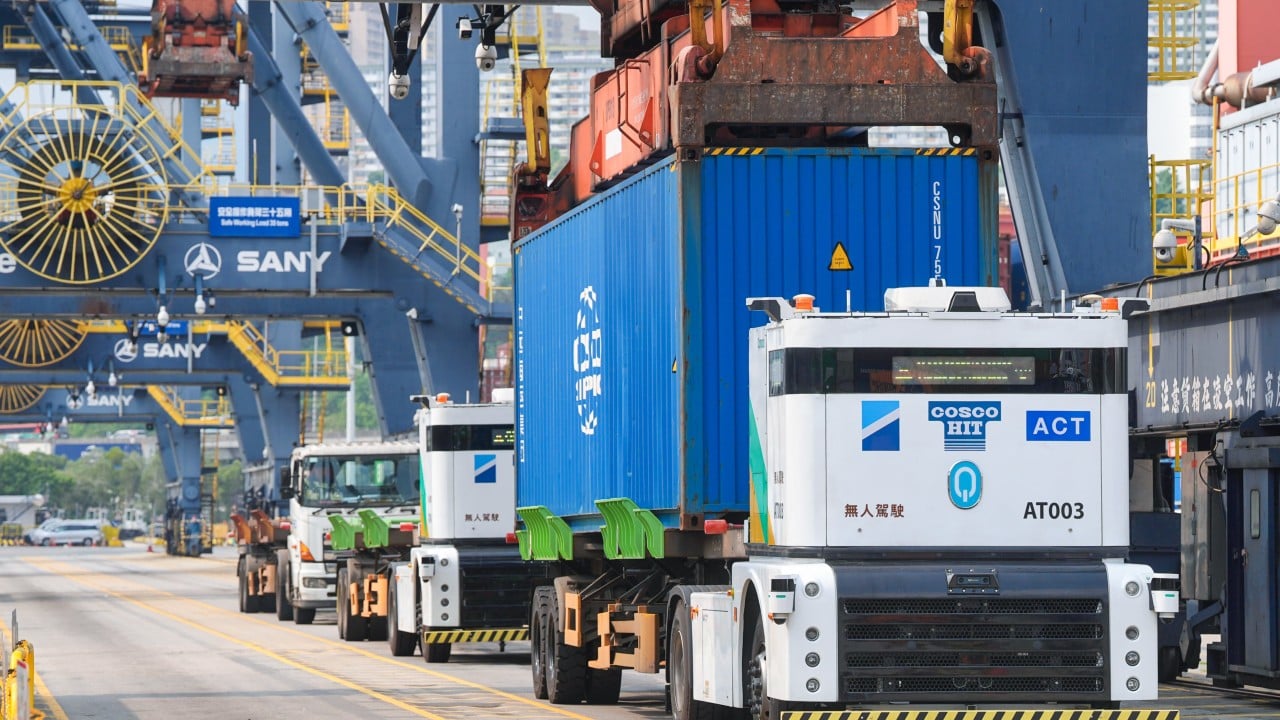
The shipping industry is finally admitting what terminal operators have whispered for years. The human element of logistics is no longer a sustainable cost. In the Kwai Tsing Container Terminals, a fleet of electric, autonomous Q-Trucks has begun moving cargo without a single soul behind the wheel. While initial reports frame this as a friendly response to a local labor shortage, the reality is far more aggressive. This is not just a patch for a missing workforce; it is a fundamental restructuring of how global trade interfaces with the land.
Hong Kong faces a chronic deficit of roughly 800 to 1,000 container truck drivers. The average age of a licensed haulier in the territory now skews toward 60. Young people do not want to sit in a vibrating steel box for twelve hours a day in the humid heat of the New Territories. Westwell, the Shanghai-based firm behind the Q-Truck, recognized this vacuum and filled it with a machine that requires no sleep, no health insurance, and no pension. Recently making waves in this space: Mitigating Marine Bycatch Logistics Optimization and Engineering Frameworks.
The Engineering of a Ghost Fleet
These autonomous vehicles do not look like trucks. They lack a cabin, a windshield, and a steering column. By removing the interface for a human driver, the manufacturers reduced the aerodynamic drag and the physical footprint of the vehicle. It is a four-wheeled slab of sensors and batteries.
The Q-Truck operates through a fusion of technologies that must work perfectly in one of the most chaotic environments on earth. A container terminal is a labyrinth of moving metal. To navigate this, the vehicles use a sensor suite that includes: Further details into this topic are detailed by MIT Technology Review.
- Multi-beam LiDAR: These sensors fire laser pulses to create a 3D map of the surroundings in real-time, detecting obstacles within centimeters.
- High-definition Cameras: These provide visual confirmation, identifying lane markings and standardized port signage.
- Millimeter-wave Radar: Essential for operating in the torrential rains common during Hong Kong's typhoon season, as radar can "see" through heavy precipitation that blinds cameras.
- GNSS and Inertial Navigation: These systems ensure the truck knows its exact position on the terminal grid, even when skyscrapers or stacks of containers block satellite signals.
The logic is simple. A human driver makes decisions based on intuition and sight. A Q-Truck makes decisions based on a constant stream of telemetry processed by an onboard industrial computer. When a crane operator lowers a forty-foot box, the truck aligns itself with a precision that a human, fatigued by an eight-hour shift, simply cannot replicate.
The Economic Brutality of the Shift
Terminal operators are not investing in AI because they enjoy the novelty. They are doing it because the margins in the shipping business are becoming razor-thin. The "labor shortage" narrative serves as a convenient political shield against accusations of automation-driven job loss. If there are no workers to hire, the union cannot complain when a robot takes the spot.
However, the cost-benefit analysis goes beyond mere wages. A traditional internal combustion engine truck at the port wastes an incredible amount of energy idling in queues. The Q-Truck is fully electric. By switching to an autonomous electric fleet, terminal operators slash their carbon footprint—a metric that is becoming a hard currency in international trade due to new environmental regulations.
Efficiency is the primary product here. In a standard manual operation, the "handshake" between the quay crane and the truck is a point of friction. Drivers miss their marks. They take breaks. They get distracted. The autonomous system integrates directly with the Terminal Operating System (TOS). The TOS acts as the brain, the 5G network acts as the nervous system, and the Q-Trucks are the muscle. It is a closed-loop environment where every movement is optimized for speed.
The Hidden Complexity of the Hong Kong Grid
Implementing this in Hong Kong is significantly harder than in a greenfield site like the Port of Khalifa in the UAE. Hong Kong is a legacy port. It was built for humans, and it is cramped. The stacks are high, and the lanes are narrow.
The integration process involves "digital twinning." Before a single robot touched the asphalt in Kwai Tsing, the entire terminal was mapped and simulated. Every potential collision point was analyzed by an algorithm. This allows the AI to predict where a human-driven vehicle might behave erratically. Because the transition isn't overnight, these robots must coexist with the remaining human drivers. This "mixed-mode" operation is the most dangerous phase of port automation. Humans are unpredictable. Robots are not. When a human driver cuts off an autonomous truck, the robot's immediate reaction is to stop. In the early stages of deployment, this actually caused more congestion, not less.
The fix wasn't better driving; it was better communication. The trucks now broadcast their intentions to a central hub that monitors every moving part in the yard.
The Sovereignty of Software
There is a geopolitical layer to this deployment that most analysts ignore. Westwell is a Chinese company. By deploying Chinese autonomous systems in Hong Kong, the regional supply chain becomes further tethered to mainland hardware and software standards. This isn't just about moving boxes; it is about who owns the data of those movements.
The software running these trucks learns with every kilometer. It gathers data on container dwell times, crane efficiency, and traffic patterns. This data is gold. It allows the operator to predict bottlenecks before they happen. If a specific berth is consistently slow, the AI identifies the variable—whether it’s a specific crane model or a particular time of day—and suggests a bypass.
The Human Cost of Silence
While the port authority emphasizes that no one is being fired, the reality of "attrition" is a slow death for the profession. As the older generation of drivers retires, there are no apprentices to take their place. The skill of maneuvering a heavy articulated vehicle in a tight space is being digitized.
The job is shifting from the cab to the control room. A single "tele-operator" can now monitor a fleet of ten trucks from an air-conditioned office. They only intervene when the AI encounters an "exception"—a situation it hasn't seen before, like a stray piece of debris or a sensor malfunction. This is the new blue-collar reality. It is cleaner, safer, and arguably more boring. It also pays less because the specialized skill of driving has been replaced by the general skill of monitoring a screen.
Why the Tech Often Fails Initially
History is littered with failed automation projects. The reason most fail is not the software, but the infrastructure. If the 5G signal drops for even a second in a high-density metal environment, the trucks "fail safe" and grind to a halt. In a busy port, ten trucks stopping simultaneously creates a localized economic heart attack.
Hong Kong has invested heavily in private 5G networks specifically to avoid this. These are not the same networks your phone uses. They are hardened, low-latency bands dedicated to industrial traffic. Without this invisible infrastructure, the Q-Trucks are just expensive paperweights.
The transition also requires a massive overhaul of maintenance. You don't fix a Q-Truck with a wrench and a rag. You fix it with a laptop and a replacement LiDAR module. The port has had to retrain its mechanical staff to become electronics technicians. This shift in the labor force is the most significant hurdle for any port looking to follow Hong Kong’s lead.
The Global Domino Effect
What happens in Hong Kong doesn't stay there. The success of this deployment provides a blueprint for every other major transshipment hub. If a legacy, high-density port like Kwai Tsing can successfully automate its horizontal transport, then ports in Los Angeles, Rotterdam, and Singapore have no excuse.
The barrier to entry for autonomous trucking is falling. The hardware is becoming commoditized. The real value is in the "Stack"—the proprietary AI that manages the fleet. We are entering an era where the competitiveness of a nation’s port is determined not by its geographic location, but by the latency of its data networks and the sophistication of its algorithms.
The Inevitable Conclusion of the Human Haulier
The romanticized image of the long-haul trucker or the gritty port driver is a relic. The Q-Truck doesn't care about the view of the harbor. It doesn't care about the heat. It is a tool designed for a world that demands 24/7 productivity and zero-margin errors.
Investors are watching the Hong Kong rollout as a proof of concept for the "lights-out" terminal. This is a facility where the cranes, the trucks, and the gates all operate in the dark, without human intervention, governed entirely by a central AI. It is efficient, it is cold, and it is coming to every coastline on the planet.
The deployment of these trucks isn't a victory for labor; it is the final notice. The port of the future has no room for the fallibility of man. You either manage the machines, or you are replaced by them. There is no middle ground left on the docks. The silence of the electric motors in Kwai Tsing is the sound of an industry finally cutting the cord.
Invest in the software or get out of the way.