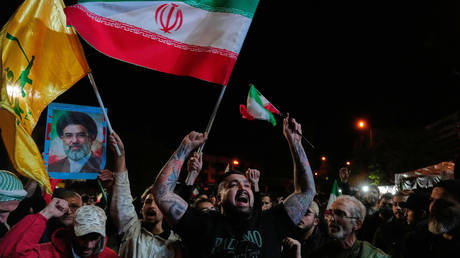
Tehran has achieved what once seemed impossible. By engineering a fragmented security environment across the Middle East, Iran has effectively neutralized the traditional military superiority of its rivals. This is not a victory born of economic strength or social cohesion, but rather a masterclass in asymmetric persistence. While the West focused on formal treaties and conventional deterrence, Tehran built a decentralized network of influence that makes traditional "victory" against them an expensive, perhaps impossible, proposition.
The regional map has been redrawn. It was not moved by tanks or standard divisions, but by a patient, forty-year investment in non-state actors that now function as an unofficial outer border for the Islamic Republic. From the Mediterranean to the Bab al-Mandab Strait, Iran-aligned groups dictate the flow of trade and the frequency of conflict.
The Architecture of Fragmented Power
Western military doctrine relies on the existence of a state. You can sanction a state. You can bomb its infrastructure. You can negotiate with its diplomats. Iran’s genius lies in making the state irrelevant. By supporting groups like Hezbollah, the Houthis, and various militias in Iraq, Tehran has created a "gray zone" where the rules of international law provide no leverage.
When a Houthi missile strikes a commercial tanker in the Red Sea, there is no Iranian return address on the wreckage. This provides Tehran with a layer of plausible deniability that renders traditional carrier strike groups nearly useless. You cannot deter a shadow. This strategy has forced the United States and its allies into a reactive posture, spending millions on interceptor missiles to down drones that cost less than a used sedan.
The cost-to-effect ratio is heavily skewed in Iran's favor. While Riyadh and Abu Dhabi poured billions into the latest fighter jets, Tehran focused on cheap, precision-guided munitions and the "human software" required to use them. They realized early on that they did not need to win a war; they only needed to make the status quo too expensive for their enemies to maintain.
The Failure of Maximum Pressure
Economic warfare was supposed to bring the system to its knees. The theory was simple: starve the treasury, and the regional ambitions would wither. Instead, the opposite happened. Under the weight of heavy sanctions, the Iranian Revolutionary Guard Corps (IRGC) tightened its grip on the domestic economy, effectively turning the country into a fortress state where the black market became the only market.
Sanctions did not stop the regional expansion. They merely forced the IRGC to become more creative in its financing. Today, the "Axis of Resistance" is largely self-sustaining through local taxation, smuggling routes, and illicit trade. By the time Western intelligence agencies track a financial node, the money has already moved through three different shell companies in three different jurisdictions.
The fundamental miscalculation was believing that Tehran shares the same risk-benefit analysis as a Western democracy. For the ruling elite in Iran, survival is the only metric of success. If the population suffers while the regional footprint expands, the regime views that as an acceptable trade-off. They are playing a multi-generational game of Go, while their opponents are playing a four-year cycle of electoral chess.
The Proxy Evolution
We often talk about these groups as "proxies," but that term is increasingly outdated. It suggests a master-slave relationship where Tehran pulls every string. In reality, these organizations have evolved into sophisticated political and social actors with their own internal logic.
Hezbollah as a State Model
Hezbollah is no longer just a militia; it is the most powerful political force in Lebanon. It provides healthcare, education, and security in areas where the official government has long since vanished. This creates a level of grassroots loyalty that cannot be broken by air strikes. When Tehran looks at Lebanon, it sees a successful prototype for how to hollow out a nation-state from the within and replace its functions with an ideological loyalist.
The Yemen Lever
The Houthis in Yemen represent perhaps the most significant strategic shift in the last decade. By securing a foothold on the Red Sea, they have given Iran the ability to choke global trade without firing a single shot from Iranian territory. This is not just a regional issue; it is a global economic reality. If the Bab al-Mandab is closed, the price of oil in London and New York spikes instantly.
The Nuclear Umbrella Without the Bomb
The most fascinating aspect of the current Middle Eastern order is that Iran has achieved nuclear deterrence without actually testing a weapon. By maintaining the capability to "break out" within weeks, they have created a permanent state of tension that forces the West to handle them with kid gloves.
They have turned their nuclear program into a diplomatic shield. Every time tensions rise in the Persian Gulf, the conversation shifts back to the centrifuges. It is a brilliant diversion. While the world's diplomats are locked in rooms in Vienna or Geneva debating enrichment percentages, the IRGC is on the ground in Baghdad and Damascus, cementing the next phase of their regional integration.
The New Security Architecture
We are witnessing the birth of a post-American Middle East. For decades, the region relied on the "security guarantee" provided by Washington. That guarantee is now viewed with deep skepticism by nearly every local player.
Nations that were once sworn enemies of Tehran are now hedging their bets. The normalization of relations between Iran and its neighbors is not a sign of newfound friendship. It is an admission of reality. If the United States is unwilling or unable to roll back Iranian influence, the regional players must find a way to live with it.
This has led to a series of paradoxical alliances. You see intelligence sharing between rivals and trade deals between countries that are simultaneously funding opposing militias. It is a messy, unstable equilibrium that favors the actor most comfortable with chaos.
The Internal Fragility
However, describing this as a total victory ignores the rot at the center. Iran’s regional success is built on a foundation of domestic failure. The gap between the regime’s geopolitical ambitions and the aspirations of its youth is a canyon that continues to widen.
A state that can project power in four foreign capitals but cannot provide steady electricity or a stable currency to its own citizens is inherently brittle. The IRGC has become a massive corporate conglomerate that happens to have an army, and like any over-leveraged corporation, it is vulnerable to a sudden loss of confidence.
The "victory" is also dependent on the continued dysfunction of its neighbors. Iran thrives in failed states. If Iraq, Syria, or Lebanon were to develop strong, transparent institutions, the Iranian model would lose its oxygen. Tehran does not offer a vision for prosperity; it offers a mechanism for survival in a broken world.
The End of the Interventionist Era
The primary takeaway for any analyst is that the era of "solving" the Iranian problem through external force or diplomatic grand slams is over. The regional presence is too deeply embedded to be extracted by anything short of a total regional war—a war that no one has the appetite or the resources to fight.
The focus must shift from "rollback" to "containment and competition." This requires a shift in how we define power. It is no longer about who has the most advanced aircraft, but about who can build the most resilient social structures.
Instead of trying to out-gun the militias, the challenge is to out-govern them. This is a slow, unglamorous process that does not fit well into a news cycle or a political campaign. It involves supporting local civil societies, building transparent financial systems, and providing a viable alternative to the "resistance" narrative.
Iran has indeed changed the Middle East, but they have done so by turning it into a collection of fiefdoms and shadows. They have won the battle for influence by ensuring that no one else can truly govern. It is a triumph of destruction over construction, and while it serves the immediate needs of the regime in Tehran, it leaves behind a region that is more volatile and less predictable than at any point in modern history. The new map is drawn in disappearing ink, and the only certainty is that the cost of maintaining this hollow victory will eventually come due.