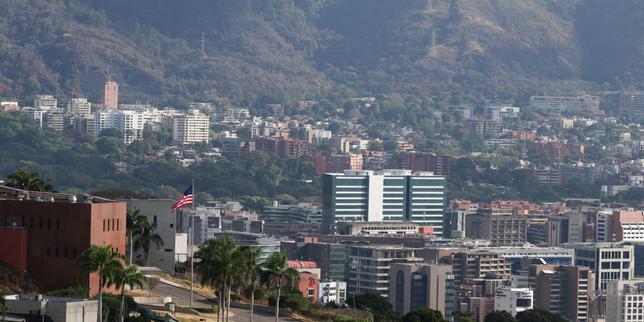
The heavy iron gates of the United States Embassy in the Valle Arriba district of Caracas are swinging open again, ending a seven-year period of diplomatic blackout that transformed the hillside compound into a ghost town of overgrown tropical weeds and silent corridors. This reopening follows the sudden, chaotic removal of Nicolás Maduro from power, an event that has fundamentally shifted the geopolitical map of the Western Hemisphere. While the immediate focus remains on the logistical sprint to restore consular services and secure the perimeter, the underlying reality is far more complex. The United States is not simply returning to a country; it is inheriting a structural wreckage that decades of sanctions and internal decay have rendered nearly unrecognizable.
Diplomacy in a vacuum rarely yields the clean results promised by televised handshakes. The State Department is currently rushing a skeleton crew of veteran officers back into a city where the power grid flickers and the local currency has long since surrendered to the dollar. For the thousands of Venezuelans waiting for visas or official recognition, the reopening represents a lifeline. For the American government, it represents the start of a grueling, decade-long project to pull a once-wealthy petrostate back from the brink of total failure. If you enjoyed this article, you should read: this related article.
The Long Shadow of the 2019 Severance
The road to this moment began in early 2019, when the Trump administration recognized Juan Guaidó as the legitimate leader, prompting Maduro to give American diplomats 72 hours to pack their bags. What followed was a period of "virtual diplomacy" run out of a specialized unit in Bogotá, Colombia. This arrangement was always a stopgap. Trying to influence the internal dynamics of a nation from across a border is like trying to perform surgery through a keyhole. You can see the patient, but you cannot stop the bleeding.
The absence of a physical presence meant the United States lost its eyes and ears on the ground. Intelligence became filtered through the lens of exile groups and regional allies, each with their own agendas. By the time Maduro was captured, the gap between Washington’s policy assumptions and the grim reality of life in the Caracas barrios had grown into a canyon. For another perspective on this development, see the recent update from BBC News.
Rebuilding From the Rebar Up
The physical restoration of the embassy is the easiest part of this equation. Contractors have already begun the process of sweeping the facility for listening devices and repairing the infrastructure that suffered during years of neglect. The real challenge lies in the bureaucratic and political restoration. Venezuela is not the same country it was in 2019. The institutional memory of the Venezuelan civil service has been hollowed out. Most of the professionals who once managed the technical aspects of the oil industry, the electrical grid, and the legal system are now living in Miami, Madrid, or Bogotá.
The United States finds itself in the position of a landlord returning to an apartment that has been stripped of its copper wiring.
The Energy Equation
The global energy market is watching this reopening with a level of scrutiny that borders on desperation. Venezuela holds the largest proven oil reserves on the planet, but its production capacity is currently a fraction of its peak. Years of underinvestment and the systematic purging of experts from PDVSA, the state oil company, have left the infrastructure in a state of advanced rust.
Washington’s primary interest here is stability. The Biden-era realization that Venezuelan heavy crude is essential for Gulf Coast refineries has led to a quiet but firm directive to prioritize energy security. We are seeing a shift from the rhetoric of "maximum pressure" to a more pragmatic "maximum extraction" strategy. This involves negotiating with remnants of the old guard and local power brokers who still control the flow of oil in the Orinoco Belt.
The Security Dilemma
Capturing a leader is not the same as dismantling a regime. The Maduro government was not a monolith; it was a patchwork of interests involving the military, paramilitary "colectivos," and foreign actors. As American diplomats settle back into their offices, they are surrounded by a city where non-state actors still hold significant territory.
The "Tren de Aragua," a transnational criminal organization that flourished under the previous administration’s lawlessness, now presents a direct threat to the stabilization efforts. The U.S. will have to decide how much it is willing to coordinate with the Venezuelan military—an institution that was the backbone of the Maduro regime—to maintain order. It is a classic diplomatic trap. To ensure safety, you must often shake hands with the very people who created the danger.
The Human Cost of the Gap
Behind the high-level negotiations are the stories of six million migrants. The reopening of the embassy signals the beginning of a massive repatriations debate. Will the U.S. begin deporting Venezuelans back to a country that is still largely broken? The consular section will be overwhelmed from day one with cases involving split families, expired passports, and the legal limbo of a generation born in exile.
Restoring these services is a moral imperative, but it is also a logistical nightmare. The embassy is expected to handle a volume of applications that would strain a facility three times its size. There is no blueprint for reintegrating a diaspora of this magnitude while simultaneously trying to stabilize a domestic economy plagued by hyperinflation.
Avoiding the Errors of the Past
History is littered with examples of the United States declaring victory after a regime change, only to find itself bogged down in an endless cycle of nation-building. The temptation to micromanage the new Venezuelan government will be strong. However, the political reality is that any administration perceived as a puppet of Washington will lose legitimacy within months.
The State Department’s new mission is to act as a facilitator rather than a director. This means allowing Venezuelan actors to negotiate their own transition, even if the results are messy or prioritize local interests over American corporate ones. The era of the "Proconsul" approach is dead. If this reopening is to mean anything more than a change in flag, it must be supported by a policy that acknowledges the deep scars left by the last decade.
The success of this mission will not be measured by the number of visas issued in the next six months. It will be measured by whether the lights stay on in Caracas next year, and whether the millions of people who fled feel it is finally safe enough to look toward home. The gates are open, but the house is still on fire.
The most pressing task for the returning diplomatic corps is to establish a credible channel of communication with the transitional authorities that does not rely on the old habits of patronage. Venezuela needs a functional judicial system and a transparent electoral framework more than it needs another round of emergency aid. The U.S. must resist the urge to flood the country with short-term solutions that provide good optics but fail to address the systemic corruption that allowed the previous regime to flourish. True stability requires a slow, deliberate reconstruction of the rule of law, starting with the very basics of property rights and administrative transparency.