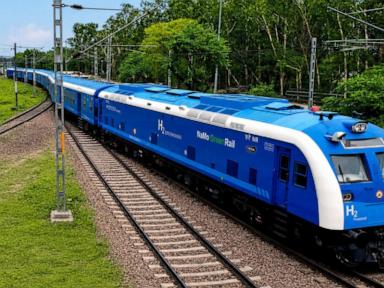
The pre-dawn air at the Jind railway station smells of damp earth, fried diesel exhaust, and anticipation. For generations, the rhythm of this junction in Haryana has been dictated by the heavy, shuddering idle of locomotives—massive steel beasts that cough thick soot into the sky, coughing life into the veins of a nation that moves by rail.
But on a recent Friday morning, a different sound emerged from the platform. Not a roar. Not a mechanical rattle. If you found value in this piece, you might want to look at: this related article.
A quiet, rhythmic hiss.
Imagine standing close enough to feel the warmth of steam, only to realize the exhaust is perfectly clean. It is pure water vapor. As the morning sun broke over the horizon, Prime Minister Narendra Modi raised a green flag, and a sleek, ten-coach passenger train glided out toward Sonipat. For another perspective on this event, check out the recent coverage from TechCrunch.
India has officially entered the hydrogen age.
The event marks the launch of the nation’s first indigenously developed hydrogen fuel cell-powered train. For a country whose railway system carries over seven billion passengers annually, the stakes behind this quiet departure could not be higher. It is a gamble on the future of clean energy, played out not in a pristine Silicon Valley laboratory, but on an 89-kilometer stretch of low-traffic rural track.
The Chemistry of Moving Millions
To understand why engineers are sweating over high-pressure storage tanks in Haryana, one must look at the invisible math of heavy transit. Indian Railways has already achieved something remarkable: over 99 percent of its broad-gauge network is electrified. But that final one percent—the remote tracks, the historic mountain loops, the local feeders—remains stubbornly tethered to diesel.
Running overhead electrical wires through every dense forest or historic mountain pass is an environmental and financial nightmare.
Enter the alternative. The new train does not pull electricity from wires overhead, nor does it burn fossil fuels in an internal combustion engine. Instead, it is a rolling chemical plant.
Consider how the mechanism actually functions: tucked inside two specialized Hydrogen Driving Power Cars are banks of Proton Exchange Membrane Fuel Cells. Compressed hydrogen gas, stored at immense pressure in cylinders, is fed into these cells alongside oxygen drawn directly from the surrounding air. When the hydrogen protons pass through a specialized polymer membrane, their electrons are forced through an external circuit.
Movement. Electricity. Power.
The byproduct of this elegant dance is not carbon dioxide, sulfur, or particulate matter. It is simply heat and moisture.
The numbers behind the system are staggeringly large. The train boasts a 3,200-horsepower propulsion system powered by a 1,200-kilowatt fuel cell environment, making it the longest and most powerful hydrogen passenger train currently operational anywhere in the world. While international pilots in Germany or Japan have typically relied on short, two-to-three-coach configurations, India built a ten-coach workhorse designed to carry up to 2,600 daily commuters.
The Human Weight of Clean Air
Statistics, however, have a way of flattening reality. The true weight of this technology is best understood through the eyes of someone like Ramesh, a hypothetical daily commuter who has taken the morning run from Jind to Sonipat for the last twenty years.
For two decades, Ramesh’s morning routine involved finding a window seat, only to pull it shut when the diesel locomotive upfront started accelerating, spitting a oily black haze back along the platforms. The noise was deafening; the air, thick enough to taste.
When the new hydrogen train, operating as train number 74010, glides into the station at 7:40 AM, the difference is visceral. The train is eerily quiet. As it accelerates toward its operational limit of 75 kilometers per hour, the usual violent vibrations of a diesel engine are replaced by the smooth hum of electric traction motors.
For the 2,600 people traveling inside the eight trailer coaches, the experience transitions from an endurance test to a modern transit experience. The air inside stays clean, supported by a specialized, non-stop ventilation system designed specifically for the unique properties of hydrogen.
But the real challenge of this project does not lie in the passenger experience. It lies in the shadows of the maintenance yards.
The Volatile Element
Hydrogen is the universe’s most abundant element, but it is also a fickle, restless ghost. It is exceptionally light, prone to leaking through the microscopic imperfections of standard metals, and highly flammable.
"Is it safe?"
It is the question every passenger thinks but rarely asks aloud. To answer it, Indian engineers built a multi-layered safety net under the guidance of the Research, Design & Standards Organisation. The train is laced with highly sensitive hydrogen leak detectors, flame sensors, and automated shut-off mechanisms. If the system detects even a trace of heat or unexpected gas accumulation, the hydrogen supply cuts off instantly.
Even the locomotive pilot's cabin features a dedicated emergency mode, allowing the operator to isolate the fuel cells entirely and limp the train to safety using onboard Lithium Iron Phosphate batteries. These batteries act as a buffer, soaking up excess energy when the train slows down and throwing that power back into the motors during acceleration.
The heart of the safety operation, however, sits permanently back at the Jind depot.
To make this pilot possible, India had to construct its largest railway hydrogen storage and refueling facility right at the station. Securing the necessary approvals from the Petroleum and Explosives Safety Organisation was a bureaucratic and engineering mountain to climb. The facility holds roughly 3,000 kilograms of compressed hydrogen at any given time, backed up by dual compression systems to ensure that a single mechanical failure cannot strand the morning commuters.
The Financial Horizon
Nothing about this transition is cheap. A senior railway official admitted that the pilot project carried an initial price tag of roughly $12 million—a figure significantly higher than the cost of putting a standard diesel train on the same route.
The economic truth is stark: green hydrogen remains an expensive luxury. The process of using renewable electricity to split water into hydrogen, compressing it, storing it, and then converting it back into electricity onboard a train involves inherent energy losses. It is far less efficient than plugging a train directly into an overhead power line.
But efficiency is not the only metric that matters.
India has set a target to achieve net-zero carbon emissions by 2070, with the national rail network aiming for decarbonization much sooner. By investing heavily in the "Hydrogen for Heritage" project—which aims to eventually place 35 of these clean trains on ecologically sensitive, scenic tourist routes—the country is building an industrial muscle memory. They are training the technicians, creating the supply chains, and establishing the safety protocols required for a future where fossil fuels are no longer viable.
The costs will likely fall as production scales up, mirroring the dramatic cost curves previously seen in solar and wind power.
A New Rhythm on the Rails
At 9:40 AM, the train glides to a stop at Sonipat New, right on schedule. Two hours. Twelve intermediate stops, including small rural halts like Lalit Khera and Butana.
Passengers step down onto the platform, blending into the bustling crowds of the morning rush. Most of them do not look back at the roof-mounted storage cylinders or think about the proton exchanges happening inside the power cars. They simply know they arrived on time, without the smell of diesel smoke clinging to their clothes.
Behind them, the train prepares for its 10:40 AM return journey to Jind. As the traction motors engage, a faint cloud of moisture rises from the exhaust pipe, vanishing into the hot Haryana air before it can even touch the ground.
The steel tracks remain, but the footprint left upon them has fundamentally changed.