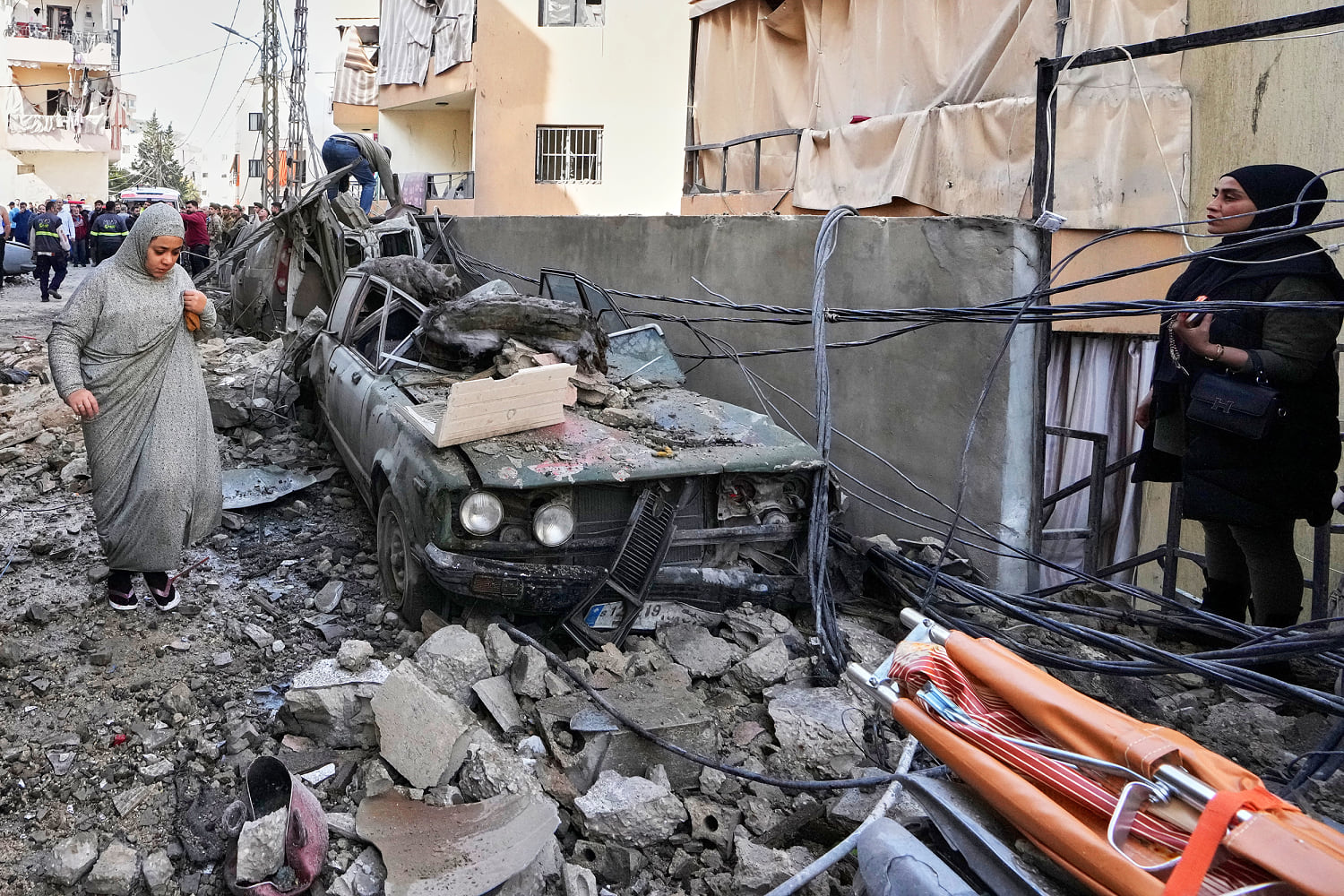
The sound of a tea kettle whistling used to mean a break in the afternoon. Now, in the cramped apartments of Beirut and the makeshift camps in the mountains, that high-pitched ring is often mistaken for the preamble of a strike. It is a phantom noise that lingers in the ears of over a million people. One million. It is a number so large it becomes abstract, a statistic that policymakers use to balance ledgers or justify logistics. But a million is not a monolith. It is a million individual decisions to leave behind a wedding album, a favorite cast-iron skillet, or a cat that wouldn't come out from under the bed.
Lebanon is a country built on layers of history, but right now, it is being defined by a single, frantic layer of movement. As the offensive against Hezbollah expands, the geography of the nation is being redrawn by the tires of old Mercedes sedans and the exhausted feet of families who have nowhere left to go.
Consider Maya. She is a hypothetical composite of the women I’ve spoken with in the schools turned shelters in the Chouf Mountains. Maya didn't leave when the first warnings flashed on her phone. She waited. She believed the walls of her home in Tyre were thick enough to keep out the geopolitical tremors. Then the windows shattered. Not from a direct hit, but from the sheer physical weight of the air being displaced nearby. She packed a single duffel bag. She didn't choose her best clothes; she chose the ones that dried the fastest.
That is the reality of displacement. It isn't a cinematic montage. It is a series of gritty, practical humiliations.
The Arithmetic of Agony
When we talk about "expanded offensives," we often focus on the precision of the hardware. We discuss the radius of impact and the strategic value of a ridge or a tunnel. We forget the arithmetic of the sidewalk. When a million people move at once, the infrastructure of a small nation doesn't just bend; it snaps.
Beirut, a city already reeling from years of economic strangulation and the scars of the 2020 port explosion, is now a giant, thumping heart trying to pump too much blood. Public parks have become bedrooms. Rugged men cry in the front seats of cars because they cannot provide a door that locks for their daughters. The government, cash-strapped and fractured, watches as the displacement exceeds a fifth of the total population.
Imagine if the entire population of Houston, Texas, was told they had two hours to move to Austin, and when they arrived, there were no hotels, no power, and the grocery stores were empty. That is the scale. That is the weight.
The logic of the conflict is often presented as a necessary surgical procedure. The goal is to dismantle an armed group that has embedded itself within the social fabric of the south. But how do you perform surgery when the patient is moving, screaming, and carrying a toddler? The "invisible stakes" here aren't just the military objectives. They are the social contracts being shredded. When a child spends their formative months sleeping on a thin mat in a classroom, the "security" gained today is paid for by the resentment of tomorrow.
The Ghost of the South
South Lebanon is a place of ancient olive groves and tobacco fields. It is a landscape that demands patience and sweat. For those who stayed through decades of previous friction, this time feels different. The intensity is not a slow burn; it is a flash fire.
The roads heading north are a graveyard of intent. You see abandoned strollers. You see cars that ran out of gas and were simply left where they stood, doors wide open, as if the occupants had vanished into the ether. The people aren't just fleeing a bomb; they are fleeing the realization that their presence in their own land has been deemed a variable in someone else’s equation.
Hezbollah’s presence in these areas is the stated reason for the fire. The group is a state within a state, a social provider, and a military force all at once. This complexity makes the civilian cost inseparable from the military one. When a "target" is struck in a village, the bakery next door closes. The pharmacy loses its refrigeration. The village stops being a community and becomes a coordinate.
Statistics tell us that the death toll is climbing into the thousands, but the "displaced" count is the one that will haunt the country for a generation. Displacement is a slow death of identity. You are no longer a teacher, a farmer, or a mechanic. You are a "DP"—a displaced person. You are a recipient of a food parcel. You are a person waiting for a phone call that may never come, telling you that your street still exists.
The Fragile Solidarity
There is a quiet, desperate beauty in how the rest of Lebanon has responded. In the early days of the surge, Lebanese citizens from different sects and backgrounds—people who usually spend their time arguing about politics—opened their doors. They brought mattresses to the streets. They cooked massive vats of rice and lentils.
But solidarity has a shelf life when resources are non-existent.
The economy was already a ghost. The Lebanese Lira had already lost 98% of its value before the first drone appeared in the sky this autumn. Now, with a million more mouths to feed and no tourism, no exports, and no stability, the friction is starting to show. Rent in "safe" areas has skyrocketed. Small tensions over water and electricity are blooming into neighborhood feuds.
The fear is that the "offensive" isn't just targeting an armed group, but is accidentally—or incidentally—dismantling the last remains of a functioning society.
Why does this matter to someone sitting thousands of miles away? Because the Mediterranean is not a wall; it is a bridge. History shows us that when a million people are displaced in the Levant, the ripples reach the shores of Europe and the halls of Washington within months. Stability is not a local commodity. It is an atmospheric condition. If Lebanon collapses under the weight of this human tide, the vacuum will not be filled by "peace." It will be filled by the same chaos that has defined the region’s worst decades.
The Language of the Sky
In Beirut, people have learned to read the sky. They don't look for rain. They look for the silver glint of a high-altitude reconnaissance craft. They listen for the "drone hum," a sound like a swarm of angry bees that never goes away. It is a form of psychological torture that requires no physical contact. It tells a million people: We see you. We are deciding your fate. You are not in control.
I sat with a man named Omar who had fled from the suburbs of Dahieh. He sat on a plastic crate outside a gas station. He didn't want to talk about the politics of Hezbollah or the strategy of the IDF. He wanted to talk about his fig tree.
"I planted it when my son was born," he said. "The figs were almost ready. If I don't go back in a week, the birds will get them. If the birds get them, it’s fine. But if the tree is gone, I don't know where I will put my son’s height marks anymore."
That is the invisible cost. The height marks on a door frame. The smell of a specific kitchen. The way the light hits a certain corner of a living room at 4:00 PM.
These are the things that are being "displaced." You can move a million people, but you cannot move their ghosts. You cannot move the sense of belonging that takes a century to grow and a second to incinerate.
The international community speaks in terms of "proportionality" and "de-escalation." These are cold, sterile words. They belong in air-conditioned rooms with mahogany tables. They do not belong on the road to Sidon, where a grandmother is holding a birdcage in her lap because she couldn't bear to leave her canary behind.
There is no "proportional" way to lose everything you own. There is no "de-escalated" version of watching your neighborhood turn into a plume of gray dust on a Telegram feed.
The offensive continues. The maps in the war rooms get more detailed. The red zones expand. The blue zones shrink. And on the ground, the line of cars stretches further toward the horizon, a long, metal snake of human misery.
The Final Harvest
We often think of war as a series of explosions. It isn't. War is mostly waiting. Waiting for the strike. Waiting for the bread. Waiting for the news. Waiting for the world to care.
The million people displaced in Lebanon are currently in a state of suspended animation. They are living in the "between." Between the life they had and the void that's coming. They are the collateral of a grand strategy that they did not vote for and cannot influence.
As night falls over the mountains, the campfires begin to dot the hillsides. From a distance, they look like stars. If you didn't know better, you might think it was a festival. But up close, the air smells of burning plastic and damp wool. There is no singing. There is only the low murmur of a million people wondering if they will ever be more than a headline again.
The sun will rise tomorrow over the empty houses of the south. The olives will ripen and fall to the ground, unharvested. The tea kettles will sit silent on cold stoves. And the highway will remain a river of suitcases, flowing toward a destination that doesn't yet exist.
Would you like me to research the current international aid delivery status for these displaced populations?