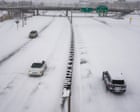
The national news cycle loves a disaster aesthetic. When a Kona Low drifts across the Pacific, the headlines immediately pivot to "apocalyptic" flash floods and "unprecedented" blizzard conditions on Mauna Kea. They paint a picture of a tropical paradise under siege, caught off guard by the whims of a volatile climate.
They are wrong.
The "shock" expressed by mainstream media regarding Hawaii’s weather patterns isn't a reflection of a changing planet as much as it is a reflection of a lazy, mainland-centric perspective on island geography. If you are surprised that it snows in Hawaii, or that a volcanic mountain range creates hyper-local flash flooding, you haven't been paying attention to the physics of the Pacific for the last century. We aren't witnessing a freak occurrence. We are witnessing the predictable result of aging infrastructure meeting a geography that was never meant to be paved.
The Blizzard Myth and the Altitude Gap
Let’s dismantle the "Blizzard in Hawaii" trope first. Every time the National Weather Service issues a winter storm warning for the Big Island, the internet melts down. "Snow in the tropics!" the captions scream.
Mauna Kea and Mauna Loa stand at over 13,000 feet. At that altitude, the atmospheric pressure and temperature are mathematically predisposed to freezing. In the high-altitude environment of the Central Pacific, the lapse rate—the rate at which temperature decreases with height—is roughly $6.5^\circ\text{C}$ per 1,000 meters. Do the math. When it’s a humid $27^\circ\text{C}$ ($80^\circ\text{F}$) at sea level in Hilo, the summits are hovering near freezing.
A Kona Low pulls cold upper-level air over the islands while sucking up tropical moisture from the south. This isn't a "weather anomaly." It’s a standard atmospheric pump. Calling it a "rare event" is a disservice to the residents who have seen the summits white every single year of their lives. The shock value is manufactured for clicks, ignoring the reality that Hawaii is one of the few places on earth where you can experience nearly every Köppen climate zone within a two-hour drive.
Flash Floods Are a Zoning Problem Not a Rain Problem
The media focuses on the volume of rain. They talk about "inches per hour" as if the sky is the villain. The sky is just doing its job. The real culprit is the way we’ve engineered—or failed to engineer—the drainage basins on these islands.
Hawaii’s volcanic soil is porous, but only to a point. When you cover a watershed with impermeable surfaces like asphalt and concrete, you eliminate the land’s ability to act as a sponge. In a steep, mountainous environment, gravity does the rest.
The "flash" in flash flooding isn't about the speed of the rain; it's about the speed of the runoff. We’ve built high-density housing in historical floodplains and then expressed "thoughts and prayers" when the water follows the path of least resistance. I have seen developers push through permits for "luxury estates" in valleys that the Kanaka Maoli traditionally used for taro patches precisely because they knew the land was designed to hold water.
When a storm hits, the media calls it a tragedy. I call it a predictable consequence of ignoring indigenous land management in favor of short-term real estate gains. We don't have a "rain problem." We have a "permeability crisis."
The Landslide Excuse
"Landslides close the Kuhio Highway." This is a recurring headline that treats the earth as if it’s suddenly decided to be unstable.
The geology of the Hawaiian Islands is inherently transient. These are basaltic shields undergoing constant erosion. When you cut a road into the side of a cliff on Kauai’s North Shore, you are fighting a losing battle against entropy. The current approach to landslide mitigation is reactive: wait for the slide, clear the debris, and wait for the next one.
We need to stop pretending that every landslide is a "natural disaster." Many are "engineered disasters." Poorly maintained culverts and the removal of deep-rooted native vegetation in favor of shallow-rooted invasive species create a lubricant layer between the soil and the bedrock. When the saturation reaches a critical mass, the slope fails.
The cost of clearing these roads every year is a massive drain on the state's budget. Yet, we refuse to invest in the long-term stabilization techniques—like high-tensile steel mesh or deep-soil grouting—because the upfront cost looks bad on a four-year political cycle. It’s cheaper to act surprised by the rain than to fix the hill.
The Tourism Industrial Complex and the "All Clear" Lie
There is a specific type of gaslighting that happens during these storms. While the local news warns residents to stay off the roads, the tourism boards are often silent or downplay the risks to ensure that the $18 billion-a-year engine keeps humming.
Visitors arrive in Honolulu during a Kona Low and are shocked to find the "Garden Isle" looks like a mud pit. They aren't warned that "Paradise" has a rainy season that can turn a hiking trail into a death trap in minutes. This lack of transparency is dangerous. We see it every time a tourist is swept away by a "rogue wave" or a flash flood in a gulch.
The industry treats weather as a PR hurdle rather than a physical reality. If we were honest with travelers—if we told them that Hawaii in the winter is a place of raw, violent, and beautiful power that requires respect and preparation—we might lose a few bookings. But we’d save lives.
Instead, we maintain the "endless summer" myth until the very second the sirens go off.
Abandoning the Crisis Mindset
The competitor’s article focuses on the "chaos" of the moment. It thrives on the adrenaline of the emergency. But the emergency is a distraction from the chronic failure of planning.
If we want to stop "facing" flash floods and landslides, we have to stop treating them as surprises. We need to:
- De-pave the valleys: Prioritize bioswales and permeable pavement over traditional asphalt.
- Rethink the High-Altitude Infrastructure: The roads to the summits and the observatories are built for a climate that doesn't exist up there.
- Mandate Geological Disclosure: Real estate transactions should include a "slope stability and drainage history" report that isn't buried in fine print.
The data is there. The history is there. The physics are undeniable.
Stop watching the rain gauges and start looking at the maps. The water isn't the enemy; the way we’ve forced it to move is. Hawaii isn't "facing" a storm. Hawaii is experiencing the natural cycles of its existence, and our modern world is simply in the way.
Fix the drainage. Stabilize the slopes. Respect the altitude. Or keep acting surprised when the sky follows the laws of thermodynamics.
The choice is yours, but the mountain doesn't care about your vacation photos.