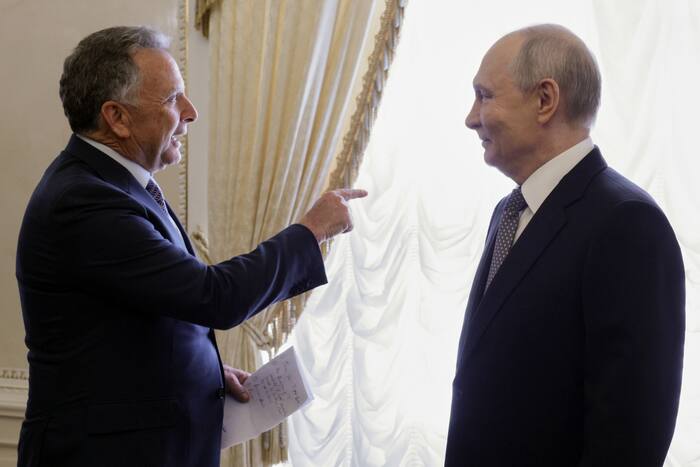
Cold rain on granite. That is the first thing you notice when a high-stakes diplomatic motorcade pulls into a city built on ambition and marble.
St. Petersburg does not whisper. It echoes. Every cobblestone remembers tsars, sieges, revolutionaries, and statesmen who arrived convinced they could bend history to their will. When Steve Witkoff, an envoy for Donald Trump, steps into a room with Vladimir Putin to talk about the war in Ukraine, the air inside that room carries weight that no press release can capture.
Outside, on a cold morning in a city far from the front lines, a kettle whistles on a stove. Let us use a hypothetical scenario to make the invisible math of diplomacy tangible. Picture Olena, a schoolteacher in eastern Ukraine whose classroom ceiling collapsed two winters ago, sitting beside a transistor radio because the power grid has flickered out again. She does not care about diplomatic protocol. She cares whether the men sitting across a polished table in St. Petersburg treat her home as a bargaining chip or a place where her students can safely walk to school next autumn.
We read headlines about envoys and presidents as if they are chess pieces sliding across a wooden board. Clean. Abstract. Neat.
They are not.
Every word spoken between a special envoy from Washington and the Russian leader reshapes real lives thousands of miles away—lives measured in sirens, winter heating bills, displaced families, and fragile hopes for an end to bloodshed. Yet standard reporting often reduces such moments to a bulleted summary: who arrived, who smiled for the cameras, what vague phrase was repeated to reporters afterward.
I have spent years watching how geopolitical crises play out on the ground and how distant decisions ripple into ordinary kitchens and quiet hallways. What strikes me most is the gap between the polished certainty of diplomatic briefings and the messy, terrifying reality of people trying to survive their consequences. When diplomats meet in a historic Russian city to discuss Ukraine, you are watching two competing versions of reality collide—one shaped by power politics and leverage, the other shaped by survival, sovereignty, and exhaustion.
Honestly, it is easy to feel cynical when you watch high-level talks unfold. You see cameras click. You hear promises of "productive conversations" or "serious discussions." Sometimes nothing changes for months. Sometimes everything shifts overnight. And if you feel a mix of fatigue and unease whenever another round of talks is announced, you are not alone. Anyone paying attention has reason to wonder whether closed-door meetings bring peace closer or simply buy time for the next offensive.
The Architecture of a Quiet Room
Diplomacy rarely looks like a dramatic movie scene. There is no yelling across a table, no table-thumping, no cinematic confession. Mostly, it is tea cooling in porcelain cups, carefully chosen phrasing, long pauses where neither side wants to blink first, and aides taking notes on every shift in tone.
When Trump sends an envoy like Witkoff to meet Putin in St. Petersburg, the choice of messenger and setting already speaks before a single sentence is uttered. A special envoy brings a distinct dynamic compared to a career diplomat bound by decades of institutional script. A special envoy can signal directness, personal backing from the top, or a willingness to test unconventional openings. Whether that produces a breakthrough or creates confusion depends entirely on what is actually on the table—and what each side believes the other is willing to concede.
Think of it like two mechanics arguing over a damaged engine while smoke still rises from under the hood. One wants to patch the belt quickly so the car can keep moving; the other insists the whole transmission has to be rebuilt before anyone talks about the road ahead. Both claim they are being practical. Both see risks the other ignores.
In the context of the war in Ukraine, that disagreement is not theoretical. Questions of territory, security guarantees, sanctions, ceasefires, and long-term stability are tangled together like wet rope. Untangling one strand pulls on five others. A phrase that sounds reasonable in one capital can sound like surrender or entrapment in another.
What happens in St. Petersburg matters precisely because St. Petersburg is far from the trenches. Distance breeds detachment. In a grand hall with gilded moldings and quiet security, it is tempting to speak of maps in broad strokes—a river here, a border line there, a timeline stretching across years.
Maps do not bleed. People do.
Why Envoys Matter When Trust Is Broken
When trust between nations collapses, formal channels often freeze. Official ministries repeat talking points they have used a hundred times because deviating feels risky. That is often when leaders turn to envoys—figures sent to take the temperature of the room, test red lines, and carry messages that might sound too blunt or too fragile for a public podium.
Consider what happens next: once a meeting takes place, rumors immediately outrun facts. Analysts dissect every camera angle. Commentators argue over whether a handshake looked warm or stiff. Meanwhile, ordinary people in Ukraine, Russia, and across Europe try to read the tea leaves for signs of what tomorrow will bring.
Will artillery fire slow down? Will prisoner exchanges expand? Will winter bring renewed strikes on energy infrastructure, or a pause that lets repair crews catch up?
These are the questions people actually ask when they hear that talks have taken place. Not "What was the diplomatic protocol?" but "Does this mean my family will be safer next month?"
Yet high-level meetings carry a built-in danger: they can create an illusion of momentum where none exists. A conversation is not a settlement. Sitting in the same room does not erase deep grievances, competing security fears, or hardened positions forged over years of conflict. At the same time, refusing to talk at all leaves the battlefield as the sole arbiter of outcomes—and everyone knows how brutal that arbiter is.
To understand why these talks draw such intense scrutiny, you have to hold two truths in your head at once. First, engagement can sometimes open doors that public hostility keeps bolted shut. Second, talks conducted without clear principles or genuine reciprocity risk rewarding aggression or leaving underlying tensions unresolved.
It is a razor's edge. Anyone who claims the right path is obvious is selling simplicity in a place where simplicity does not exist.
The Human Ledger Behind Every Negotiation
Let us return to that hypothetical picture of Olena beside her radio, because abstract strategy only makes sense when anchored to human stakes. Imagine another hypothetical figure—say, Dmitri, a young man working a logistics job hundreds of miles away, watching prices climb and hearing neighbors speak in hushed tones about mobilization, economic strain, and an uncertain future. Neither Olena nor Dmitri was invited into the room in St. Petersburg. Yet both live inside the shadow of whatever decisions, stall tactics, or deals emerge from it.
History shows us again and again that peace agreements and wartime negotiations succeed or fail based on how closely they grapple with reality on the ground. Paper arrangements drawn in isolation from lived conditions rarely hold. When negotiations ignore the core security needs of vulnerable populations, resentment festers. When they ignore hard strategic realities, talks stall into theater.
Look back at twentieth-century European history and you see this pattern repeating. Leaders gather in famous cities with grand expectations. Sometimes they craft durable frameworks that lower the temperature for decades. Other times, they produce fragile truces that collapse the moment pressure returns.
The difference usually comes down to honesty about trade-offs. Every option in a war carries a cost. Continuing to fight carries a devastating human and economic toll. Seeking a negotiated off-ramp carries risks of unfairness, compromise, or future instability. Pretending a cost-free shortcut exists is the fastest way to get burned.
That is why a meeting between Trump's envoy and Putin in St. Petersburg commands attention far beyond Washington or Moscow. It sits right at the intersection of political will, strategic calculation, and human survival. Even when no grand treaty is signed on the spot, conversations like these shape expectations, test leverage, and signal where the next move might come from.
Listening for What Is Not Said
When you read coverage of meetings like this in the future, try listening for what goes unsaid as closely as what makes the headline. Watch who speaks first after the doors close. Notice which demands are repeated loudly for domestic audiences and which details are kept quiet.
Diplomacy is often a slow dance of signals. A single visit by an envoy rarely solves a multi-year war in an afternoon. Instead, it acts like a sonar ping in dark water—bouncing off hidden obstacles, measuring depth, revealing contours that were blurry before.
Sometimes the ping shows open water ahead. Sometimes it shows a wall.
And out there, beyond the marble halls and the motorcades and the evening broadcasts, real people keep living—waiting for warmth, for safety, for news that means their lives are no longer at the mercy of distant rooms.
Rain falls on the granite streets of St. Petersburg, cold and indifferent, while miles away a mother checks the lock on her door and listens to the night.



