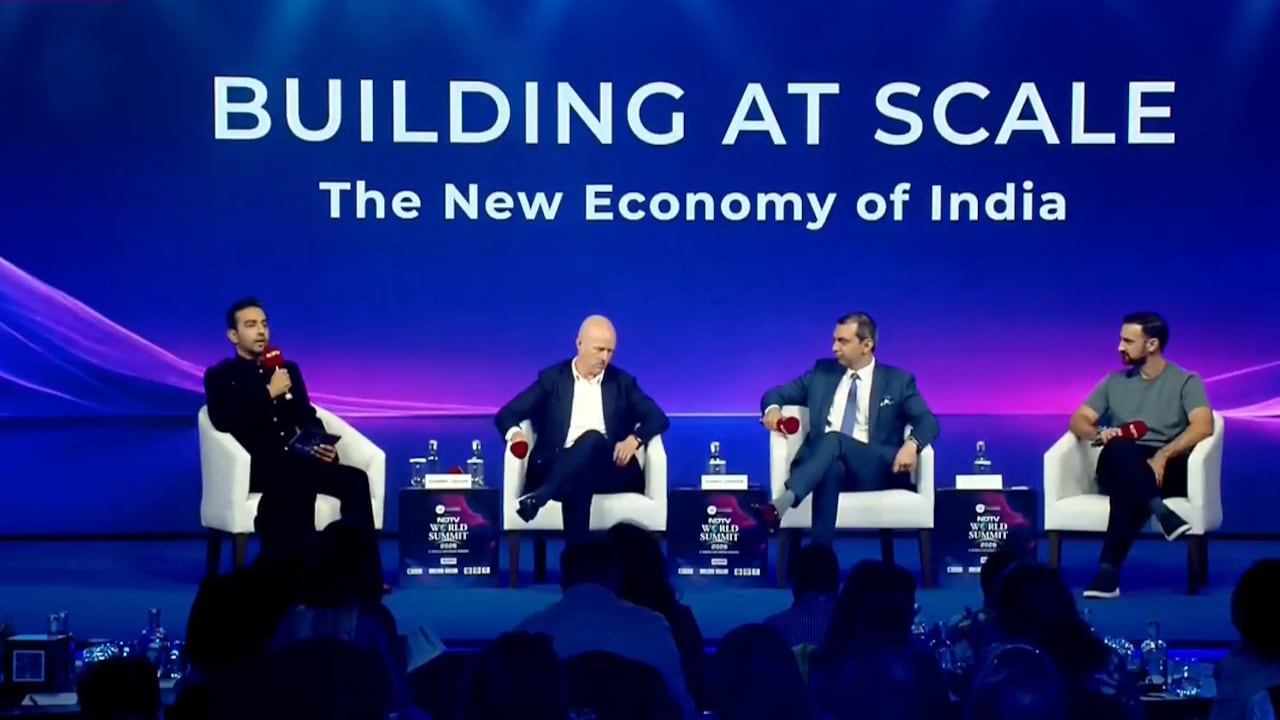
Heat rises off the asphalt in New Delhi before seven in the morning, carrying the sharp tang of diesel, hot brakes, and toasted cumin from a corner stall.
Inside a cool, brightly lit conference hall miles away from the exhaust fumes, executives in tailored jackets adjust their microphones for another panel on India's next growth phase at the NDTV World Summit. Outside on the flyover, a delivery rider taps a cracked glass screen with a thumb calloused by monsoon rain and handlebar vibration. Two worlds occupy the same latitude. Both run on electricity and impatience.
I have spent years sitting in rooms like that one and standing on street corners like the other. Often, the gap between them feels wide enough to swallow a whole policy white paper. When global tech leaders talk about artificial intelligence, smartphones, and mobility in India, it is easy to hear only quarterly projections, compute clusters, and market share percentages. Numbers are neat. Real life is noisy, dusty, and stubbornly local.
Yet something real is shifting beneath the jargon. For the past decade, India's digital story largely revolved around getting people online—cheap data plans, affordable smartphones, and instant QR code payments that turned tea stalls into micro-merchants. Connection was the headline. Now the headline is changing from access to agency.
Let me be honest: watching artificial intelligence arrive at scale makes me uneasy at times, and I doubt I am alone in feeling that knot in the stomach. When software begins to draft contracts, diagnose scans, route traffic, and speak in dozens of regional dialects without tiring, it is fair to wonder who holds the steering wheel and who gets left in the dust. Confusing? Yes. Scary? Sometimes. Still, pretending the wave isn't already lapping at every doorstep would be a mistake.
Why Cheap Data Was Only The Warm-Up
To understand why leaders gathering at summits fixate on the trio of AI, smartphones, and mobility, you have to look at how India skipped straight past several stages of conventional infrastructure. Many households never owned a landline or a desktop computer. Their first window onto the wider world fit inside a six-inch rectangle of glass and lithium.
Think of a smartphone as a pocket-sized Swiss army knife that used to require a human operator for every blade. You opened an app, hunted through menus, read English prompts you might only half-parse, and filled out forms. That worked well enough for people fluent in digital conventions and major metropolitan languages. For hundreds of millions of others, every extra tap was a tollbooth.
Now watch what changes when voice and intelligence move closer to the edge. Instead of forcing a shop owner in Madhya Pradesh or a nurse in Odisha to learn the grammar of software, software is slowly learning theirs.
To make this concrete, consider a hypothetical character—let's call her Kavita, a community health worker operating out of a dusty clinic outside Jaipur. In this hypothetical scenario, Kavita visits families across scattered hamlets, jotting notes on paper and trying to track vaccination schedules, maternal checkups, and subtle symptoms before they turn into emergencies. Under the old model, entering data meant sitting down late at night, translating thoughts into rigid fields, and hoping the signal held. With voice-first AI tools running on a mid-range smartphone in Hindi or Marwari, she can speak naturally after a home visit, flag potential risk patterns earlier, and spend less time fighting menus and more time looking people in the eye.
That is not science fiction. It is the practical bridge between raw compute and human dignity.
The Quiet Friction Inside Every Pocket
If smartphones are the entry point, why do summit discussions keep returning to the hardware itself? Because intelligence needs a body to live in, and most people don't carry a data center in their shirt pocket.
For years, smartphones were essentially glass windows looking onto distant cloud servers. Every query traveled out over cellular towers, waited for an answer, and came back. That works fine when coverage is strong and latency is low. It stumbles in basements, crowded transit corridors, or rural stretches where bandwidth dips like a sagging wire.
As models become leaner and chips pack more neural processing muscle onto smaller silicon, more intelligence can happen right on the device. Privacy improves when sensitive voice notes or health details do not have to travel across networks just to be understood. Speed improves too. A fraction of a second feels trivial on paper, yet in a bustling market or a noisy clinic corridor, instant response is the difference between a tool you trust and a gadget you shove back into your pocket.
At the same time, affordability remains a razor's edge. A brilliant AI feature locked behind a flagship price tag does very little for a college student stretching a monthly allowance or a small business owner watching margins closely. The real engineering test isn't making a phone smart for the top five percent. It is making intelligence affordable, durable, and reliable for the next five hundred million.
Consider what happens next when that intelligence steps off the sidewalk and onto the road.
When Streets Start Thinking Ahead
Mobility is where abstract code collides with steel, rubber, and human nerves.
Anyone who has sat through rush-hour gridlock in Bengaluru, Mumbai, or Delhi knows that traffic isn't just a logistics puzzle. It is a daily tax on patience, lungs, and time. Two hours spent inching across a city isn't merely lost productivity on a spreadsheet; it is two hours stolen from family dinner, rest, or a child's homework.
Across global forums like the NDTV World Summit, conversations around mobility have moved past treating transport as a collection of separate vehicles. Cars, two-wheelers, electric scooters, buses, metros, ride-hailing fleets, and freight trucks all share strained arteries. When AI enters mobility, the promise isn't magical flying cars tomorrow morning. It is quieter, sharper coordination: smarter route adjustments around bottlenecks, predictive maintenance so a commercial van doesn't break down mid-delivery, battery-swapping and charging networks balanced against grid load, and safer driver-assistance alerts tuned to chaotic, unpredictable street geometry rather than neat suburban boulevards.
Here, too, a cautionary note belongs right next to the optimism. Sensors and algorithms can spot blind spots and shave minutes off a commute, yet machines can also misread human unpredictability—a sudden pedestrian step, an unlit pothole, a monsoon downpour blurring lane markings. Technology that ignores local street reality fails fast. Technology built around it stands a chance.
Power, Trust, And Who Pays The Price
Big summits love momentum. Stage lights flatter grand arcs. Still, as a writer who has watched plenty of hyped technologies overpromise and underdeliver, I keep coming back to three unglamorous questions that determine whether this next growth phase lifts people up or leaves scars.
First: energy and infrastructure. Intelligence runs on power. Data centers need electricity and cooling; electric vehicles need charging stations and resilient grids. Growth without clean, dependable power simply shifts strain from one pipe to another.
Second: trust and accuracy. A helpful voice assistant that hallucinates a medical dosage or a navigation tool that routes a driver into a flooded underpass isn't just annoying—it is dangerous. Guardrails, local language accuracy, and human accountability matter far more than flashy demos.
Third: skilling and livelihood. Every wave of automation rearranges work. Some roles shrink while new ones open up in maintenance, local content, logistics, and digital services. The measure of success isn't how sophisticated the model sounds on a keynote stage; it is whether ordinary workers gain tools that raise their earning power rather than squeezing their bargaining room.
Look at history and you see a clear pattern: tools rarely decide the moral arc of a society on their own. Printing presses spread both pamphlets and propaganda; railways moved both grain and troops; smartphones carried both vital banking and endless distraction. What matters is the habit of mind that surrounds them—whether leaders, builders, and citizens treat technology as a shortcut to extract value or a scaffold to widen human capability.
Beyond The Stage Lights
When the summit panels wrap and the badges get tucked into drawers, the real test plays out far from auditoriums.
It happens when a farmer checks weather and crop advice in his own dialect without needing someone else to translate. It happens when a small workshop owner uses smart inventory and route planning to get goods to market on time without burning extra fuel. It happens when a young coder in a tier-two city builds a tool for neighbors because she finally understands the problem from the inside out.
None of that guarantees a frictionless future. Bottlenecks will remain. Debates over data, jobs, and urban planning will grow louder, not quieter.
Yet there is something unmistakable in the air when a billion voices begin talking back to their devices in their own cadence, navigating crowded streets with sharper eyes, and refusing to wait for someone else's blueprint.
A single spark doesn't light a whole city on its own—until it catches the dry wood of a million waiting hands.