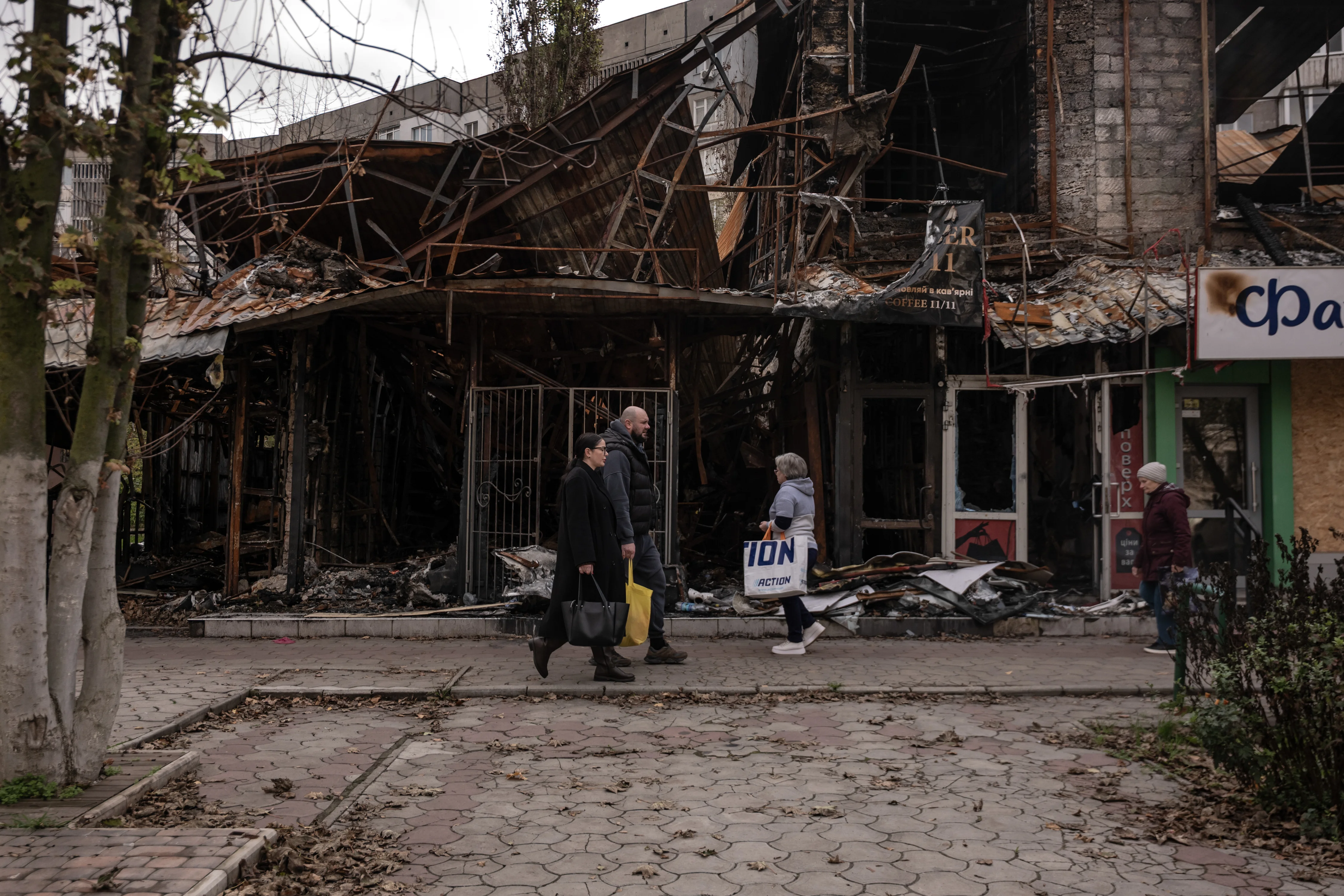
The silence did not sound like peace. It sounded like a breath held so tight that ribs threatened to snap.
In Kherson, along the wide, grey expanse of the Dnipro River, silence is rarely a gift. Usually, it is a warning. It means a drone is hovering just above the cloud line, its operator scanning for the twitch of a curtain or the white flash of a grocery bag. It means an artillery crew across the water is loading a fresh batch of 152mm shells. But on this morning, the stillness belonged to a temporary ceasefire—a fleeting, fragile pause in a war that had long stripped the region down to its rawest, most primitive nerve.
For a few hours, the artillery stopped barking. The sky emptied. And a city that had forgotten the mechanics of normal life tried, with trembling hands, to remember how to breathe.
The Choreography of Survival
To understand what a brief pause in shellfire means to Kherson, you have to understand how a day usually unfolds along the riverbank.
It begins with the windows. You do not look through them; you listen through them. You learn to distinguish between the sharp, slap-like crack of an outgoing mortar and the heavy, dull thud of an incoming Grad rocket. You learn that three seconds of whistling sound means you are already too late, and that if you hear the explosion before you hear the shell, you survived another round of Russian roulette.
Every everyday task is calculated in risk. Crossing the street to buy bread isn't an errand. It is a tactical maneuver. You map out your route by the shadow of concrete buildings, calculating how many steps lie between one doorway and the next. You never walk in the open. You never stop to chat. You buy your flour, you keep your head down, and you run.
So when the guns went quiet, the city did not burst into celebration. It crept out into the light.
First came the old women, bundled in heavy wool coats despite the faint warmth of the sun, their plastic bags rustling in the stillness. Then came the shopkeepers, sweeping glass off the pavement—not because the windows wouldn't be blown out again tomorrow, but because sweeping is something a human being does when they still care about their doorstep.
Olena, a retired schoolteacher whose apartment block bears the black, scorched scars of a strike from two weeks prior, walked to the local market. She did not run. That was the first miracle. She walked at the pace of a woman who had nowhere to hide and nowhere she urgently needed to be.
"When the shelling is constant, your body stays coiled like a spring," she said, her hands resting over a crate of small, bruised apples. "You don't feel pain. You don't feel tired. You just wait for the hit. But when it stops—even for two hours—the spring uncoils. That is when your knees start to shake. That is when you realize how exhausted you really are."
The Invisible Toll of the Riverbank
Kherson’s geography is its curse. Positioned on the right bank of the Dnipro, the city sits directly in the crosshairs of Russian positions entrenched on the left bank. There is no front line here in the traditional sense—no trenches separated by no-man's-land. There is only the water, a mile of murky current, and the relentless line of sight.
Since the liberation of the city in late 2022, the war here has evolved into a cruel, low-intensity siege. It is not the massive, sweeping armored thrusts seen in the east. It is the steady, daily erosion of human life. Drones hunt individual pedestrians. Shells hit bus stops at 8:00 AM. Rocket artillery targets power stations, water mains, and civilian cars.
The statistics tell one story: thousands of tons of steel dropped on a civilian population, dozens of daily strikes, a population decimated from over 280,000 down to a fraction of resilient, stubborn, or trapped souls. But statistics cannot capture the texture of living under a microscope held by an enemy sniper.
During the ceasefire, the immediate priorities of the survivors revealed the true nature of their daily deprivation. People did not rush to organize political rallies or assess the geopolitical landscape. They went to fix things.
Utility workers—men in faded orange vests who may well be the braves souls in the entire oblast—climbed ladders to splice severed power lines. They worked with a furious, quiet speed, knowing their window was closing. Clean water rushed back into pipes that had been dry for days. In basement apartments, mothers used the brief window of electricity to charge phones, warm soups, and wash clothes that smelled of damp concrete and woodsmoke.
Children, kept indoors for weeks in low-lit cellars, were brought out into courtyards. They did not play tag. They stood near their mothers, staring up at a sky that wasn't trying to kill them, their eyes wide and unblinking.
The False Hope of a Paused Clock
There is a psychological cruelty to a temporary ceasefire in a war zone.
When destruction is continuous, the mind adapts. A surreal sense of numbness sets in—a psychological armor that shields the human spirit from the horror of its surroundings. You accept that today might be the day, and in that acceptance, a strange, grim clarity takes over.
A pause breaks that armor.
It invites hope back into the room, and hope is a dangerous guest in Kherson. Hope tells you that perhaps the quiet will hold. Hope suggests that you can plan for next week, that you can plant tomatoes in the garden, that your grandson might come visit.
And then the pause ends.
It always ends the same way. First, a distant boom from deep within the occupied territory on the left bank. A pause of three seconds. Then the tearing sound of the air being cut open, followed by the violent, window-rattling thud of high explosives hitting earth or brick.
The city flinches. The utility workers pack their tools and descend their ladders. The old women fold their plastic bags and slip back into the darkened stairwells. The spring coils tight once more.
What Remains When the Noise Returns
The brief silence in Kherson was not a turning point in the war. It did not change map boundaries, nor did it alter the strategic calculations in distant capitals. To the military analysts, it was a negligible blip on a timeline of attrition.
But for the people who live along the Dnipro, those few hours were a stark reminder of what has been stolen. Peace, when it finally comes, will not just be the absence of explosions. It will be the return of unhurried mornings. It will be the ability to stand on a riverbank without searching the clouds for a drone. It will be the quiet restoration of a life measured in plans rather than seconds.
As the sun began to dip behind the shattered treeline, casting long, crimson shadows across the empty streets of Kherson, the artillery resumed its rhythm. The shockwave of a nearby strike rattled the glass in Olena’s kitchen window frame.
She didn't scream. She didn't drop the apple she was peeling. She simply set the knife down, moved away from the glass, and sat in the corner where two load-bearing walls met.
The quiet was over. But for a little while, she had remembered what it felt like to be human.


