The human body was never meant to leave the ground. We are creatures of clay and friction, designed to push against the earth so the earth can push back. When you strip that resistance away, the body rebels. Bone density melts like sugar in coffee. Muscles forget their purpose. For decades, space agencies operated on a rigid, unspoken consensus: to survive the vacuum of space, you had to represent the absolute pinnacle of standardized physical perfection.
Then came John McFall.
He did not fit the mold. In 2000, a motorcycle accident in Thailand tore through his right leg, forcing an amputation above the knee. He was nineteen. The world, in an instant, became a gauntlet of architectural barriers and lowered expectations. But McFall refused the narrative of limitation. He learned to run again. He ran so fast, in fact, that he took home a bronze medal in the 100 meters at the 2008 Beijing Paralympics.
Yet, sprinting on a carbon-fiber blade across a synthetic track is one thing. Floated inside a multi-billion-dollar orbital laboratory is entirely another.
When the European Space Agency (ESA) announced its "Fly!" feasibility study, they weren't looking for a feel-good public relations stunt. They were asking a cold, hard, engineering question: Can a person with a physical disability safely live, work, and survive an emergency inside the International Space Station?
To find out, they needed a guinea pig with the grit of an athlete and the precision of a scientist. McFall, who also happens to be an orthopedic surgeon, stepped forward.
The Cold Physics of the Clean Room
Step inside the neutral buoyancy laboratory. It is a massive, echoing chamber containing millions of gallons of water, designed to mimic the weightlessness of low Earth Orbit. For a traditional astronaut, entering this space requires a highly choreographed dance of specialized equipment. For McFall, it required redefining how that equipment interacts with a changing human form.
Consider the spacesuit.
A standard Extravehicular Activity (EVA) suit is a rigid, pressurized fortress. It relies on symmetrical leverage. When an astronaut moves their leg, the suit expects a specific counter-pressure from a heel and a toe. Now, imagine introducing a prosthetic limb into that microscopic ecosystem.
How does a carbon-fiber socket react to vacuum pressure? If a prosthetic component shifts by even a millimeter inside the suit, it can cause friction burns, pressure sores, or structural failure. In space, a blister isn't just uncomfortable. It is a medical emergency that can jeopardize a multi-million-dollar research mission.
The engineering team faced a wall of variables. They had to analyze the volume changes in McFall’s residual limb, which naturally swells and shrinks throughout the day based on fluid shifts. On Earth, he can simply adjust his prosthetic socks. In a pressurized suit floating 250 miles above the planet, there is no reaching inside to fix a tight fit.
Every piece of equipment inside the space station has been optimized for decades based on a single body type. The handholds, the foot restraints, the exercise bikes—even the emergency evacuation procedures via the Soyuz or Crew Dragon capsules. The protocols assume two fully functioning biological legs to wedge into the survival couch during a violent, high-G re-entry.
Change one variable, and the math breaks.
Redefining the Standard
The skepticism was quiet, but it was there. It always is when institutions built on hyper-standardization face the irregular. The doubts didn't stem from malice, but from a deeply ingrained culture of risk aversion. Space flight is a series of calculated catastrophes waiting to happen. Why add a wildcard?
But the data started coming in.
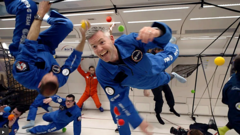
McFall spent months subjected to rigorous testing. He climbed into centrifuges that spun his body until the gravitational pull felt like an anvil on his chest. He strapped into microgravity simulation flights, experiencing the brief, sickening roller-coaster of weightlessness. He practiced emergency egress drills, proving he could navigate the cramped, labyrinthine hatches of the station just as fast—if not faster—than his able-bodied peers.
What the engineers discovered blew the old paradigm apart.
In weightlessness, legs are largely redundant for locomotion. Astronauts use their upper bodies to swing from module to module like primates in a canopy. McFall’s years of mastering upper-body balance and adapting to an asymmetrical world weren't a liability. They were an asset. He had spent two decades solving complex spatial problems with his body every single day.
The space station didn't need to be completely rebuilt to accommodate him. Instead, the study revealed that minor, highly elegant modifications could make the environment safer for everyone.
Take the T2 treadmill on the space station. Astronauts must run to prevent cardiovascular decay. McFall couldn't use the standard harness system safely without risking damage to his residual limb. The solution? A redesigned load-bearing interface that distributes force evenly across the pelvis. This adjustment didn't just help McFall; it provided data on how to reduce spinal compression for every future astronaut, regardless of their physical makeup.
The Invisible Stakes
It is easy to look at this narrative and see a heartwarming story about overcoming adversity. That is the easy trap. It minimizes the true weight of what is happening in those clean rooms and testing facilities.
This is not about inspiration. This is about infrastructure.
We are on the precipice of a new space age. Private companies are launching habitats. Plans for permanent lunar bases are moving from blueprints to reality. If humanity is truly going to become a multi-planetary species, we cannot colonize the stars using a selection criteria written in 1960.
If space remains exclusive to the genetically flawless, it remains a laboratory, a playground for the elite. The moment we figure out how to send a Paralympian into orbit is the moment space becomes an extension of the human experience.
The real test lies in the unpredictability of the environment. If a fire breaks out in the Russian segment, can McFall don his emergency breathing apparatus, navigate the dark, smoke-filled corridors, and secure a hatch with the same speed as a standard crew member? The simulation logs say yes. The telemetry proves that adaptability is not a deficit; it is a mechanism of survival.
The Weight of the Launchpad
Picture the dawn at the Baikonur Cosmodrome or Cape Canaveral. The air is crisp, heavy with the scent of ozone and coastal moisture. A rocket sits on the pad, a towering monument of liquid oxygen and controlled explosions.
When John McFall finally straps into that capsule, the g-forces will press him deep into his seat. The vibrations will rattle the marrow in his bones. As the booster separates and the roaring engine gives way to the eerie, absolute silence of orbit, his prosthetic leg will float gently beside him, tethered only by velcro and utility straps.
He will look out the cupola window at the fragile blue curve of the Earth.
Down there, millions of people live with bodies that the world deems broken, incomplete, or unsuited for the grandest stages. They navigate cities built without them in mind, fighting a daily, grinding battle against gravity and design.
But up there, floating effortlessly between the stars, the rules change. The ground is gone, and with it, the very definition of what holds us back.