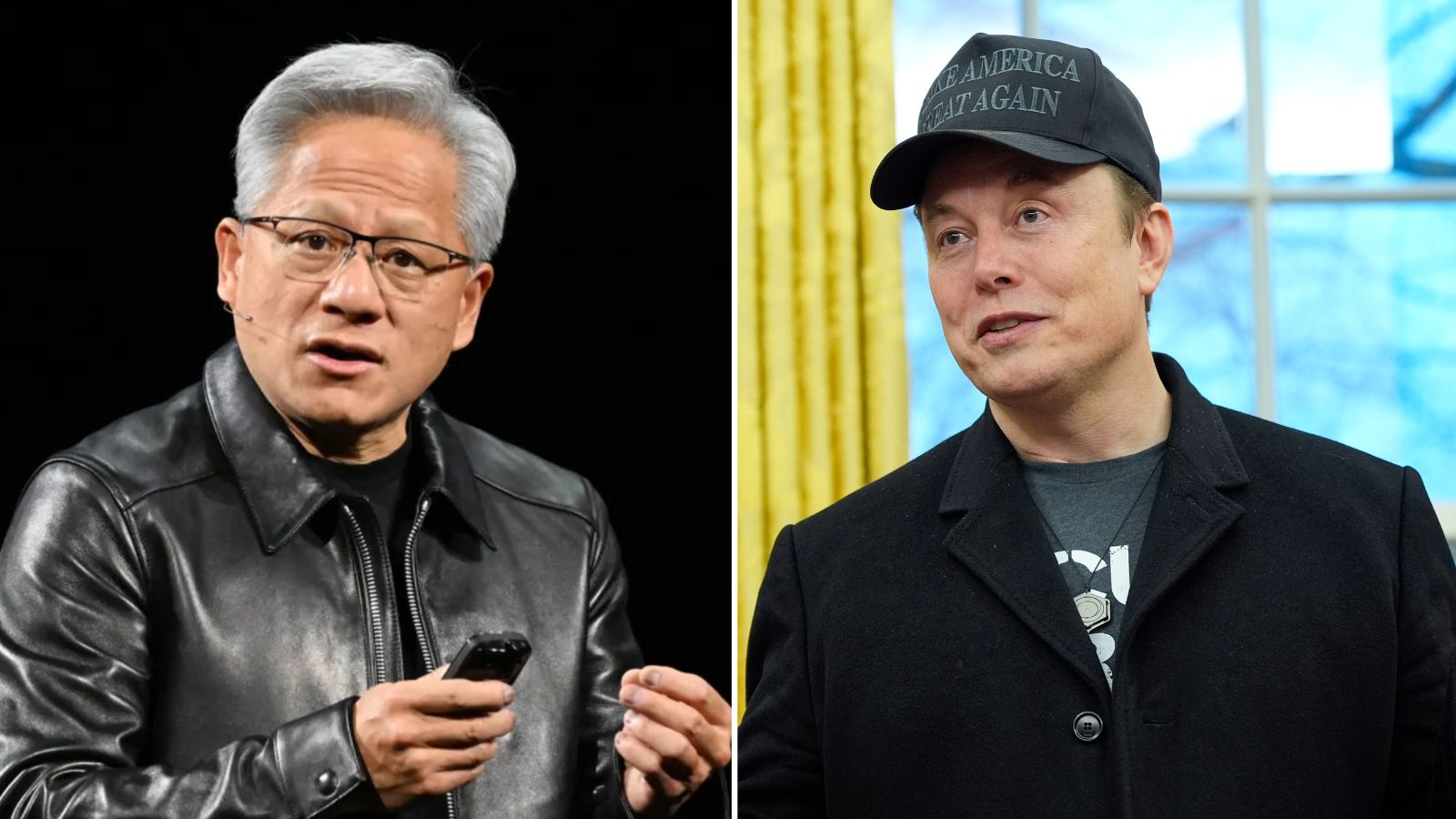
Public petitions advocating for the retention or reinstatement of a chief executive rarely alter corporate governance outcomes, yet when an influential industry peer like Elon Musk endorses a campaign supporting Nvidia CEO Jensen Huang, the signal functions as a market-clearing mechanism rather than a symbolic gesture. The core issue underlying the "Reinstate Jensen" discourse is not an actual boardroom ouster—which remains structurally improbable given Nvidia's capital efficiency and founder-led control—but the friction between founder-centric execution speed and institutional governance pressures, geopolitical export controls, and succession risk. Understanding why major capital allocators and hardware buyers publicly back a semiconductor executive requires deconstructing the supply chain dependencies, principal-agent dynamics, and valuation premiums tied directly to founder leadership.
The Structural Premise of the Petition Phenomenon
When external actors sign a petition to "reinstate" or protect a sitting executive who has not been formally removed, the action serves as a preemptive defense against governance drift. In high-capital-expenditure industries, leadership stability directly dictates multi-year product roadmaps.
- Signaling Theory in Capital Markets: In economics, costly or high-profile signaling occurs when an actor takes a visible action to communicate private information or strategic alignment. By publicly signing a petition supporting Huang, Musk—whose artificial intelligence and automotive ventures depend heavily on Nvidia’s compute clusters—signals to institutional investors and regulatory bodies that any disruption to Nvidia’s executive leadership introduces unacceptable supply chain variance.
- The Founder-CEO Valuation Premium: Empirical corporate finance demonstrates that founder-led technology firms consistently trade at higher earnings multiples than firms led by hired professional managers. Founders possess asymmetric institutional knowledge and the moral authority to make non-consensus capital allocation bets years before market demand materializes.
- Regulatory and Activist Deterrence: Public petitions operate as counter-pressure against activist investors, proxy advisory firms, or political factions advocating for leadership restructuring due to antitrust scrutiny, export compliance disputes, or stock volatility.
The competitor narrative typically frames these events as interpersonal drama or celebrity tech solidarity. That framing misses the operational reality. Musk’s endorsement is an act of vendor-risk management. When a buyer’s core infrastructure relies on a single supplier’s architectural cadence, the buyer has a direct financial incentive to preserve the supplier's decision-making apparatus.
Deconstructing the Supply Chain Dependency
To understand why an external CEO intervenes in the public perception of a supplier's leadership, one must map the physical and software bottlenecks of modern accelerated computing. Nvidia does not merely sell silicon; it controls a vertically integrated stack comprising chip architecture, proprietary interconnects, and the CUDA software ecosystem.
- Architectural Cadence Compression: Under Huang’s tenure, Nvidia compressed its data center architecture release cycle from a traditional two-year cadence to an annual rhythm. Sustaining an annual tape-out schedule for multi-reticle processors requires absolute alignment across thermal engineering, foundry allocation at TSMC, and high-bandwidth memory procurement. A leadership transition introduces a minimum 12-to-18-month decision latency as a new executive audits existing commitments.
- Allocation Arbitrage: During periods of acute wafer and packaging constraints, specifically Chip-on-Wafer-on-Substrate (CoWoS) capacity, allocation decisions are adjudicated at the highest executive level. Major customers like xAI and Tesla rely on direct executive-to-executive channels to secure prioritized delivery schedules. Replacing the incumbent CEO resets those bilateral allocation agreements.
- Software Lock-In Maintenance: Hardware superiority degrades rapidly without continuous compiler and library optimization. Huang’s management structure treats software engineering as a primary cost center rather than an auxiliary support function. Institutional managers brought in to optimize short-term operating margins historically cut research and development budgets in non-monetized software layers, which would erode Nvidia’s primary competitive moat.
The Principal-Agent Friction in Hyper-Scale Tech
Corporate governance theory identifies a persistent conflict between principals (shareholders) and agents (executives). Standard governance frameworks attempt to mitigate this conflict through independent boards, standardized compensation metrics, and succession mandates. However, in hyper-scale technology monopolies, traditional governance mechanisms frequently destroy value by optimizing for risk avoidance rather than technological dominance.
The Cost Function of Leadership Transitions
Replacing a founder-CEO in a specialized hardware enterprise imposes three quantifiable costs on operations:
- Strategic Hesitation: A non-founder CEO faces asymmetric downside risk. If a multi-billion-dollar bet on an unproven architecture fails, the hired executive is terminated. Consequently, hired executives default to incrementalism. Founders, anchored by deep equity stakes and foundational identity, absorb tail risk to capture generational market shifts.
- Talent Attrition: Principal engineers and system architects report to technical visionaries, not administrative managers. When a technical founder departs or is sidelined, senior engineering talent typically exits within two quarters, migrating to competing startups or hyperscalers.
- Organizational Siloing: Nvidia operates with a notoriously flat organizational structure, with dozens of executives reporting directly to Huang to eliminate middle-management filtration. A conventional successor almost universally introduces hierarchical reporting layers to manage span-of-control metrics, slowing down cross-functional debugging between hardware and software teams.
Institutional Pressure vs. Operational Reality
The emergence of a "Reinstate Jensen" narrative reflects underlying anxiety regarding external pressures on Nvidia’s leadership. These pressures stem from three distinct vectors:
- Antitrust and Regulatory Scrutiny: As Nvidia’s market share in data center accelerators exceeded dominant thresholds, regulatory bodies in the United States, European Union, and China initiated inquiries into bundling practices and market dominance. Historically, prolonged antitrust litigation triggers boardroom discussions about leadership changes to appease regulators.
- Geopolitical Export Controls: Tightening restrictions on high-performance compute exports to restricted markets force Nvidia to constantly redesign compliant, reduced-capability SKUs. Navigating these regulatory boundaries requires rapid executive authorization to write off inventory and reallocate wafer starts.
- Succession Anxiety: Institutional asset managers routinely penalize companies lacking a clear, publicly vetted succession plan. When analysts press for succession clarity, markets often misinterpret the inquiry as dissatisfaction with the incumbent, creating a feedback loop of speculation that public petitions attempt to arrest.
Evaluating the Efficacy of Public Petitions in Corporate Governance
While a petition signed by high-profile figures generates immediate media velocity, its mechanical impact on corporate governance is strictly bounded by corporate law and shareholder voting structures.
- Zero Legal Binding: Public petitions carry no fiduciary weight. Under Delaware corporate law, where the vast majority of major technology firms are incorporated, the authority to appoint or remove a chief executive rests exclusively with the Board of Directors, who are accountable only to shareholders of record via proxy votes.
- Signal Amplification vs. Governance Reality: The utility of Musk’s signature lies entirely in narrative framing. By lending credibility to the campaign, he reframes any hypothetical governance challenge against Huang as an attack on the broader artificial intelligence infrastructure buildout. This raises the reputational cost for any board member or activist investor contemplating a governance intervention.
- The Limitations of Peer Endorsements: Peer endorsements cannot insulate an executive from material financial underperformance, verified compliance breaches, or regulatory mandates requiring structural separation. If a government body mandates operational restructuring as a condition for market access, external petitions become irrelevant.
Strategic Framework for Assessing Executive Risk
For institutional investors, supply chain managers, and enterprise buyers evaluating vendor stability in concentrated technology markets, relying on media narratives or viral petitions is an inadequate risk-management strategy. Decision-makers must track objective operational indicators to assess true executive stability.
- Monitor Insider Equity Dispositions vs. Rule 10b5-1 Plans: Distinguish between pre-scheduled automated stock sales and unscheduled discretionary liquidations. Sudden alterations in executive equity holdings signal internal strategic shifts far earlier than public statements.
- Audit Direct-Report Retention Rates: Track the tenure of vice presidents overseeing core architecture, foundry operations, and software libraries. Stability at the direct-report layer indicates that the flat management structure remains intact and functional.
- Evaluate Capital Expenditure Commitments: Examine multi-year non-cancellable purchase obligations with foundries and memory suppliers. Rising long-term commitments confirm that the board has fully ratified the incumbent CEO’s multi-year product roadmap.
- Analyze Board Composition Changes: Watch for the addition of directors with backgrounds in regulatory compliance, government relations, or corporate restructuring, as opposed to technical engineering. A shift toward legal and compliance profiles on the board indicates preparing for prolonged regulatory defense rather than pure product expansion.
Enterprise technology leaders and institutional allocators must treat public executive-support campaigns as secondary sentiment indicators rather than primary governance events. Maintain long-term compute procurement contracts and capital allocations anchored to verified product execution milestones—specifically wafer allocation security and annual architectural release adherence—while discounting viral governance noise until structural changes appear in formal SEC proxy filings.