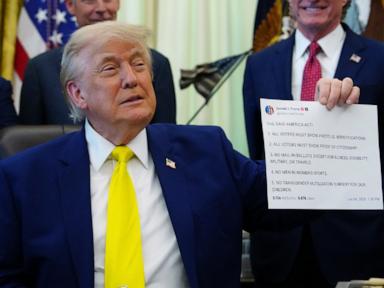
The screen flashes. A blue notification pill drops from the top of a smartphone display in a cramped apartment in Queens, or a leather-lined boardroom in Frankfurt, or a dimly lit car idling in traffic on the Capital Beltway.
It is a digital utterance. A string of words typed onto a private platform. Within microseconds, stock prices twist. Supply chains shudder. Futures contracts leap or plummet. The market does not wait for a press conference or an official White House transcript. It reacts to the ping.
And now, the mechanics behind that ping have shifted into something entirely new.
To understand what happens when political gravity intersects with monetization, we have to look past the dense fog of campaign finance laws and public relations statements. We have to look at the raw architecture of attention.
Imagine, for a moment, a crowded trading floor thirty years ago. Shouting men, paper flying, landline telephones gripped white-knuckled in sweating fists. A rumor crosses the room. A whisper from a senator’s aide. Fortunes are made and lost in the space of a heartbeat based on who heard what, and crucially, who heard it first.
Speed has always been the ultimate currency. But today, the trading floor is invisible, global, and algorithmic. And the whisper does not travel through a crowded room. It travels through an exclusive digital pipeline, where fast access to the social media posts of the most powerful political figure in the modern era can be bought and sold.
This is not a traditional lobbying effort. It bypasses the quiet mahogany dining rooms of K Street. It short-circuits the traditional rituals of governance.
Consider the mechanics. When policy announcements are deliberately or casually dropped into the digital ecosystem, they carry immediate financial weight. A single sentence regarding tariffs, corporate tax rates, or regulatory rollbacks can shift billions of dollars in market valuation across an afternoon. If you know the words are coming—or if you can purchase a high-speed, prioritized window to receive them before the rest of the world processes the signal—you hold an arbitrage opportunity of unprecedented proportions.
Critics call it unprecedented. Historians call it an evolution.
Power has always found a way to monetize its own proximity. In ancient courts, access meant a whispered word in the king's ear before the royal decree was pinned to the town square. In the industrial age, it meant private dinner parties with railroad barons and treasury secretaries. But what makes the current moment distinct is its sheer velocity. Technology has compressed time and space until the distance between a thought in one man's mind and a multibillion-dollar market reaction is measured in milliseconds.
Let us trace the path of a hypothetical trader named Marcus. Marcus sits behind three curved monitors in a modest office space in New Jersey. He is not a cartoonish Wall Street villain; he is a data technician, staring at volatility indices and sentiment tracking software. For Marcus, the value of a political announcement is not ideological. It is mechanical.
When a policy shift regarding domestic energy production is teased via social media, Marcus's automated trading algorithms are programmed to scrape, parse, and execute orders within fractions of a second. If his feeds are delayed by even two seconds compared to a premium, pay-for-access conduit, his capital is stranded on the wrong side of the trade.
This is where the fusion of politics and commerce reaches its most complex frontier. When the dissemination of executive or legislative intent becomes a tiered subscription product, the boundary between public service and private enterprise blurs beyond recognition.
We are often told that transparency is the bedrock of a healthy republic. Sunlight, the old saying goes, is the best disinfectant. But what happens when the sunlight itself is metered? When the illumination of public policy is placed behind a velvet rope, accessible only to those who pay a premium for expedited visibility?
The implications stretch far beyond the trading desks of Wall Street. They touch the heart of public trust.
When citizens watch leaders interact with digital platforms, they assume a shared reality. They assume that when a policy is announced, it belongs to everyone at once. They assume that the rules of the marketplace are flat, that information travels at a uniform speed, and that the playing field, however rugged, remains fundamentally open.
Shattering that assumption does something corrosive to the civic fabric. It breeds a quiet, pervasive cynicism. It convinces the average person that the game is rigged not by hidden conspiracies, but by open architecture—by business models that explicitly trade on the uneven distribution of truth.
Look closely at how information travels today. It is fractured into silos, monetized at every junction, and optimized for maximum emotional and financial friction. When the distribution of governance itself is subjected to those same market forces, the results are unpredictable.
We are navigating a terrain where the old rules no longer apply, and the new rules are written by those who profit most from the chaos.
The notification pings again. Another screen lights up. Somewhere, a trade is executed, a price moves, and the distance between power and profit grows just a fraction wider.
The quiet hum of the server racks continues beneath the floorboards of the financial district, cool and indifferent to the debates raging above ground. Data flows in. Data flows out. And the future is bought, sold, and delivered at the speed of light.