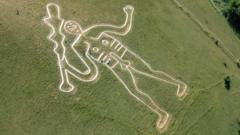
The wind off the Dorset downs does not care about history. It carries a heavy, wet salt from the English Channel, driving it straight into the chalk ribs of the hillside. If you stand at the base of the ridge in the village of Cerne Abbas, the air tastes of damp earth and crushed limestone. It is a quiet place. Yet, cut deep into the steep green turf above is a 180-foot defiance of British modesty.
He holds a knotted club. His ribs are defined by stark white trenches. Most notably, he is explicitly, unmissably erect.
For centuries, the Cerne Abbas Giant has stared up at the sky, a towering monument to fertility, folklore, or perhaps just ancient humor. But Britain is getting wetter. The rain, relentless and increasingly intense, does not just wash over the hillside; it dissolves it. Left alone, the giant would simply bleed into the grass, his sharp lines blurring until he became nothing more than an ambiguous white smudge on a green canvas.
Maintaining a masterpiece cut into the earth is not a matter of a quick touch-up. It is a battle against gravity, weather, and time.
The Weight of the White Line
To understand what it takes to keep an ancient chalk figure alive, you have to look at the dirt beneath your fingernails.
The process is called scouring. Every few years, a dedicated army of volunteers and conservationists from the National Trust ascends the steep incline. They do not bring heavy machinery. The slope is too treacherous, the heritage too fragile. Instead, they carry hand tools, buckets, and tons of fresh, premium chalk sourced from a nearby quarry.
Picture a volunteer named Sarah. This is a hypothetical composite of the people who actually show up, but her blisters are real. She is kneeling on a forty-five-degree slope. The wind is trying to push her off the hill, and the rain is starting to slick the grass. In her hands, she holds a heavy wooden rammer.
Her task is deceptively simple: pack the fresh chalk into the trenches.
But the execution is grueling. Each strike of the rammer must be precise. If the chalk is packed too loosely, the next autumn downpour will wash it down into the valley. If it is packed too tightly without proper drainage, water pools behind it, causing the turf walls to collapse inward.
The trenches are roughly a foot wide and several inches deep. There are thousands of feet of these lines tracing the giant’s anatomy. The volunteers move inches at a time, their knees bruised, their shoulders aching. It is a slow, rhythmic penance paid to the landscape.
A History Written in Lime
Why do they do it? The easy answer is tourism. The giant draws thousands of eyes to this corner of Dorset every year. But the deeper truth lies in the collective memory of the community.
For generations, the giant was a mirror. The locals looked up at him to predict the weather, to bless their crops, or to cure infertility. Traditional lore dictated that couples struggling to conceive should spend a night sleeping within the outlines of his giant form. It sounds quaint, perhaps foolish to a modern observer, but it speaks to a time when human lives were inextricably linked to the earth beneath their feet.
The origin of the figure itself remains a battlefield for historians.
- The Saxon Theory: Some believe he represents Heil, an Anglo-Saxon god of fertility.
- The Roman Connection: Others argue he is Hercules, a theory supported by the club and the lion-skin mantle that scanning technology suggested might once have hung from his arm.
- The Political Satire: A later theory posited he was a caricature of Oliver Cromwell, mocked by a local landowner.
Recent optically stimulated luminescence testing by the National Trust shifted the narrative again, dating the giant's creation to the late Saxon period, around the tenth century. He is older than many believed, yet younger than prehistoric myths suggested. He has survived plagues, world wars, and the rise and fall of empires.
During the Second World War, the giant faced a different kind of threat. The British government feared German bombers would use his brilliant white silhouette as a navigation landmark to find nearby cities. So, they covered him. They used brushwood, turf, and canvas to camouflage his form, rendering him invisible from the air. For years, the hillside was dark.
When the war ended, the locals uncovered him. The act of pulling away the brushwood was a collective sigh of relief. The giant was still there. The world had broken, but the hillside remained.
The Chemistry of Decay
The enemy today is not camouflage; it is chemistry.
Chalk is calcium carbonate. When rainwater falls, it absorbs carbon dioxide from the atmosphere, turning slightly acidic. As this weak acid contacts the chalk lines of the giant, a chemical reaction occurs, slowly dissolving the stone into soluble calcium bicarbonate. The rain literally eats the artwork.
Compounding the chemical erosion is the physical displacement caused by heavy downpours. The UK's weather patterns have shifted, bringing more frequent, intense rainfall events rather than the steady, gentle mists of the past. When inches of rain fall in a matter of hours, the water cascades down the steep Dorset downs. It forms miniature torrents within the giant's trenches, acting like a chisel, carving away the packed chalk and carrying it away as white mud.
This is why the recent "glow-up" was critical. The National Trust team utilized seventeen tons of new chalk. They didn’t just dump it into the tracks. They used a technique where the chalk is crushed to a specific granular size, allowing it to lock together more effectively when tamped down. It creates a sacrificial layer. The weather will still attack the figure, but it will consume the new, tightly packed chalk before it can damage the ancient sub-strata of the trench floors.
The Human Element on the Down
Standing at the top of the giant's head, looking down over his massive form, the scale of the human effort becomes overwhelming. You realize that this monument is entirely artificial, not just in its creation, but in its survival.
Without human intervention, the hillside would reclaim him in less than two decades. Grass would encroach on the edges. Silt would fill the trenches. The wild thyme and marjoram would take root where the stark white lines once stood.
It is a profound realization. The giant is not a permanent fixture of the landscape; he is a continuous performance. Every generation must decide if he is worth saving. Every generation must climb the hill with rammers and buckets to rewrite him into the turf.
The volunteers who spent weeks on the hillside this season understood that burden. They worked in the biting wind, their faces splattered with white dust, their hands numbed by the cold. They did it because the giant belongs to them, and they belong to the giant.
As the final buckets of chalk were emptied and the last sections were smoothed flat, the sun broke through the heavy Dorset clouds. The effect was immediate. The giant seemed to lift off the green slope, his freshly scoured lines brilliant, almost glowing against the deep emerald of the summer grass.
He looked sharp. He looked permanent, if only for a little while.
Down in the village, the pubs began to light their fires. The tourists would come tomorrow, pointing and laughing at the ancient, shameless figure on the hill. They would see a curiosity, a quirky piece of British history. But up on the downs, the damp earth held the footprints of the people who had spent their strength to keep him there, a line of white defiance held fast against the coming rain.