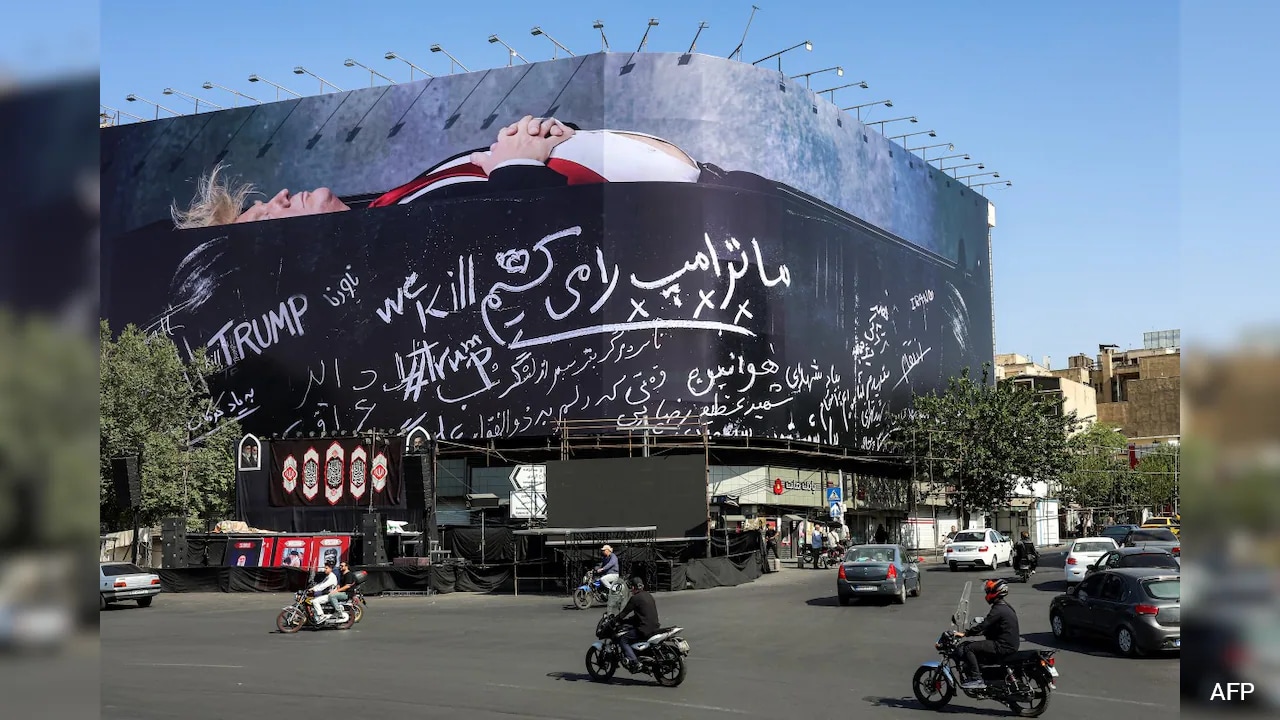
The vinyl smelled of fresh ink and hot adhesive as it unrolled in the mid-morning heat. In Tehran’s Enghelab Square—the historic hub of revolution, where students and traffic have clashed for decades—a crane groaned. It hoisted a massive, towering image onto the side of a prominent building.
People stopped to look. Motorcyclists idling in the thick, exhaust-heavy air cut their engines.
The face staring back at them was unmistakable. It was Donald Trump. But he was not standing at a podium or boarding a helicopter. He was lying flat on his back, eyes closed, mouth slightly agape, his signature disheveled hair framed by the rigid edges of an open black coffin. His hands were crossed over a bright red tie. Painted across the image in jagged, dripping white graffiti were the words, in both Persian and English: "We Will Kill Trump".
For the people walking below, this billboard is not just state-sponsored art. It is a visual countdown.
To understand what this billboard represents, we have to look past the ink and the concrete and look at the people living in its shadow. Consider a hypothetical resident—let us call him Reza, a middle-aged tea merchant whose shop sits a few blocks from the square. Reza has spent his life watching these walls. He remembers when they featured towering portraits of martyrs from the Iran-Iraq war, then fiery anti-American slogans, and later, solemn tributes to Qasem Soleimani.
Reza knows how to read the city’s walls. They are Tehran’s barometer. When the billboards are conceptual, peace is possible. When they are this literal, war is already at the doorstep.
The Weight of the Paint
Propaganda is often viewed from the West as a crude caricature, a hollow theater of a desperate regime. But on the ground, it is an atmosphere. It shapes the daily decisions of ordinary families.
The coffin on the billboard is constructed of black concrete funeral barriers, the exact kind used in state funerals. It is an intimate, ominous detail designed to evoke a sense of inevitable reality. Beside it, another banner looms, depicting a grave with the likeness of U.S. Senator Lindsey Graham and a warning that his dreams will be buried with him.
But the most devastating detail on the billboard is not the threat against the American president. It is the smaller, frantic scrawl near the bottom: "In memory of Minab's children".
This refers to a tragedy that occurred on February 28, when a military strike struck an elementary school in the southern Iranian city of Minab. For local Iranians, that name is an open wound. It represents the civilian cost of a shadow war that has suddenly stepped into the light. The billboard seeks to tie the geopolitical fury of the state directly to the grief of grieving parents.
Reza looks at the scrawled name of Minab and does not see a political talking point. He sees his own children. He worries about the sound of planes overhead.
The air is thick with anticipation. It is the quiet before a storm that has been brewing for years.
The Iron Blockade and the Midnight Sky
While the billboard went up on Wednesday, the real conflict was unfolding hundreds of miles to the south, where the blue waters of the Strait of Hormuz have become a choke point.
The United States military had just announced a renewed naval blockade on maritime traffic to and from Iranian ports. The goal is simple: starve the Iranian economy of its remaining energy exports. Trump's administration is betting that economic strangulation will force Tehran to its knees. Iran is betting that it can make the cost of that blockade too high for the rest of the world to bear.
The pressure turned white-hot on Wednesday night.
At exactly 9:00 PM Eastern Time, U.S. Central Command completed a sweeping, multi-city wave of airstrikes inside Iran. Using precision-guided munitions, American jets and warships struck command centers, air defenses, and coastal missile sites. Among the primary targets was Bandar Abbas, the vital port city that serves as Iran's maritime gateway to the world.
Imagine standing on the coast of Bandar Abbas as those strikes hit. The sky lighting up in brilliant, terrifying flashes of orange. The deep, chest-rattling boom of explosions echoing off the water. The immediate realization that the war is no longer a distant threat debated in Washington or Brussels. It is here. It is loud.
Back in Washington, Trump sat in the Situation Room with his top national security advisors, debating whether to push even further. Reports suggest his team presented options that would have been unthinkable just months ago: launching deep airstrikes against previously untouched strategic sites, deploying ground troops to seize key islands near the Strait of Hormuz, or targeting the heavily fortified Pickaxe Mountain nuclear facility.
It is a terrifying game of chicken played with hypersonic missiles and the global oil supply.
The Fragility of the Everyday
It is easy to get lost in the military jargon of "precision strikes," "naval blockades," and "degraded capabilities". These terms are designed to sound clean, calculated, and controlled.
They are not.
In reality, power is shifting in unpredictable ways. This war has shown how the global order can be violently disrupted by cheap, asymmetrical tools. A million-dollar air defense system can be bypassed by a swarm of low-cost, off-the-shelf drones. A single maritime choke point can throw global markets into chaos.
For the average person in Tehran, this translates to a profound, exhausting instability. The value of the currency drops with every headline. The price of bread rises. Pharmacies run low on imported medicines.
Yet, life must go on. Reza must still open his shop. He must still brew tea for his customers, even as they sit on plastic chairs under the giant image of a dead American president, debating whether they will have a home left by next week.
Some passersby look at the billboard and feel a surge of defiance, a pride in a government that refuses to back down. Others look at it with a sinking dread, knowing that the ink on that canvas is an invitation for more steel to rain down from the sky.
The giant billboard in Enghelab Square is a monument to a world on the brink. It is a stark reminder that behind the grand maneuvers of presidents and generals are millions of quiet lives, waiting to see if the coffin on the wall is a prophecy for one man, or a symbol of what is to come for them all.
This footage of Tehran's Coffin Mural offers a direct look at the scale of the billboard in Enghelab Square and how local residents are reacting to the escalating tensions.


