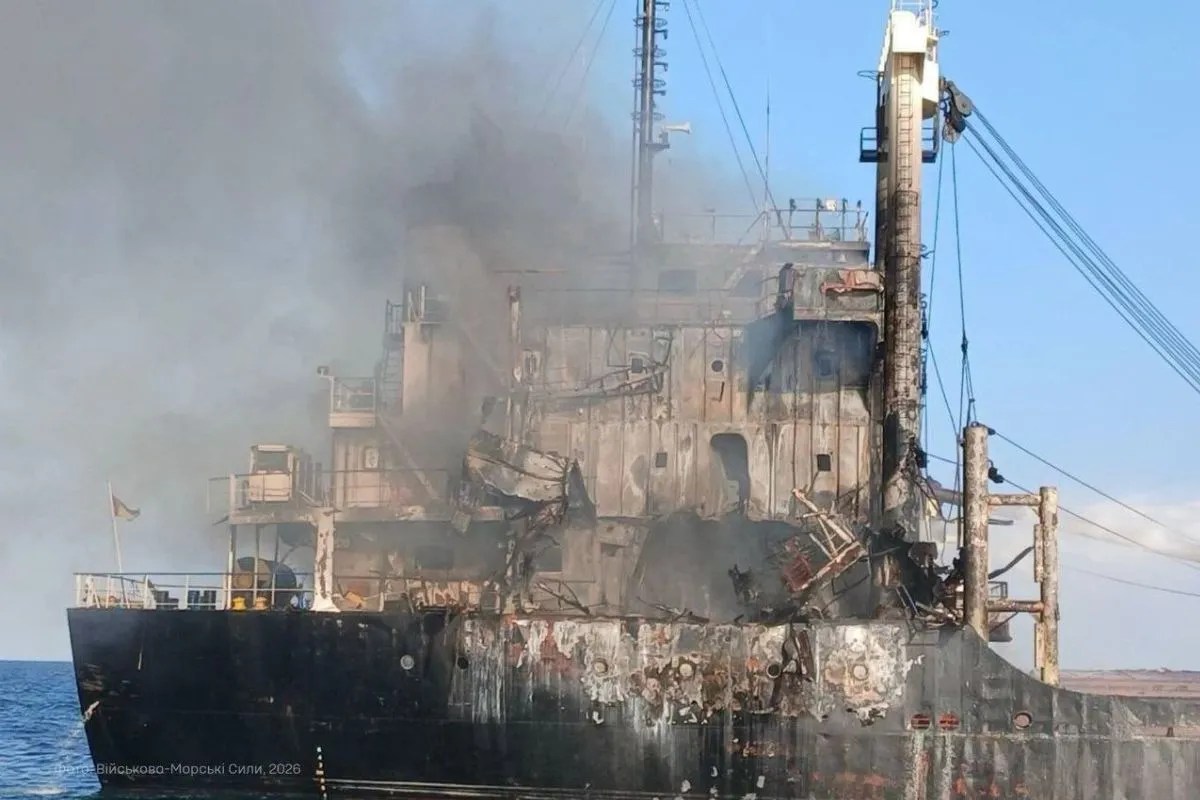
Salt crusts on the eyelashes before the sun even breaches the horizon. Out here, on the obsidian swells of the Black Sea, silence is never peaceful. It is loaded. It hums with the distant, predatory whine of a fiberglass hull skimming across the water at fifty knots, carrying a payload of high explosives wrapped in fiberglass and bad intentions.
Imagine standing on the iron deck of a grain carrier, a hulking bulk of steel designed to feed nations, now reduced to a floating target in a technological slaughterhouse. You listen. You wait. You pray to whatever gods protect men who move wheat through a war zone. Meanwhile, you can find related developments here: Why Converting Prison Laundries into Cells is a Desperate Mistake.
For months, the sea belonged to the ghosts. Unmanned surface vessels, sleek grey wedges cutting through the dark without a heartbeat or a soul on board, changed the math of naval warfare overnight. They didn’t need sleep. They didn’t feel fear. They simply steered toward the nearest silhouette on the horizon and detonated. Traditional steel armor was built to stop a shell arc from a heavy cruiser, not a swarm of autonomous aquatic kamikazes packing the punch of a torpedo into a speed boat's chassis.
So, what do you do when the rules of the ocean are rewritten by machines? To explore the complete picture, we recommend the excellent analysis by Associated Press.
You improvise. Or you sink.
Walk the docks of major Black Sea ports right now, and you will witness a frantic, makeshift renaissance. Sailors, port workers, and marine engineers—people whose daily vocabulary used to revolve around cargo manifests and tidal charts—are now amateur military architects. They are bolting crude cages of heavy-duty chain-link fencing, old steel bedframes, and surplus cargo netting around the hulls of multi-million-dollar cargo vessels.
It looks ridiculous. It looks like something cobbled together in a post-apocalyptic film set.
It is also the only thing standing between a multi-ton bulk carrier and a catastrophic breach at the waterline.
To understand why a simple wire fence can stop a weapon driven by artificial intelligence and satellite guidance, you have to look at how these naval drones actually kill. They are not precision-guided missiles dropping through a roof from the stratosphere. They are surface-skimming sleds. When they strike a target, their primary goal is kinetic impact married to a contact fuse.
When a drone hits a solid steel hull, the fuse trips, and the shaped charge does what it was engineered to do: punch through iron like paper.
Now, introduce the fence.
(Note: This entire makeshift architecture of survival functions as a physical tripwire and a standoff buffer—a concept I will explain through a simple mechanical analogy.)
Think of it like a medieval castle moat, except vertical and floating. When a drone slams into an outer perimeter of heavy mesh suspended meters away from the actual ship's hull, the explosive nose cone hits the wire before it ever touches the structural steel. The mesh catches, tangles, and distorts the incoming hull. More importantly, it can prematurely trigger the contact detonator yards away from the vessel's vital organs, or worse for the attacker, trap the spinning propellers and disable the drone's steering before impact can be achieved.
The standoff distance is everything. Physics is brutal about distance; energy dissipates exponentially with every foot of separation between a blast and its target. By forcing the explosion to detonate in the open air just outside the wire net, the shockwave washes harmlessly over the hull instead of punching straight through it.
Is it foolproof? Absolutely not.
Captains know it. The crews know it. Every time a vessel slips out of port with its strange, metallic skirts trailing in the water, everyone on board knows that this is a gamble. It is a technological band-aid slapped over a gaping wound in international maritime security.
Consider what happens when the sea gets rough. A heavy swell rolls in, and those improvised wire cages begin to act like massive, water-logged parachutes, dragging down the vessel's speed, burning extra fuel, and straining the winches holding them aloft. In a fierce storm, a poorly secured anti-drone cage can tear away from the hull, becoming a jagged, swinging hazard that smashes against the ship it was meant to protect.
It is a desperate trade-off. Risk being blown apart by a silent drone in the dead of night, or risk tearing your own ship apart in a gale because you’ve wrapped it in scrap metal.
This is the reality of modern supply chains. We talk about global economics as if they exist in a clean, digital spreadsheet—shipping indexes, commodity prices, grain futures traded in Chicago and London. But at the sharp end of the supply chain, economics smells like diesel exhaust, salt spray, and sweat. It looks like an aging Ukrainian mechanic welding a discarded shipping container frame to the side of a grain freighter while the air raid sirens wail three miles inland.
The maritime industry has been forced to unlearn a century of naval architecture. For generations, ships were designed for efficiency, hydrodynamics, and cargo capacity. Aesthetics and aerodynamics ruled the drafting tables. Today, the primary design philosophy on the Black Sea is simple: Survive the morning.
We are watching an entire sector adapt in real-time, evolving through trial, error, and immense human cost. When the history of this conflict is written, the grand strategies of ministries and generals will fill the chapters. But the footnotes—the quiet, gritty stories of sailors stringing chicken wire and heavy chains across their vessels in the dark—will tell the truest story of human ingenuity pushed to the absolute edge.
The sun dips below the horizon, turning the water the color of bruised steel. On the bridge of a grain carrier, the radar screen flickers with ghost contacts. The crew doesn't sleep. They adjust the tension on the wire nets, listen to the low, grinding rhythm of the engines, and watch the dark water roll by.

